[0028]Particular embodiments for breath-species analysis and monitoring, and in particular the measurement of endogenous NO as a breath marker, bring the advantages of novel nanostructured electronic sensors to medical applications: (i) performance that matches or exceeds that of
infrared technology; (ii) plug-and-play simplicity in a disposable
package; (iii) the small size and low
power consumption needed for portability and / or
wireless integration; (iv) the ability to incorporate arrays of sensors on a
single chip; and (v) an
order of magnitude reduction in the cost of the sensor component.
[0030]Exemplary embodiments of sensor devices having aspects of the invention provide for detection of chemical, physiologic, or biomolecular species employing nanostructures as elements, both for use in gaseous and in liquid media, such as
biological fluids, electrolytes, and the like. Real time electronic detection and monitoring and offers high sensitivity, is rapid and reversible, and has a
large dynamic range. The output is digital so electronic filtering and post
processing may be used to eliminate extraneous
noise, if need be. Certain embodiments include multiplexed assays on a single sensor platform or
chip.
[0031]Alternative embodiments having aspects of the invention are configured for detection of analytes employing nanostructured sensor elements configured as one or more alternative types of electronic devices, such as capacitive sensors,
resistive sensors, impedance sensors,
field effect transistor sensors, electrochemical sensors, and the like, or combinations thereof. Two or more such measurement strategies in a may be included in a sensor device so as to provide orthogonal measurements that increase accuracy and / or sensitivity. Embodiments may have functionalization groups or material associated with nanostructured elements to provide sensitive, selective
analyte response.
[0032]Nanotubes were first reported in 1993 by S. Iijima and have been the subject of intense research since. Single walled nanotubes (SWNTs) are characterized by strong covalent bonding, a unique one-dimensional structure, and exceptionally high tensile strength, high resilience, metallic to semiconducting
electronic properties,
high current carrying capacity, and extreme sensitivity to perturbations caused by
charged species in proximity to the
nanotube surface.
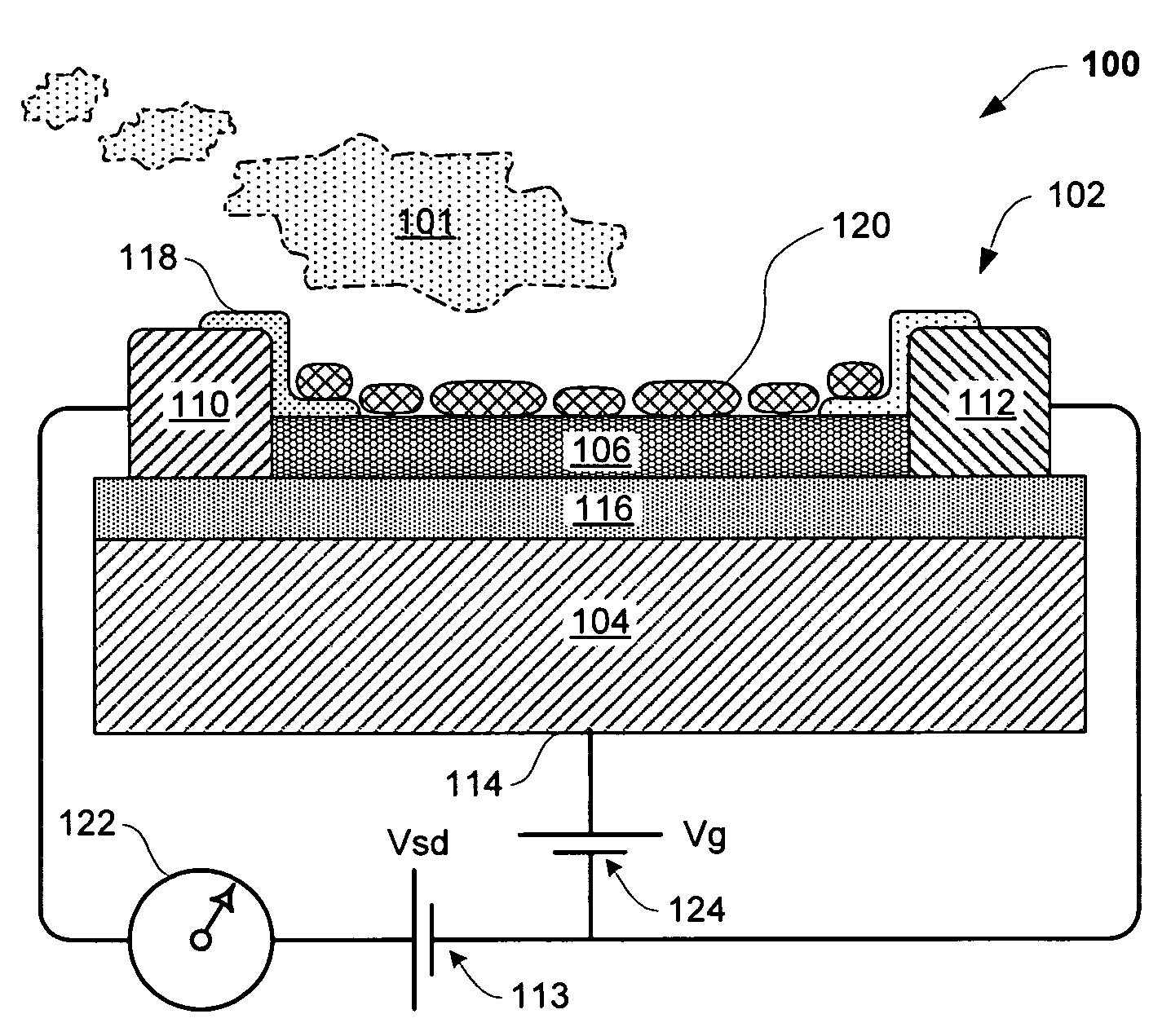
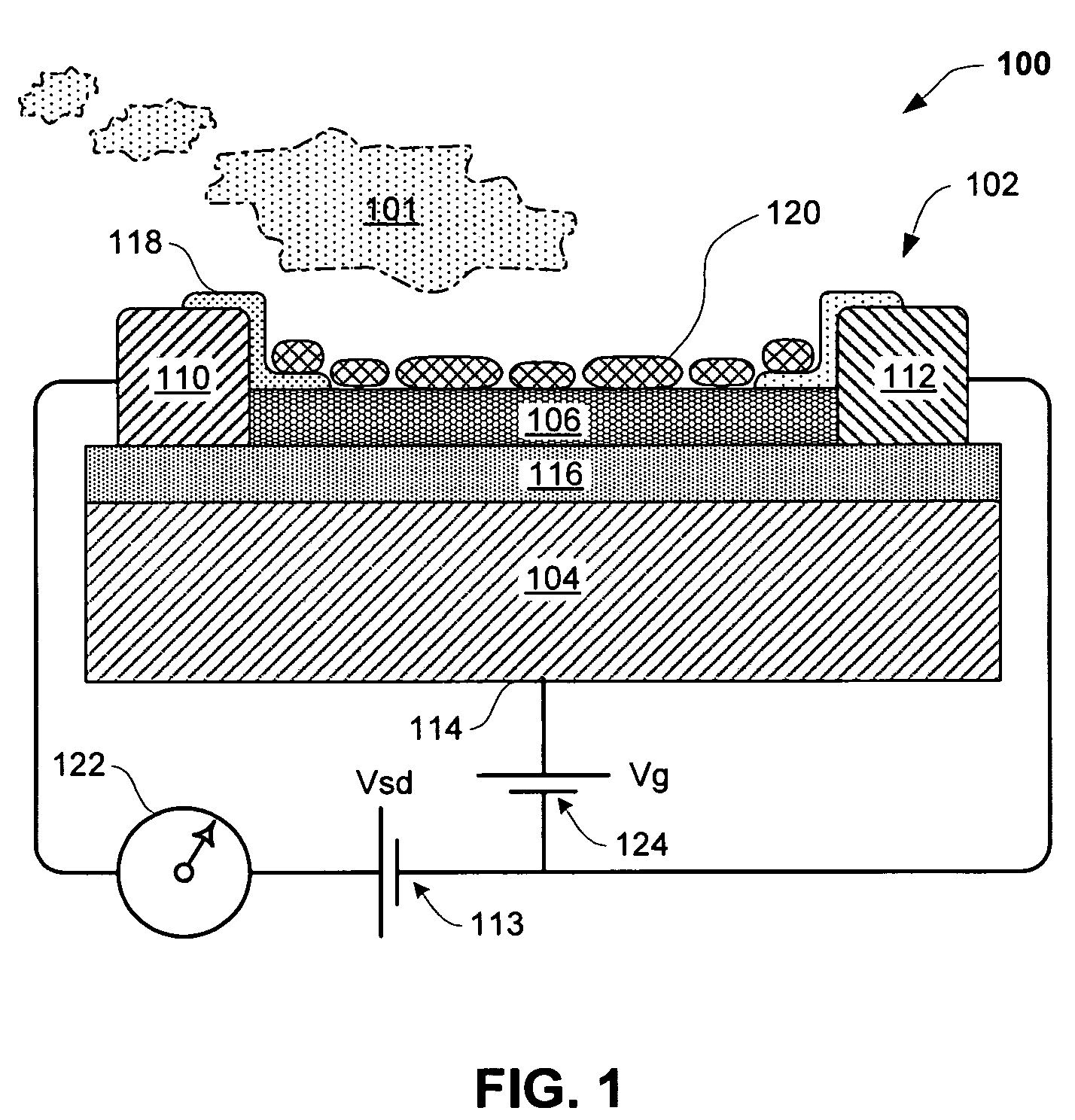
[0046]Sensor with thin film functionalization / inhibition layer. One exemplary embodiment having aspects of the invention of a sensor device for detecting an
analyte species in a gas or liquid sample medium, comprises (a) a substrate having a
substrate surface; (b) one or more nanostructures disposed over the
substrate surface; (c) one or more conducting elements in electrical communication with the
nanostructure and configured to communicate with measurement circuitry; and (d) a functionalization / inhibition layer disposed so as to cover all or a portion of the one or more nanostructures; and to cover all or a portion of the
substrate surface, the layer configured and composed so as to: (i) permit at least one interaction between the one or more nanostructures and the
analyte species; so as to provide a detectable change in a property of the
nanostructure in response to the presence of the analyte in the sample; and (ii) inhibit at least one interaction between the substrate surface and the sample medium, so as to prevent or reduce at least one interference response of the device which would be detectable by the measurement circuitry via the one or more conducting elements in the absence of the functionalization layer. The functionalization layer can also provide inhibition for exposed portions of
electrical contacts.
[0048]NO to NO2 conversion device. One exemplary embodiment having aspects of the invention of a NO to NO2 conversion device for converting endogenous NO to NO2 in an exhaled breath sample for subsequent measurement of the produced NO2, and comprises (a) an conduit including in communicating sequence: (i) an inlet portion configured to receive the breath sample under an input pressure sufficient to induce flow in the conduit, (ii) a conversion portion, and (iii) an outlet portion configured to dispense the breath sample following conversion; and (b) a conversion material disposed within the conversion portion, the conversion material comprising an active substance promoting conversion of NO to NO2 and a
carrier material configured to support the active substance in contact with the breath sample, the conversion material configured to provide minimal pressure drop during sample flow across the conversion portion, to provide high conversion efficiency of NO to NO2, and to provide low loss of NO and / or NO2 via destruction or absorption.


 Login to View More