
Method and plant for purifying a carbohydrate rich liquid
a technology of carbohydrate and plant, applied in the field of method and plant for purifying a carbohydrate rich liquid, can solve the problems of high operating cost, high investment, and common association with rvf, and achieve the effect of reducing the required size of the membrane unit and less discoloration of the starch hydrolysate permea
- Summary
- Abstract
- Description
- Claims
- Application Information
AI Technical Summary
Benefits of technology
Problems solved by technology
Method used
Image

Examples
example 1
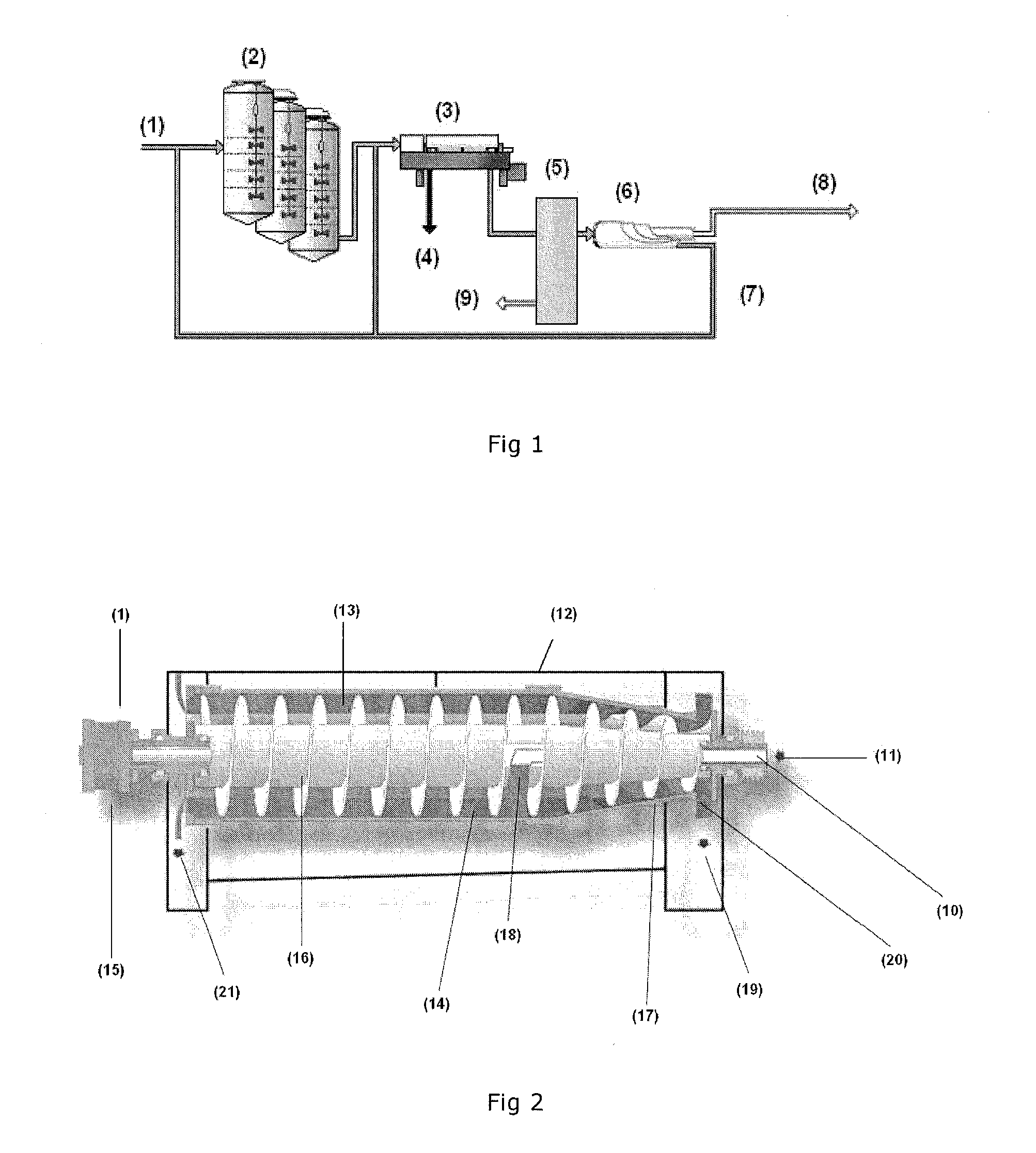
Purification of a Carbohydrate Solution
[0066]A carbohydrate solution having a DE value of 95 was treated by the method according to the invention. The stream of carbohydrates had a dry matter content of 28-33% by weight, a sludge part of 0.3 to 0.4% by weight, a nitrogen content of 350 ppm, and a fat content of 0.21% by weight. The clarity of the carbohydrate solution was measured to >200 NTU.
[0067]The carbohydrate solution was fed into a two phase decanter (STNX 438 available from Alfa Laval). The decanter separated the sludge portion (heavy phase) of the remainder of the carbohydrate solution (light phase). The sludge had DS value of 65-70% and a Brix value of approximately 10, i.e. the decanter cake contained 10% by weight of carbohydrate.
[0068]The desludged carbohydrate solution was treated in a strainer. The strainer contained a mesh retaining particles of 100 μm and above. The filtered carbohydrate solution was fed into a membrane filtration system with spiral wound elements u...
example 2
Purification Using Diafiltration Water
[0070]The product stream of the hydrolysis process comprised 13.65 m3 / h carbohydrate, 0.182 m3 / h mud and 31.668 m3 / h water. In a two-phase decanter 95% of the mud was removed. Only 7% (v / v)| of the mud consisted of carbohydrates, corresponding to a loss of 0.02 m3 / h carbohydrates in the mud. The heavy phase of the decanter, which corresponds to a volume stream of 54.23 m3 / h was filtered in a strainer of the piston type and entered into an ultrafiltration apparatus. In the last stage of the ultrafiltration an amount of 4 m3 / h diafiltration water was added to the feed. The product flow from the ultrafiltration process, i.e. the permeate, was 48.226 m3 / h and contained 28% (v / v) carbohydrate. The retentate stream (9 m3 / h) was recycled and mixed with the product stream from the hydrolysis stream prior to entering into the decanter.
PUM
| Property | Measurement | Unit |
|---|---|---|
| diameter | aaaaa | aaaaa |
| pore size | aaaaa | aaaaa |
| diameter | aaaaa | aaaaa |
Abstract
Description
Claims
Application Information
 Login to View More