
Organic floating gate memory device having protein and method of fabricating the same
a floating gate memory and protein technology, applied in thermoelectric devices, solid-state devices, nano-informatics, etc., can solve the problems of substantial increase in production costs and process complexity, and achieve the effect of increasing the flexibility of the organic floating gate memory devi
- Summary
- Abstract
- Description
- Claims
- Application Information
AI Technical Summary
Benefits of technology
Problems solved by technology
Method used
Image

Examples
example 1
Top-Contact Organic Floating Gate Memory Device Having A Protein Material
Preparation of Silk Solution
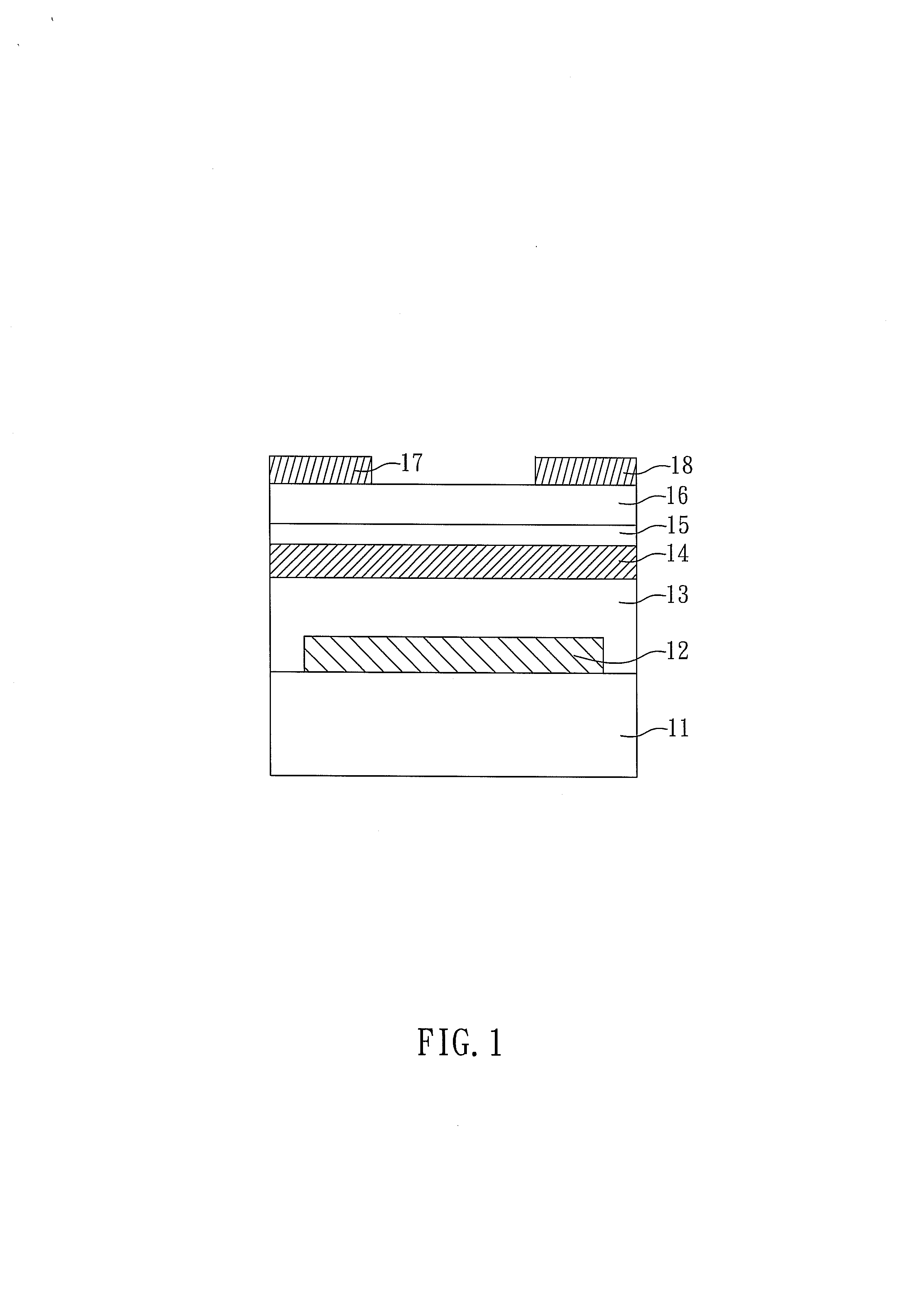
[0038]First, an aqueous 10 wt % sodium carbonate solution is prepared and heated to boil. The solution is further boiled for 30 minutes to 1 hour to remove the sericin in the outer layer of silk after addition of dried silkworm cocoon (natural silk). Then, the silk is washed by deionized water to remove the alkaline solution on the outer layer of silk. After drying, a refined silk protein, namely, fibroin, is obtained.
[0039]Next, the refined silk protein is placed, stirred, and dissolved in a 20 ml of 85 wt % H3PO4 solution. After that, the H3PO4 solution containing dissolved silk protein is placed in a dialysis membrane (Spectra / Por 3 dialysis membrane, molecular weight cutoff=14000) and dialyzed with water for 3 days, to remove the excess phosphate. By controlling the water volume and the dialysis frequency, not only the phosphate can be removed, but also the pH value of the obtain...
example 2
Bottom-Contact Organic Floating Gate Memory Device Having A Protein Material
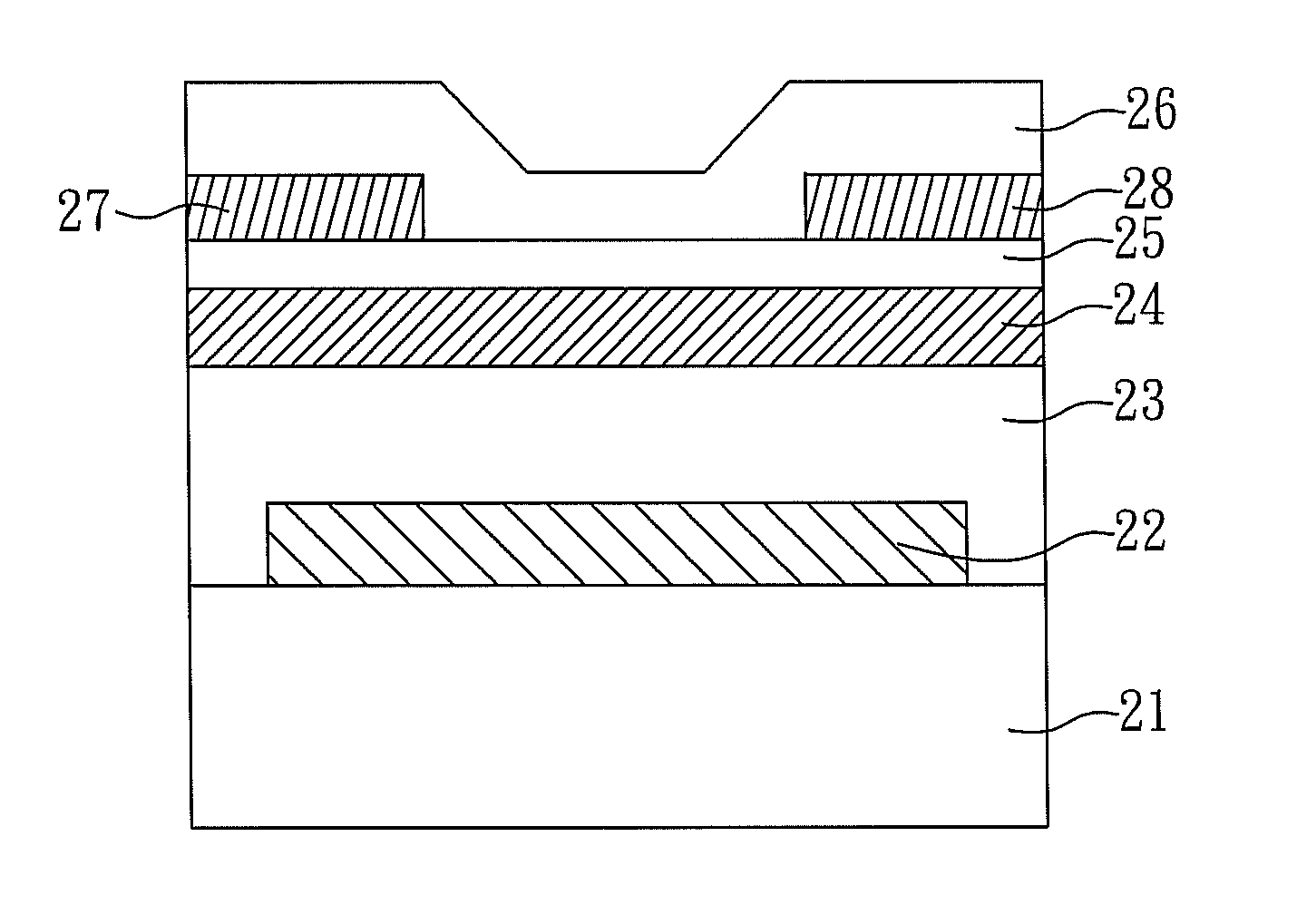
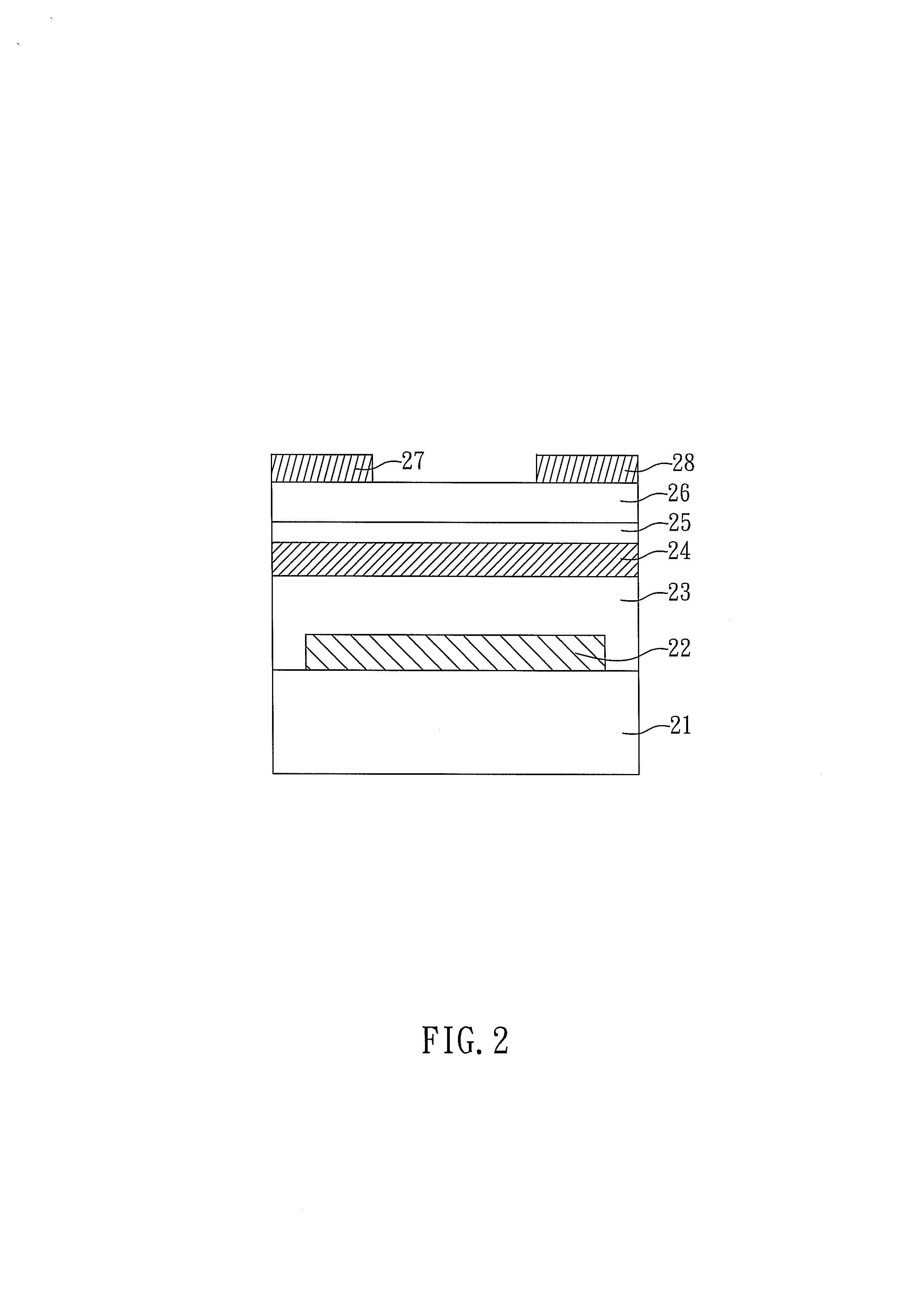
[0053]Referring to FIG. 4, a substrate 21 is provided, and gate electrode 22 and gate dielectric layer 23 are formed thereon sequentially. In this Example, the same method for manufacturing the substrate 21, gate electrode 22, and gate dielectric layer 23 as in Example 1 is performed. In this Example, the gate electrode has a thickness of 80 nm, and the gate dielectric layer 23 has a thickness of 400 nm.
[0054]Then, a mask (not shown) is used to form a patterned metal layer on the gate dielectric layer 23 by evaporation coating, to form a floating gate electrode 24 made of gold. By the same method as in Example 1, a biopolymer protein film is formed on the floating gate electrode 24 to serve as the protein dielectric layer 25.
[0055]Through the same process conditions for forming the gate electrode as in Example 1, a patterned metal layer is formed on the protein dielectric layer 25 by evaporation coating, to ...
PUM
 Login to View More
 Abstract
Description
Claims
Application Information
 Login to View More