Partially fluorinated alcohols and derivatives
- Summary
- Abstract
- Description
- Claims
- Application Information
AI Technical Summary
Benefits of technology
Problems solved by technology
Method used
Image

Examples
example 1
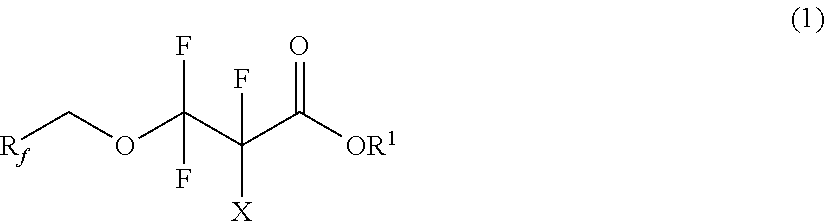
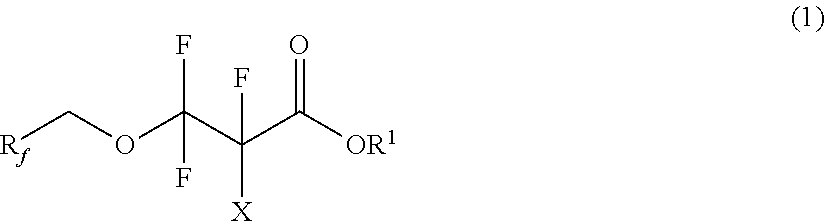
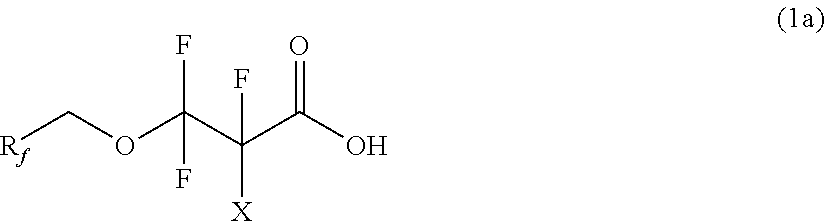
[0072]Example 1 illustrates the preparation of bis(2,2,3,3,3-pentafluoropropyl) carbonate and the subsequent preparation of 2,2,3,3-tetrafluoro-3-(2,2,3,3,3-pentafluoropropoxy)propanoic acid. Triphosgene (24.5 g, 82.5 mmol) and anhydrous diethyl ether (˜400 mL) were added to a 1-L 4-neck flask. The mixture was cooled to 0° C., and 2,2,3,3,3-pentafluoropropanol (75 g, 0.50 mol) was added. The mixture was stirred for 30 minutes. Pyridine (40.0 g, 0.51 mol) was then slowly added to the mixture via addition funnel. The resultant mixture was then gently refluxed for 1 hour. The solution was filtered to remove white solids and washed with dilute hydrochloric acid solution. The solution was then vacuum distilled to remove ether resulting in bis(2,2,3,3,3-pentafluoropropyl) carbonate (CF3CF2CH2O)2CO (71 g, 88% yield).
[0073]A catalyst was first prepared by slow addition of 2,2,3,3,3-pentafluoropropan-1-ol (15.0 g, 100 mmol) to a suspension of sodium hydride (60% in mineral oil, 6.0 g, 150 mm...
example 2
[0074]Example 2 is a repeat of Example 1, with a longer fluorinated chain on the alcohol. Triphosgene (24.5 g, 82.6 mmol) and anhydrous diethyl ether (˜400 mL) were added to a 1-L 4-neck flask. The mixture was cooled to 0° C. and 2,2,3,3,4,4,4-heptafluorobutanol (100 g, 0.50 mol) was added and the mixture was stirred for 30 minutes. Pyridine (40.0 g, 0.51 mol) was then slowly added to the mixture via addition funnel. The resultant mixture was then gently refluxed for 1 hour. The solution was filtered to remove white solids and washed with dilute hydrochloric acid solution. The solution was then vacuum distilled to remove ether resulting in bis(2,2,3,3,4,4,4-heptafluorobutyl)carbonate (CF3CF2CF2CH2O)2CO (82 g, 80% yield).
[0075]A catalyst was first prepared by slow addition of 2,2,3,3,4,4,4-heptafluorobutan-1-ol (15.0 g, 75 mmol) to a suspension of sodium hydride (60% in mineral oil, 4.3 g, 108 mmol) in anhydrous tetrahydrofuran (130 mL) in a 500-mL flask. The resultant mixture was st...
example 3
[0076]Example 3 illustrates the preparation of an ethyl ester of Example 1. 2,2,3,3-tetrafluoro-3-(2,2,3,3,3-pentafluoropropoxy)propanoic acid (65 g, 220 mmol), ethanol (50 mL, excess), and concentrated sulfuric acid (50 g) were added to a 250 ml, round bottom flask. The resultant mixture was refluxed for three hours under atmosphere of nitrogen. The product mixture was slowly added to water (400 mL), the organic layer was separated, washed with water (2×50 mL), and dried over magnesium sulfate to yield ethyl 2,2,3,3-tetrafluoro-3-(2,2,3,3,3-pentafluoropropoxy)propanoate C2F5CH2OCF2CF2C(O)OCH2CH3 (70 g, 98% yield).
PUM
| Property | Measurement | Unit |
|---|---|---|
| Temperature | aaaaa | aaaaa |
| Content | aaaaa | aaaaa |
Abstract
Description
Claims
Application Information
 Login to View More
 - R&D
- Intellectual Property
- Life Sciences
- Materials
- Tech Scout
- Unparalleled Data Quality
- Higher Quality Content
- 60% Fewer Hallucinations
Browse by: Latest US Patents, China's latest patents, Technical Efficacy Thesaurus, Application Domain, Technology Topic, Popular Technical Reports.
© 2025 PatSnap. All rights reserved.Legal|Privacy policy|Modern Slavery Act Transparency Statement|Sitemap|About US| Contact US: help@patsnap.com