Check patentability & draft patents in minutes with Patsnap Eureka AI!

SILYL PHOSPHINE COMPOUND, PROCESS FOR PRODUCING SILYL PHOSPHINE COMPOUND AND PROCESS FOR PRODUCING InP QUANTUM DOTS

Active Publication Date: 2021-01-07
NIPPON CHECMICAL IND CO LTD
View PDF0 Cites 1 Cited by
  • Summary
  • Abstract
  • Description
  • Claims
  • Application Information

AI Technical Summary

Benefits of technology

The present invention relates to a method for improving the quality of InP quantum dots. The inventors found that by using a silyl phosphine compound with reduced arsenic content as a raw material for the quantum dots, the quantum yield of the dots was improved. This was achieved by reducing the amount of arsenic in the production process using phosphine, a silylating agent, and a basic compound. The resulting high-purity silyl phosphine compound with low arsenic content acts as a preferable raw material for InP quantum dots.

Problems solved by technology

However, since toxicity and environmental burden of cadmium are high, development of cadmium-free quantum dots is being expected.

Method used

the structure of the environmentally friendly knitted fabric provided by the present invention; figure 2 Flow chart of the yarn wrapping machine for environmentally friendly knitted fabrics and storage devices; image 3 Is the parameter map of the yarn covering machine
View more

Image

Smart Image Click on the blue labels to locate them in the text.
Viewing Examples
Smart Image
  • SILYL PHOSPHINE COMPOUND, PROCESS FOR PRODUCING SILYL PHOSPHINE COMPOUND AND PROCESS FOR PRODUCING InP QUANTUM DOTS
  • SILYL PHOSPHINE COMPOUND, PROCESS FOR PRODUCING SILYL PHOSPHINE COMPOUND AND PROCESS FOR PRODUCING InP QUANTUM DOTS
  • SILYL PHOSPHINE COMPOUND, PROCESS FOR PRODUCING SILYL PHOSPHINE COMPOUND AND PROCESS FOR PRODUCING InP QUANTUM DOTS

Examples

Experimental program
Comparison scheme
Effect test

example 1

[0114]A reaction vessel was charged with 189.8 kg of toluene, and then charged with 82 kg of triethylamine and 149.5 kg of trimethylsilyl trifluoromethanesulfonate, and the reaction vessel was purged with nitrogen, followed by adjusting the liquid temperature to 30° C.

[0115]An adsorption tower in which a stainless-steel pressure-resistant column having an inner diameter of 25 cm and a length of 2 m had been packed with 8.5 kg of granular activated carbon (manufactured by TSURUMI COAL CO., LTD.) was prepared. Into this adsorption tower, 7.5 kg of crude phosphine gas (manufactured by NIPPON CHEMICAL INDUSTRIAL CO., LTD.) having an arsenic content shown in Table 1 was introduced under the conditions of a flow rate of 750 g / hr and an introduction pressure of 2 MPa, thereby obtaining high-purity phosphine gas (purity: 99.9999 vol %) having been reduced in the arsenic content down to a content shown in Table 1 (the value shown in Table 1 is a volume-based value in terms of arsine).

[0116]A...

example 2

Synthesis of InP Quantum Dots

[0141]To 17.8 g of 1-octadecene, 0.375 mmol of indium myristate was added, and under reduced pressure, they were heated to 120° C. while stirring and deaerated for 90 minutes. After the deaeration, the resulting mixture was cooled down to 70° C. to obtain a 1-octadecene solution of indium myristate. Separately from this, 0.25 mmol of tris(trimethylsilyl)phosphine (TMSP) obtained in Example 1 was added to 0.6 g of 1-octadecene to obtain a 1-octadecene solution of TMSP. The resulting 1-octadecene solution of TMSP was heated up to 70° C. and then added to the 1-octadecene solution of indium myristate, and they were heated up to 300° C. while stirring and then maintained for 2 minutes, thereby obtaining a red liquid containing InP quantum dots.

Synthesis of InP / SnSe / ZnS Quantum Dots

[0142]To 18.6 g of 1-octadecene, 4.5 mmol of zinc myristate was added, and under reduced pressure, they were heated to 120° C. while stirring and deaerated for 90 minutes to obtain...

example 3

Synthesis of InZnP Quantum Dots

[0146]To 63.4 g of 1-octadecene, 2.4 mmol of indium myristate and 1.6 mmol of zinc myristate were added, and under reduced pressure, they were heated to 110° C. while stirring and deaerated for 50 minutes. After the deaeration, the resulting mixture was heated to 300° C. to obtain a 1-octadecene solution of indium myristate and zinc myristate. Separately from this, 1.0 mmol of tris(trimethylsilyl)phosphine (TMSP) obtained in Example 1 was added to 2.25 g of 1-octadecene to obtain a 1-octadecene solution of TMSP. The resulting 1-octadecene solution of TMSP (room temperature) was added to the 1-octadecene solution of indium myristate and zinc myristate, and they were maintained at 300° C. for 30 minutes while stirring, thereby obtaining a dark red liquid containing InZnP quantum dots.

Synthesis of InZnP / ZnSe / ZnS Quantum Dots

[0147]The liquid containing InZnP quantum dots was set to 220° C., and to the liquid, 22.0 mmol of trioctylphosphine selenide was add...

the structure of the environmentally friendly knitted fabric provided by the present invention; figure 2 Flow chart of the yarn wrapping machine for environmentally friendly knitted fabrics and storage devices; image 3 Is the parameter map of the yarn covering machine
Login to View More

PUM

No PUM Login to View More

Abstract

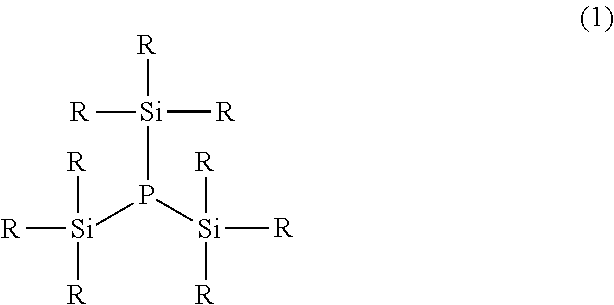
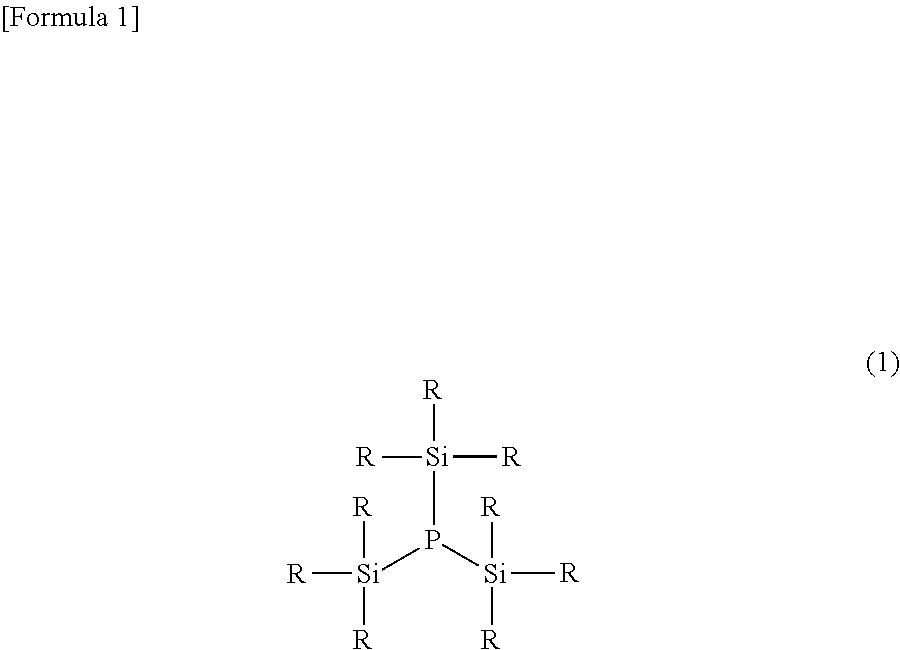
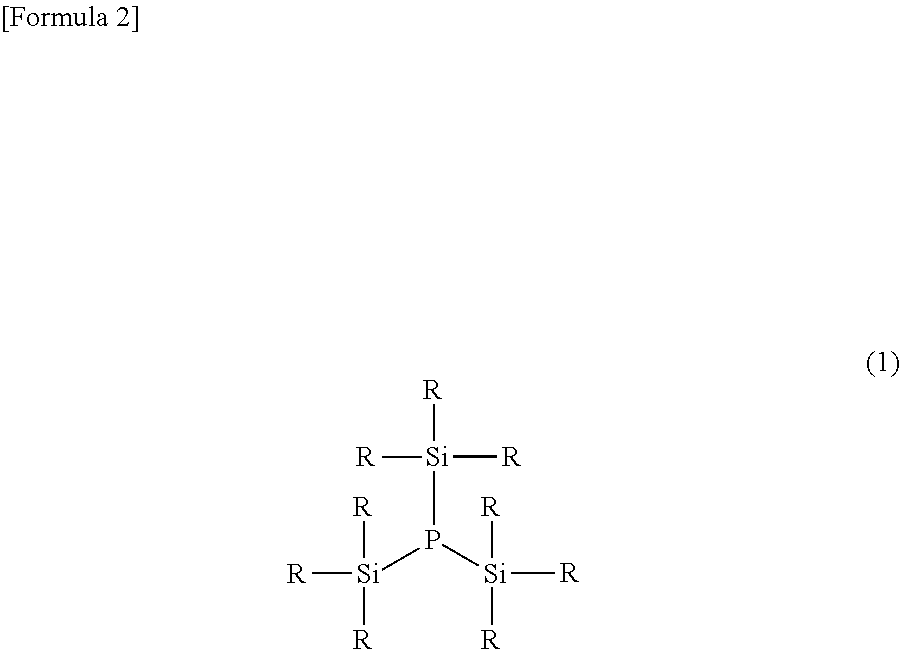
The silyl phosphine compound of the present invention is represented by the formula (1) and has an arsenic content of not more than 1 ppm. The process for producing a silyl phosphine compound of the present invention is a process comprising mixing a basic compound, a silylating agent and phosphine to obtain a solution containing a silyl phosphine compound, removing a solvent from the solution to obtain a concentrated solution of a silyl phosphine compound, and distilling the concentrated solution, wherein an arsenic content in the phosphine is adjusted to not more than 1 ppm by volume in terms of arsine. The process for producing InP quantum dots of the present invention uses, as a phosphorus source, a silyl phosphine compound represented by the formula (1) and having an arsenic content of not more than 1 ppm by mass.(For definition of R, see the specification.)

Description

TECHNICAL FIELD[0001]The present invention relates to a process for producing a silyl phosphine compound that is useful as a phosphorus component raw material of indium phosphide quantum dots.BACKGROUND ART[0002]In recent years, development of quantum dots as luminescent materials has been under way. Development of cadmium-based quantum dots such as CdSe, CdTe and CdS that are typical quantum dots has been promoted from their excellent optical properties, etc. However, since toxicity and environmental burden of cadmium are high, development of cadmium-free quantum dots is being expected.[0003]One of the cadmium-free quantum dots is, for example, indium phosphide (InP). In the production of indium phosphide, a silyl phosphine compound such as tris(trimethylsilyl)phosphine is often used as a phosphorus component raw material. Since the silyl phosphine compound such as tris(trimethylsilyl)phosphine can be used in a solid state or in a stake of a liquid phase in which the compound is di...

Claims

the structure of the environmentally friendly knitted fabric provided by the present invention; figure 2 Flow chart of the yarn wrapping machine for environmentally friendly knitted fabrics and storage devices; image 3 Is the parameter map of the yarn covering machine
Login to View More

Application Information

Patent Timeline
no application Login to View More
IPC IPC(8): C09K11/70C07F9/06C01B25/08
CPCC09K11/70C01B25/087C07F9/06C01B25/08H01L29/06C07F9/062C07F19/00C07F9/5004C07F7/0805C07F7/0834C09K11/025C09K11/883C09K11/565C07F7/08C07F9/5009
Inventor TAKUBO, YOSUKETAMURA, KENNAKATSUI, KAZUHIRO
Owner NIPPON CHECMICAL IND CO LTD
Features
  • R&D
  • Intellectual Property
  • Life Sciences
  • Materials
  • Tech Scout
Why Patsnap Eureka
  • Unparalleled Data Quality
  • Higher Quality Content
  • 60% Fewer Hallucinations
Social media
Patsnap Eureka Blog
Learn More