HDAC inhibitor compounds and methods of treatment
a technology of hdac inhibitors and compounds, applied in the field of hdac inhibitor compounds and methods of treatment, can solve the problems of limiting the broad clinical utility of the currently known classes, raising the risks of significant off-target activities, unpredictable clinical toxicity, and unable to determine the importance of hdac inhibition for anticancer effects using pan-hdaci due to off-target activities, so as to prevent inactivation and facilitate syringability
- Summary
- Abstract
- Description
- Claims
- Application Information
AI Technical Summary
Benefits of technology
Problems solved by technology
Method used
Image

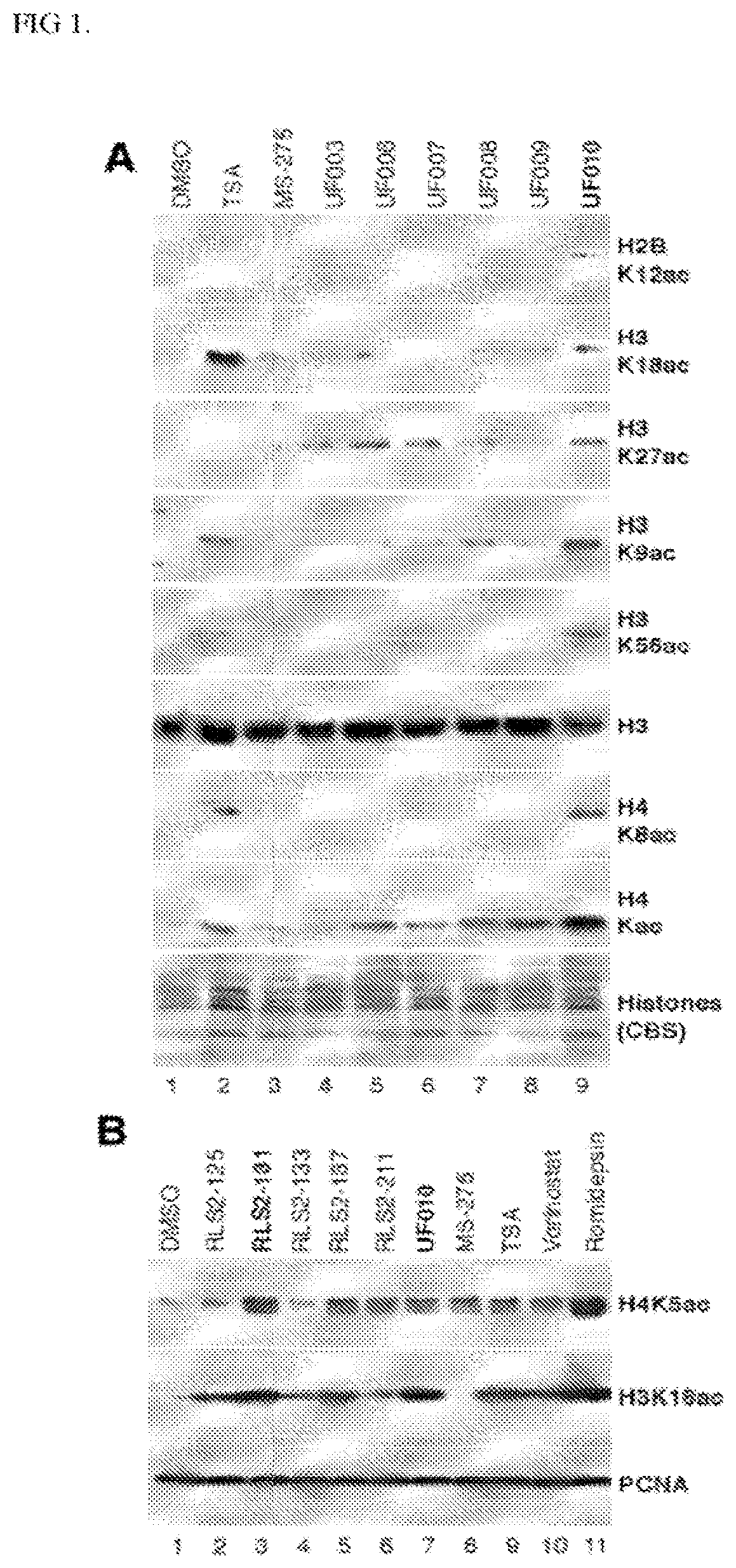
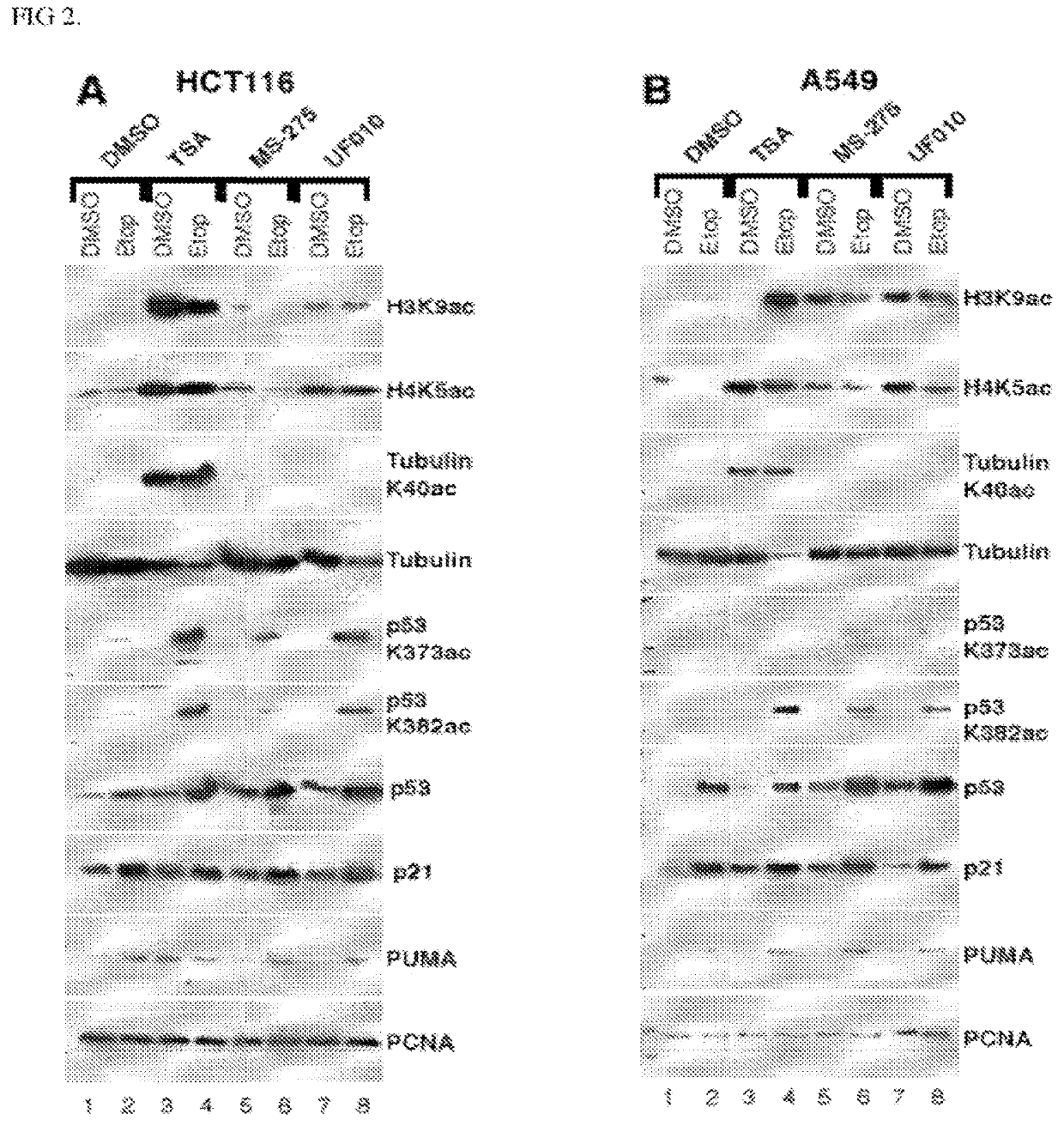
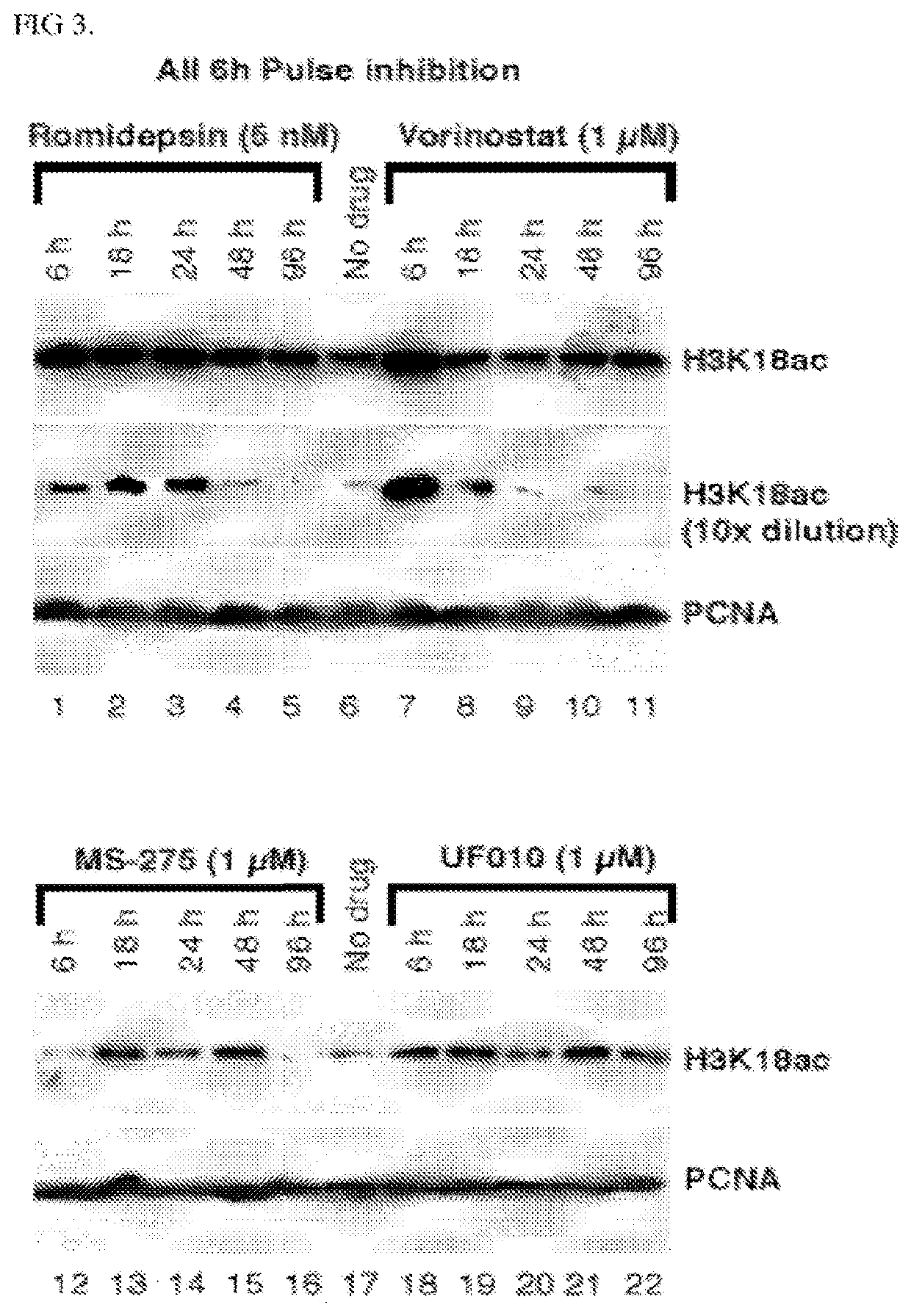
Examples
example 1
ation of UF010
[0275]A high-throughput screening (HTS) campaign of the 622,360 compounds in the Scripps Drug Discovery Library was conducted using a luciferase reporter under the control of the adenovirus (Ad) major late promoter (Ad-MLP-Luc) in the colon cancer HCT116 cell line as the primary screen. Compared to the luciferase reporter under the control of the Ad E2 early promoter (Ad-E2-Luc), the Ad-MLP-Luc reporter activity was dramatically increased in a dose-dependent manner by HDACi romidepsin or vorinostat. The similar observed responses of the Ad-MLP-Luc reporter to different classes of HDACi indicate that HDAC inhibition is the primary mechanism for the reporter activation. Each library compound was assayed at a single point at the dose of 8.6 μM. The reporter activity was detected as luminescence readout and cell viability was monitored with the PrestoBlue dye as fluorescence intensity in a multiplex format. The viability counterscreen assay was used to remove highly toxic ...
example 2
[0277]
4-bromo-N′-butylbenzohydrazide (RLS2-134 or UF010)
[0278]A scintillation vial containing a Teflon-coated magnetic stir bar was charged with 4-bromobenzohydrazide (50 mg, 0.25 mmol). 1 mL of methanol, 22 μL of butyraldehyde (1 eq, 0.25 mmol) and catalytic p-toluenesulfonic acid were subsequently added to the vial. The resultant solution was allowed to stir for 12 h at room temperature. The reaction mixture was then acidified to approximately pH 5 through the addition of 4M HCl in dioxane. Sodium cyanoborohydride (19 mg, 1.2 eq, 0.31 mmol) was added and the reaction mixture was allowed to stir for 3 h at room temperature. The reaction mixture was then concentrated in vacuo. Water was added to the resultant residue followed by diethyl ether. The aqueous layer was extracted three times with diethyl ether. The organic layers were combined, dried and concentrated. The resultant white solid was further purified by flash chromatography utilizing a solvent gradient from 0-65% EtOAc in h...
example 3
[0279]
N′-butyl-4-fluorobenzohydrazide (RLS2-123)
[0280]The title compound was synthesized in a similar fashion as described for Example 2, except that 4-bromobenzohydrazide was replaced with 4-fluorobenzohydrazide. 1H NMR (400 MHz, CDCl3) δ=7.77 (m, 2H), 7.11 (m, 2H), 2.92 (t, J=7.1, 2H), 1.51 (m, 2H), 1.39 (m, 2H), 0.91 (t, J=7.4, 3H); LRMS-ESI (M+H+) m / z: calcd 211.2, found 211.2.
PUM
| Property | Measurement | Unit |
|---|---|---|
| time | aaaaa | aaaaa |
| enantiomeric excess | aaaaa | aaaaa |
| enantiomeric excess | aaaaa | aaaaa |
Abstract
Description
Claims
Application Information
 Login to View More
 - R&D
- Intellectual Property
- Life Sciences
- Materials
- Tech Scout
- Unparalleled Data Quality
- Higher Quality Content
- 60% Fewer Hallucinations
Browse by: Latest US Patents, China's latest patents, Technical Efficacy Thesaurus, Application Domain, Technology Topic, Popular Technical Reports.
© 2025 PatSnap. All rights reserved.Legal|Privacy policy|Modern Slavery Act Transparency Statement|Sitemap|About US| Contact US: help@patsnap.com