
Bone implants with central chambers
a bone implant and central chamber technology, applied in the field of implants with central chambers, can solve the problems of limiting the efficacy of implants, not always possible or even desirable to use autografts, and additional patient discomfort during rehabilitation, and achieve the effect of facilitating the implantation of spacers
- Summary
- Abstract
- Description
- Claims
- Application Information
AI Technical Summary
Benefits of technology
Problems solved by technology
Method used
Image

Examples
first embodiment
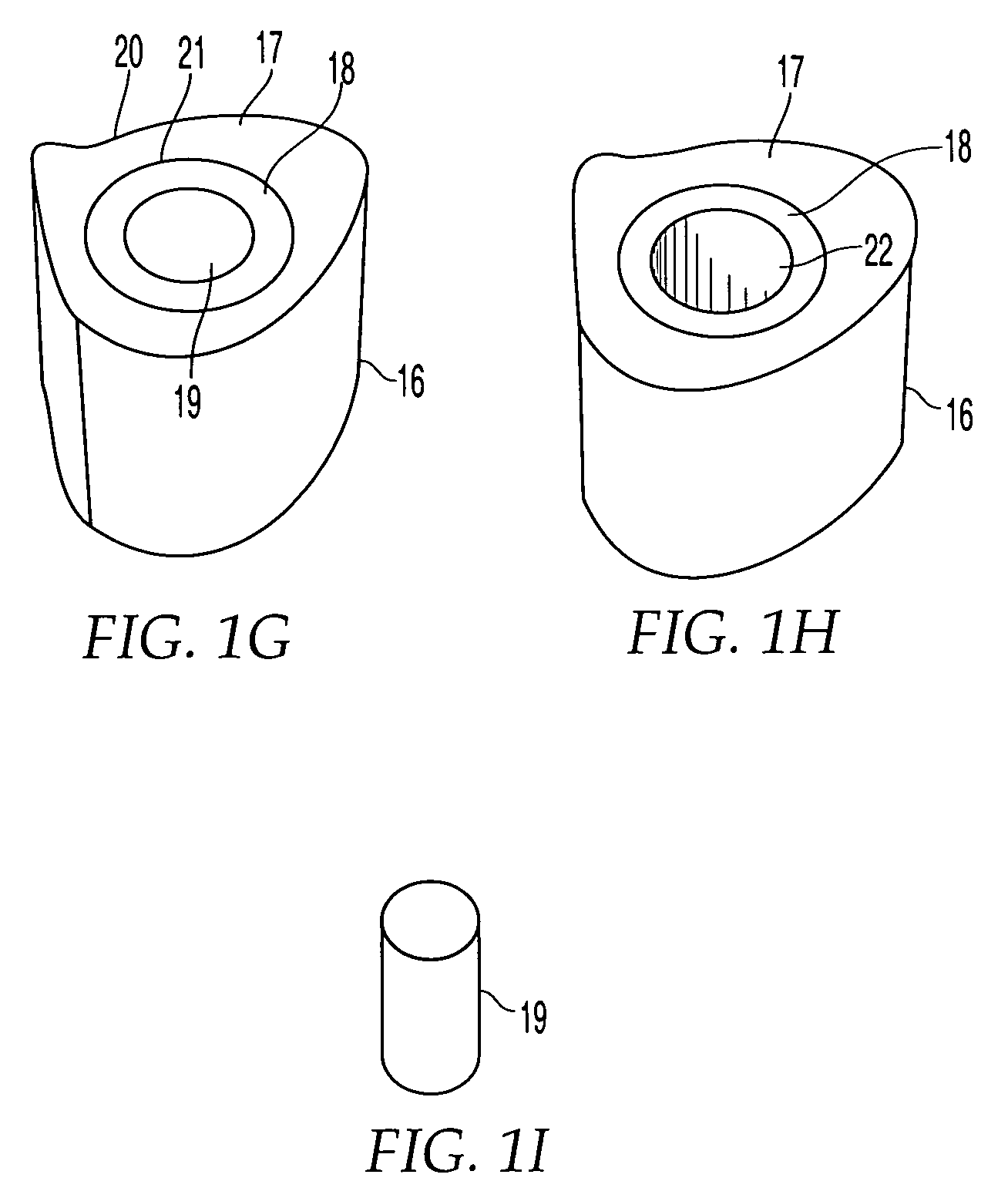
[0107]FIG. 1G shows implant 16 having an outer sheath 17, an intermediary sheath 18, and a core 19. It should be noted that while bone sections described herein are referred to as sleeves, these components need not be cylindrical or otherwise symmetrical. In this embodiment, outer sheath 17 is a bone section, for example of a femur, that has the outer surface or contour naturally found on a femur. Thus, the outer surface 20 of outer sheath 17 does not require machining and is not machined. The inner surface 21 of outer sheath 17 has been machined to a particular configuration so that intermediary sheath 18 fits within outer sheath 17. Alternatively, as shown in FIG. 1H, implant 16 may have a through hole 22 instead of a core 19, creating a cavity in implant 16. If a through-hole is provided instead of core 19, a hollow implant may be created and bone growth materials such as bone materials in the form of chips, slurries, or fibers, as well as bone inducing substances can be provided...
second embodiment
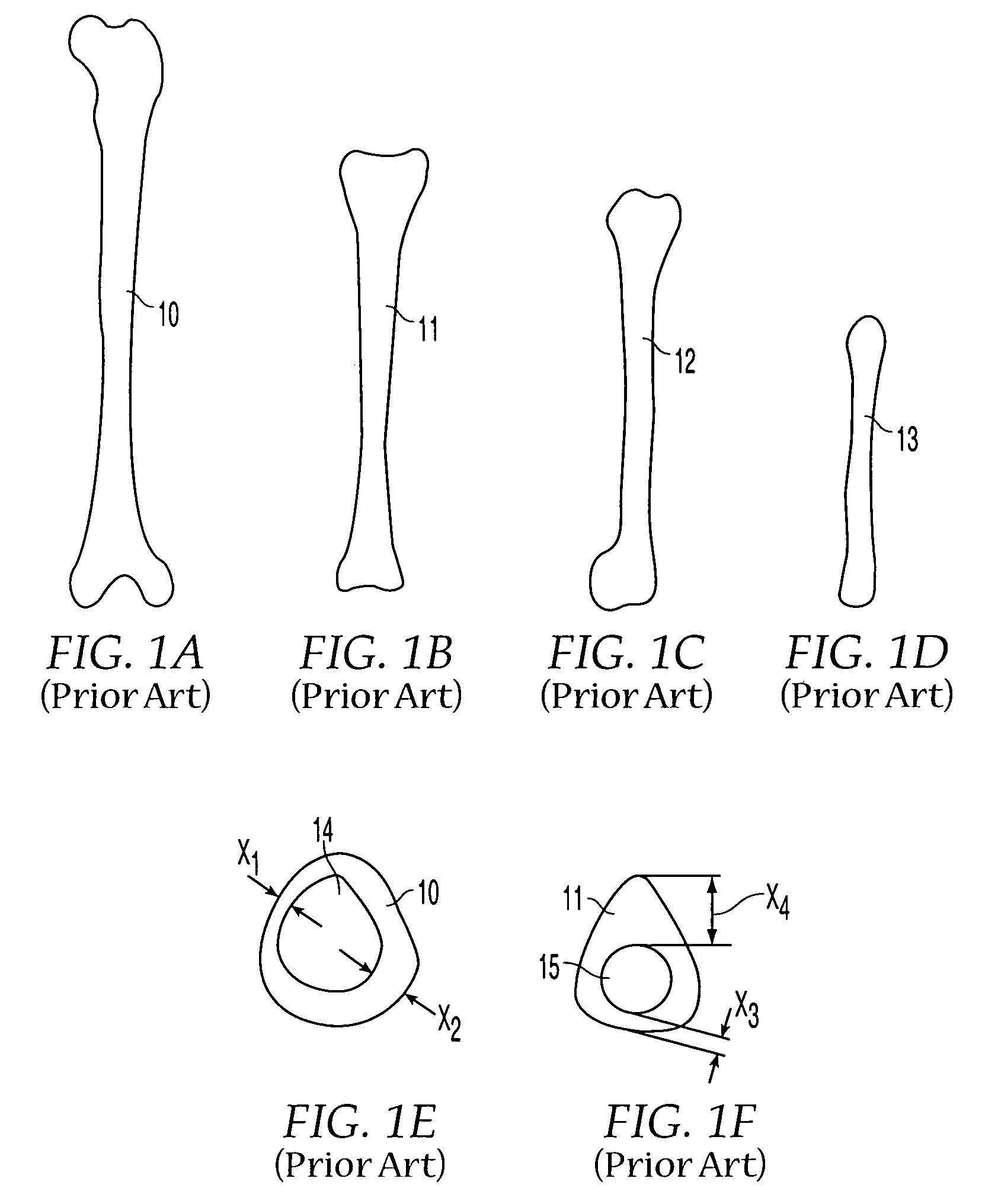
[0109]As shown in FIG. 1J, in the present invention many types of bones may be combined in layers to form bone stock 25′. A radius 13 may be encased in humerus sleeve 12, which may be encased in tibia sleeve 11, which may further be encased in femur sleeve 10 that retains the original outer shape of the femur. In alternate embodiments, other bones may be used, such as a fibula or ulna. By machining the inner and / or outer surfaces of each bone section, the bone sections may be inserted into each other with an interfitting relationship. This may result in a strong press-fit, but additional or alternate means of fixation may be employed, such as mechanical means.
[0110]The moisture content of the bone sections also may be varied to advantageously permit improved interlocking. Bone sections initially may be provided with moisture content as follows: (1) bone in the natural state fresh out of the donor without freezing, (2) bone in the frozen state, typically at −40° C., with moisture con...
PUM
| Property | Measurement | Unit |
|---|---|---|
| Pressure | aaaaa | aaaaa |
| Shape | aaaaa | aaaaa |
Abstract
Description
Claims
Application Information
 Login to View More