
Composite system of scanning electron microscope and focused ion beam
a scanning electron microscope and focused ion beam technology, applied in the field of composite systems of scanning electron microscopes and focused ion beams, can solve the problems of noise, small foreign matter or abnormal shape is overlooked, secondary electron involved in fib irradiation is mixed in a detection signal, etc., to achieve accurate adjustment of signal level and remove noise components
- Summary
- Abstract
- Description
- Claims
- Application Information
AI Technical Summary
Benefits of technology
Problems solved by technology
Method used
Image

Examples
first embodiment
[First Embodiment]
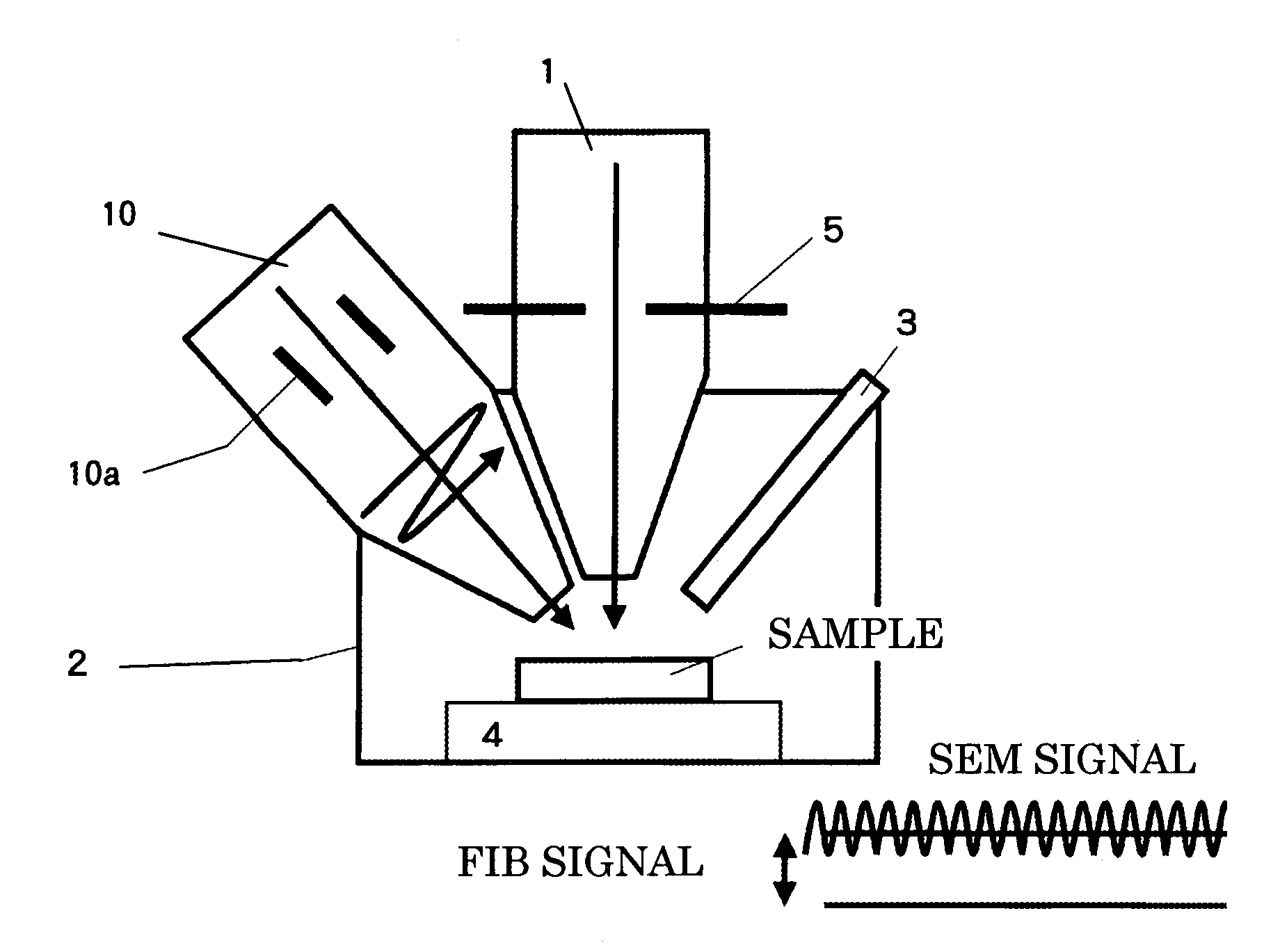
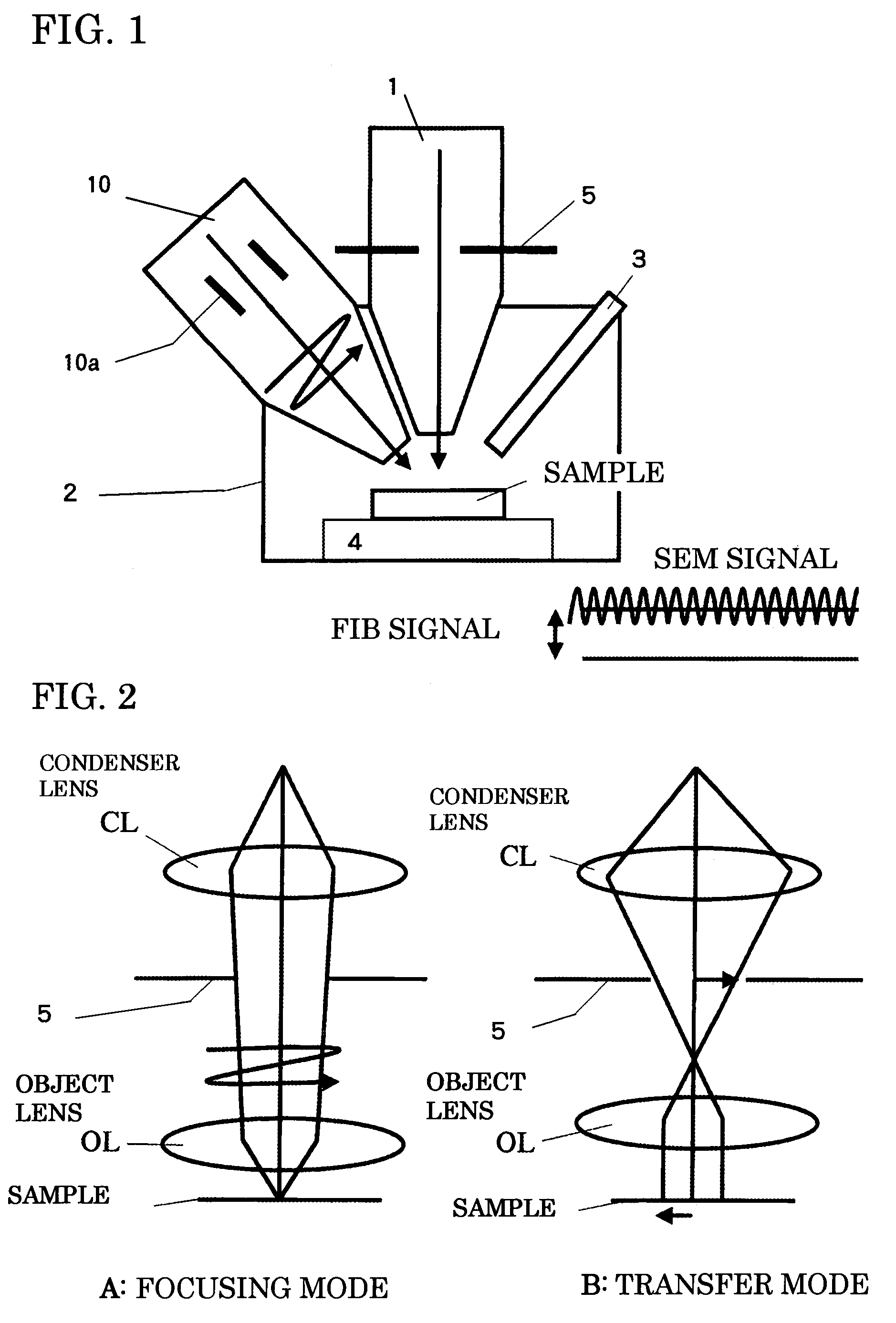
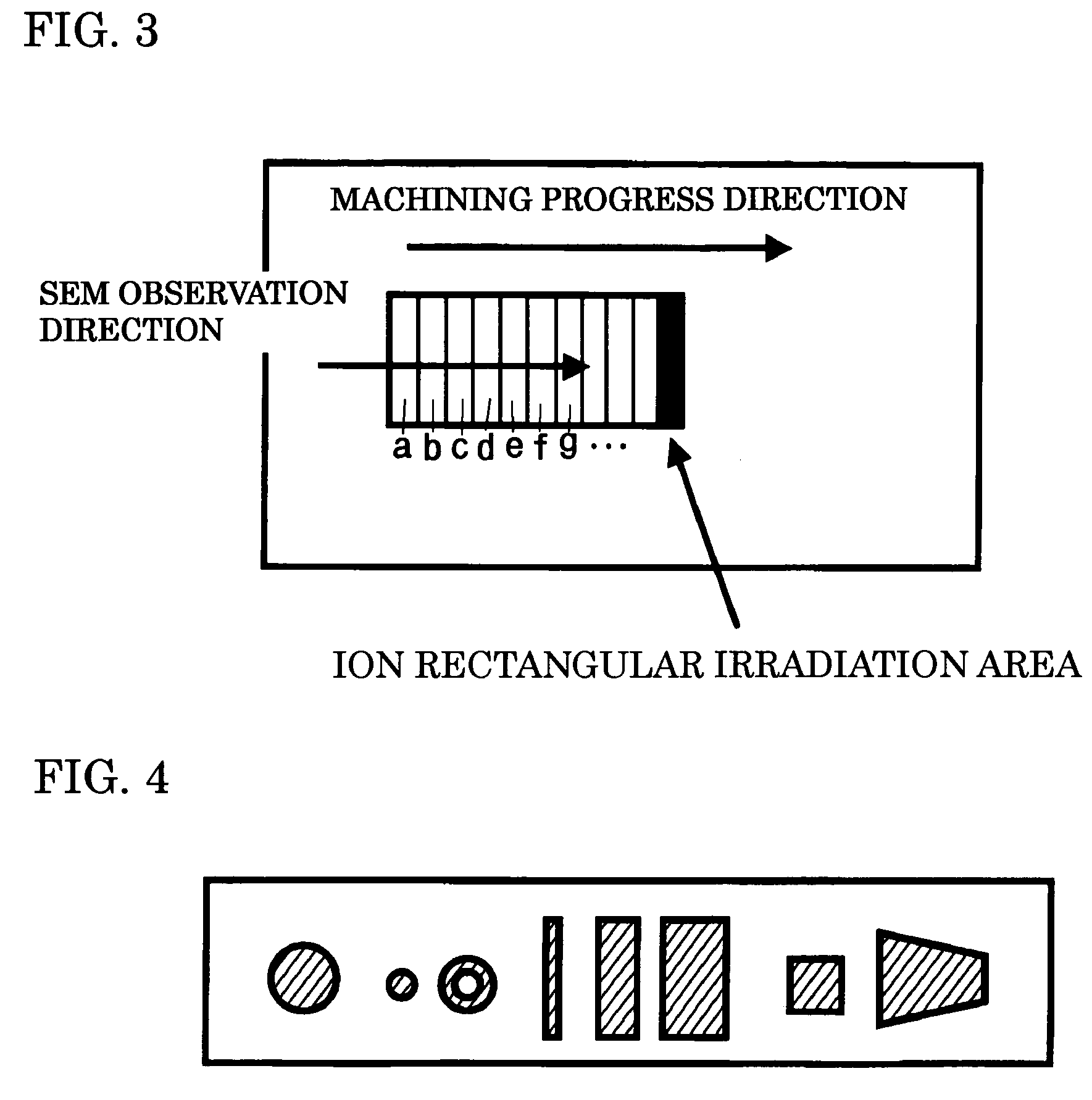
[0038]FIG. 4 shows an embodiment of an aperture that is used in the complex apparatus of the invention. In the embodiment shown here, opening patterns are a large circle, a small circle, a ring, rectangles with small, medium, and large widths, a square, and a trapezoid. It is needless to mention that patterns are not limited to these and can be created appropriately. In use, when a pattern matches a machining area, the pattern only has to be selected and used. Alternatively, it is also possible to combine several patterns to create a necessary machining pattern. In the latter case, patterns to be combined only have to be selected in order to carry out machining. All the cases are the same in that an area is uniformly irradiated by an FIB rather than scanning the area with the FIB to form a machining pattern. Thus, the FIB simply becomes a uniform background noise for an SEM signal in the machining area,
second embodiment
[Second Embodiment]
[0039]Next, FIG. 5 shows an embodiment including means for removing a uniform background noise due to ion beam irradiation from an SEM signal in which the background noise is detected. In view of the fact that this background noise is superimposed on the SEM signal as a bias component corresponding to a beam current of an FIB, the inventors have achieved an idea of detecting the beam current of the FIB and correct the beam current. For this beam current detection, it is advantageous to arrange the aperture 5 of a transfer pattern determining a machining are a between the object lens OL and a sample surface in a mask form. By forming this mask with a conductive material, it is possible to use the aperture 5 also as a beam current detector. In other words, as shown in FIG. 5, the aperture 5 arranged in the mask form between the object lens OL, which is arranged on a tip side of the FIB lens-barrel 1, and the sample surface is used as a detection electrode to pick up...
third embodiment
[Third Embodiment]
[0041]Next, FIG. 7 shows another embodiment including means for removing a uniform background noise due to ion beam irradiation from an SEM signal in which the background noise is detected. In the embodiment described above, a beam current of an FIB, which causes this background noise, is detected and corrected. However, in this embodiment, in view of the fact that a beam current of an FIB is measured in advance and can be allocated to setting conditions for a lens optical system of an FIB apparatus, the inventors have achieved an idea of performing level adjustment based on the setting conditions for the lens optical system without measuring a beam current directly. As shown in FIG. 7, in this embodiment, it is unnecessary to provide a special component. A beam current is calculated from the setting conditions for the lens optical system in a controller and a background noise level based on this beam current is further calculated to perform correction for the back...
PUM
 Login to View More
 Abstract
Description
Claims
Application Information
 Login to View More