
Vectors, cells and processes for pyrimidine deoxyribonucleosides production
a technology of pyrimidine and ribonucleosides, which is applied in the field of production of pyrimidines, purines and derivatives, can solve the problems of not ensuring a commercially viable level of thymidine production, thymidine synthesis in e. coli /i>not at a commerically viable level, and the cost of thymidine produced by chemical synthesis used in the manufacture of azt is no
- Summary
- Abstract
- Description
- Claims
- Application Information
AI Technical Summary
Benefits of technology
Problems solved by technology
Method used
Image

Examples
example 1
Cloning of T4 nrdCAB Genes and Demonstration of Activity
[0057]The bacteriophage T4 nrdAB genes were cloned by performing the polymerase chain reaction (PCR) with isolated phage T4 DNA. The primers for PCR nrdA gene were: 5′-TAT TCT AGA CGA TTT TCA AGT TGA GGA CTT ATG C-3′SEQ ID NO: 1); and 5′-TAT ATC GAT AAT TCA TTA CAA TTT ACA CGC TGC AC-3′ (SEQ ID NO: 2).
[0058]The restriction site Xbal was the introduced at the beginning of the nrdA in the amplified DNA, and Clal was introduced at the 3′ end of nrdA. The primers for PCR amplification of nrdB gene were:
[0059]
(SEQ. ID NO:3)5′-TAT ATC GAT AAA TGT AAA TTT AAG GAT TCT AAATG-3′and(SEQ. ID NO:4)5′-TAT GTC GAC TCC TTA AAA GTA TTT TTT AAA ACTC-3′.
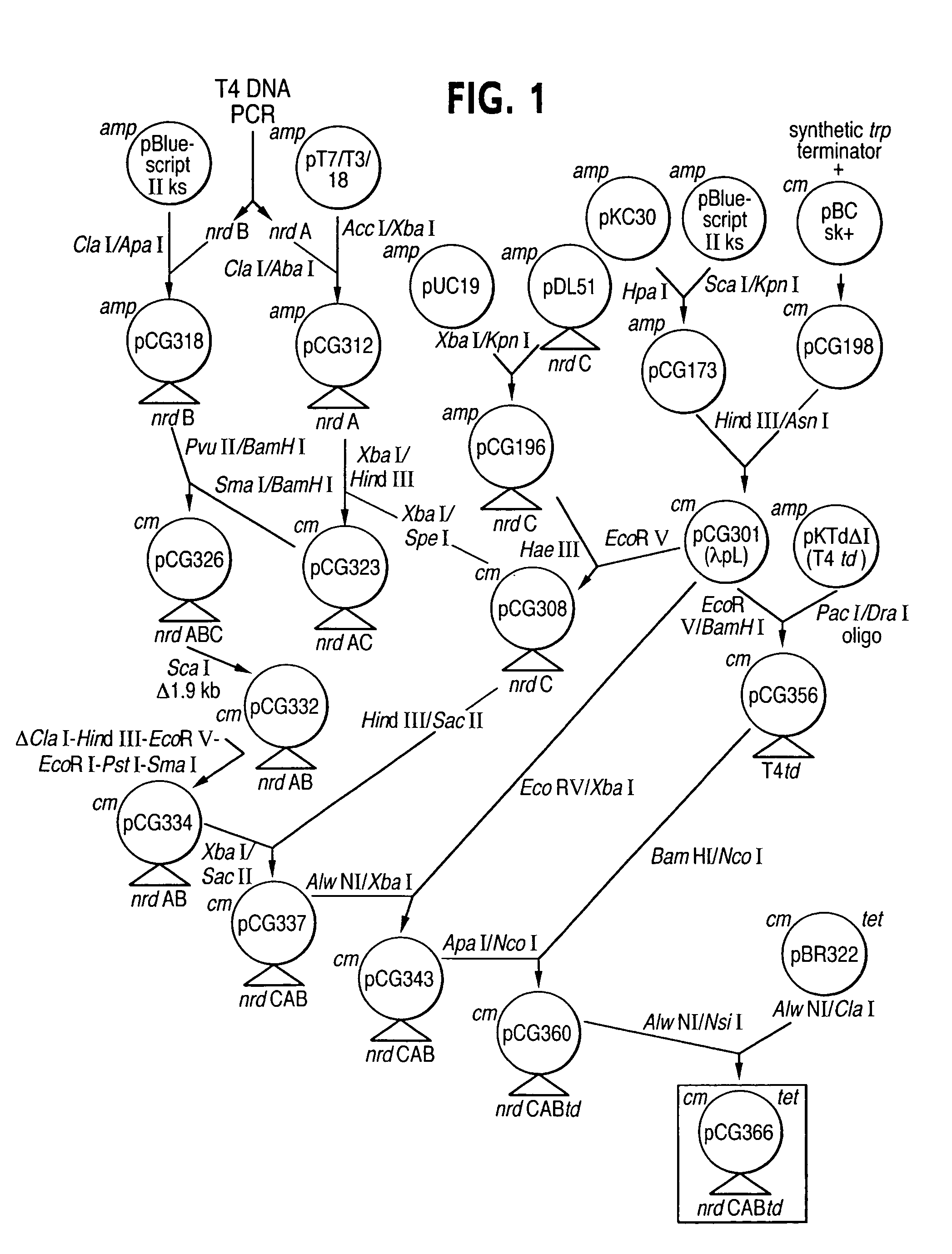
[0060]The restriction site ClaI was thus introduced at the beginning of the nrdB, and ApaI was introduced at the end of nrdB in the amplified DNA. The PCR fragments were cloned into plasmid vectors as illustrated in FIG. 1 according to techniques known to those skilled in the art. The cloned nrdAB...
example 2
Derivation of Host Strain CMG2451 from Strain CMG1115
[0067]Strain CMG1115 is fully described in McCandliss & Anderson (U.S. Pat. No. 5,213,972). CMG1115 was the starting point for development described herein. Strain CMG1115 was improved for thymidine productivity by selection for growth on medium containing 30 mg / L of 5-fluorouridine that yielded strain CMG2401. Strain CMG2401 was then selected for growth on medium containing 30 mg / l of 3′-azido-3′-deoxythymidine which yielded strain CMG2404. CMG2404 requires L-proline for growth due to the inherited mutation Δ(lac-pro) from its original parent JM101. Hfr mating between CMG2404 and a Hfr stain CAG5053 (Singer, M. et al. Microbiological Review: 5:1-24,1989) was performed according to techniques known to those skilled in the art and yielded strain CMG2434 which is Lac+, Pro+. The udp (uridine phosphorylase) mutation in CMG2434 still had partial uridine phosphorylase activity that was evident based on thymine accumulation after induct...
example 3
Cloning and Expression of T4 td Gene into Thymidine Production Plasmid
[0069]The T4 td gene was cloned into pKTd.DELTA.I by West et al. (J. Biol. Chem 261:13446-13450, 1986) without the 1017-base pair intron. The td gene was sub-cloned into pCG301using two oligonucleotides as linkers with the following sequences:
[0070]
(SEQ. ID NO:7)5′-GAT CCG GAG GAT AAA TGA AAC AAT ACC AAG ATTTAA T-3′and;(SEQ. ID NO:8)5′-TAA ATC TTG GTA TTG TTT CAT TTA TCC TCC G-3′.
[0071]The result plasmid was pCG356. The td gene from pCG356 was then sub-cloned into pCG343 to create pCG360 (FIG. 1). The tetracycline resistance gene and plasmid replication origin from pBR322 (Bolivar, F. et al., Gene 2: 95-113, 1977) was sub-cloned into pCG360 and formed pCG366. The thymidylate synthase activity was measured by spectrophotometric method of Wahba and Friedkin (J. Biol. Chem. 236: PC11-PC12, 1961 ). The results are shown in Table 4.
[0072]
TABLE 4Thymidylate Synthase ActivitySpecific ActivityΔOD340 / mgStrainprotein / minCMG...
PUM
| Property | Measurement | Unit |
|---|---|---|
| pH | aaaaa | aaaaa |
| volume | aaaaa | aaaaa |
| OD | aaaaa | aaaaa |
Abstract
Description
Claims
Application Information
 Login to View More