Supercharge Your Innovation With Domain-Expert AI Agents!

Mold, method for producing the same and magnetic recording medium

a technology of magnetic recording medium and mold, which is applied in the field of mold, can solve the problems of limited head processing, warpage or distortion of conventional stampers produced by the above-mentioned method, and the inability to increase the surface recording density of conventional improved methods, etc., and achieves the effect of superior flatness, small warpage amount, and small variation in the amount of warpag

Inactive Publication Date: 2010-08-31
FUJIFILM CORP
View PDF8 Cites 12 Cited by
  • Summary
  • Abstract
  • Description
  • Claims
  • Application Information

AI Technical Summary

Benefits of technology

The solution significantly reduces warpage and enhances the flatness of the mold, enabling the formation of precise concavo-convex patterns and improving the adhesion and durability of magnetic recording media, thereby facilitating higher surface recording density and accurate magnetic transfer.

Problems solved by technology

However, problems such as limitations of head processing, incorrect recording of information to another track situated next to a target recording track stemming from the widening of a magnetic field, and crosstalk at the time of reproduction have become conspicuous, and thus surface recording density can hardly be increased by conventional improved methods anymore.
However, conventional stampers produced by the above-mentioned method are not necessarily flat but often warped or distorted.
Hence, there is a problem that highly accurate concavo-convex patterns cannot be formed, as concavo-convex patterns formed are deformed or distorted.
However, conventional master disks produced by the above-mentioned method are not necessarily flat but often warped or distorted as a result of being deformed at the times of processes exemplified by the peeling step in which metal plates are peeled off original plates and the punching step in which the metal plates are cut by punching into predetermined sizes.
In addition, warpage and distortion may be caused by internal stress of electroforming layers in a photo-etching step as well.
When a master disk is warped or distorted as just described, there is a problem that it is impossible to improve the state in which the master disk and a slave disk are closely attached to each other and thus impossible to perform highly accurate magnetic transfer.
However, despite these attempts, the problems with adhesion have not completely been solved; in essence, it is necessary to improve the flatness of the master disk by removing the warpage or distortion of the master disk.
Also, there is a possibility that increasing adhesive pressure may damage or deform a concavo-convex pattern of the master disk, hence a cause of decrease in the durability of the master disk.

Method used

the structure of the environmentally friendly knitted fabric provided by the present invention; figure 2 Flow chart of the yarn wrapping machine for environmentally friendly knitted fabrics and storage devices; image 3 Is the parameter map of the yarn covering machine
View more

Image

Smart Image Click on the blue labels to locate them in the text.
Viewing Examples
Smart Image
  • Mold, method for producing the same and magnetic recording medium
  • Mold, method for producing the same and magnetic recording medium
  • Mold, method for producing the same and magnetic recording medium

Examples

Experimental program
Comparison scheme
Effect test

example 1

Production of Mold

[0120]As shown in FIG. 5A, on a substrate 15 made of a silicon wafer whose surface is flat, smooth and clean, a resist film 16 was formed by applying an electron beam resist solution by means of spin coating, etc. and baked. Then in an electron beam exposer (not shown in the figure) provided with a highly accurate rotational stage or X-Y stage, the substrate 15 mounted on the stage was irradiated with an electron beam B modulated correspondingly to a servo signal or the like, and a desired concavo-convex pattern P′ was created in the resist film 16 by means of drawing exposure.

[0121]Next, as shown in FIG. 5B, the resist film 16 underwent a developing process, and the desired concavo-convex pattern P′ was formed by the residual resist film 16 from which the exposed portion had been removed. A conductive layer (not shown in the figure) was provided on this concavo-convex pattern P′ by means of sputtering, and an original plate 17 which can be subjected to an electrof...

example 2

Production of Mold

[0143]A mold of Example 2 was produced in a similar manner to Example 1, except that the condition of the electroforming process in Example 1 was changed to such a condition that electroforming was conducted in three cycles at a current density of 6 A / dm2 for 70 min each.

[0144]The crystal orientation in cross section of the mold, the amount of warpage (the degree of flatness), and the variation in the amount of warpage were measured in a similar manner to Example 1, with respect to the mold of Example 2 obtained. The results are shown in Table 1.

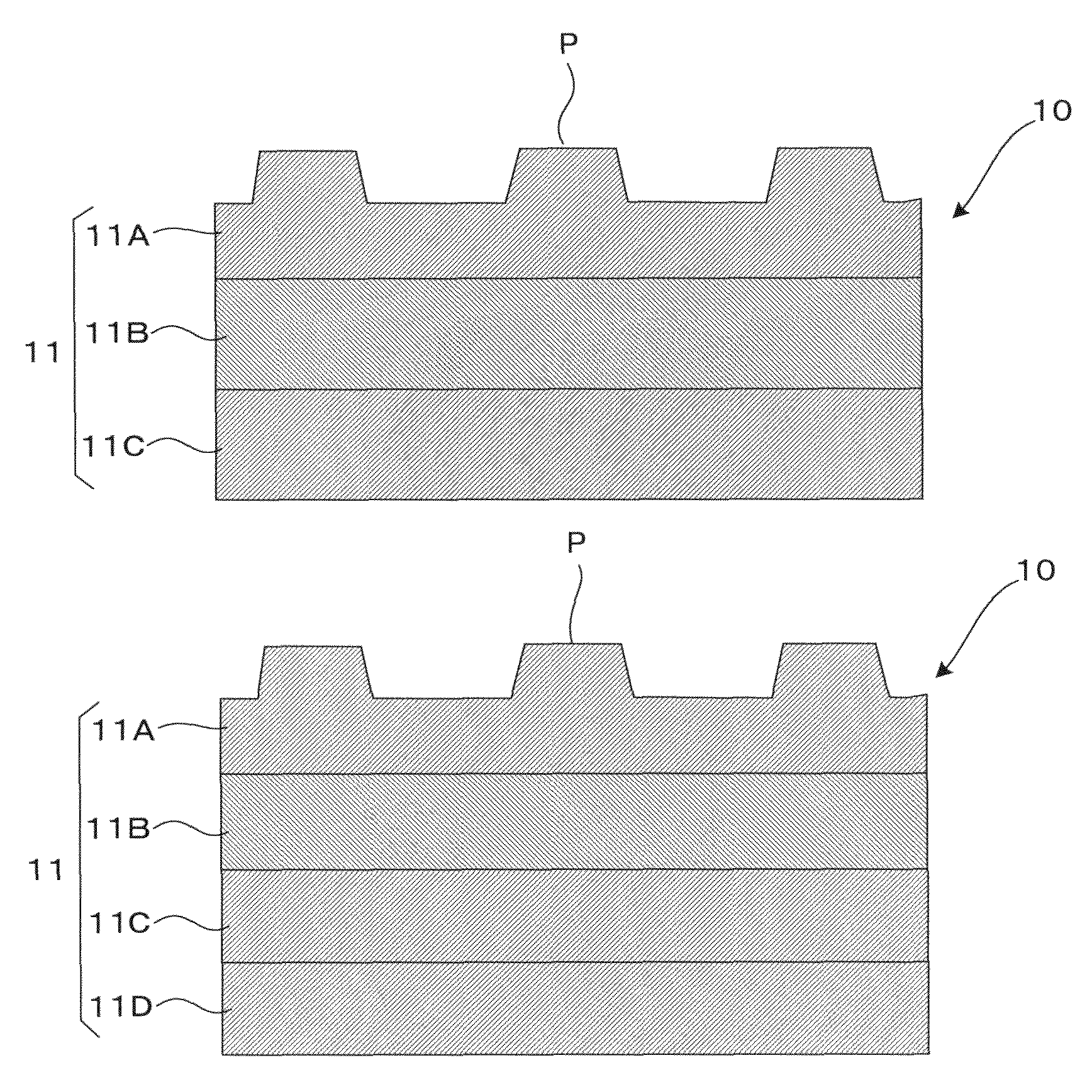
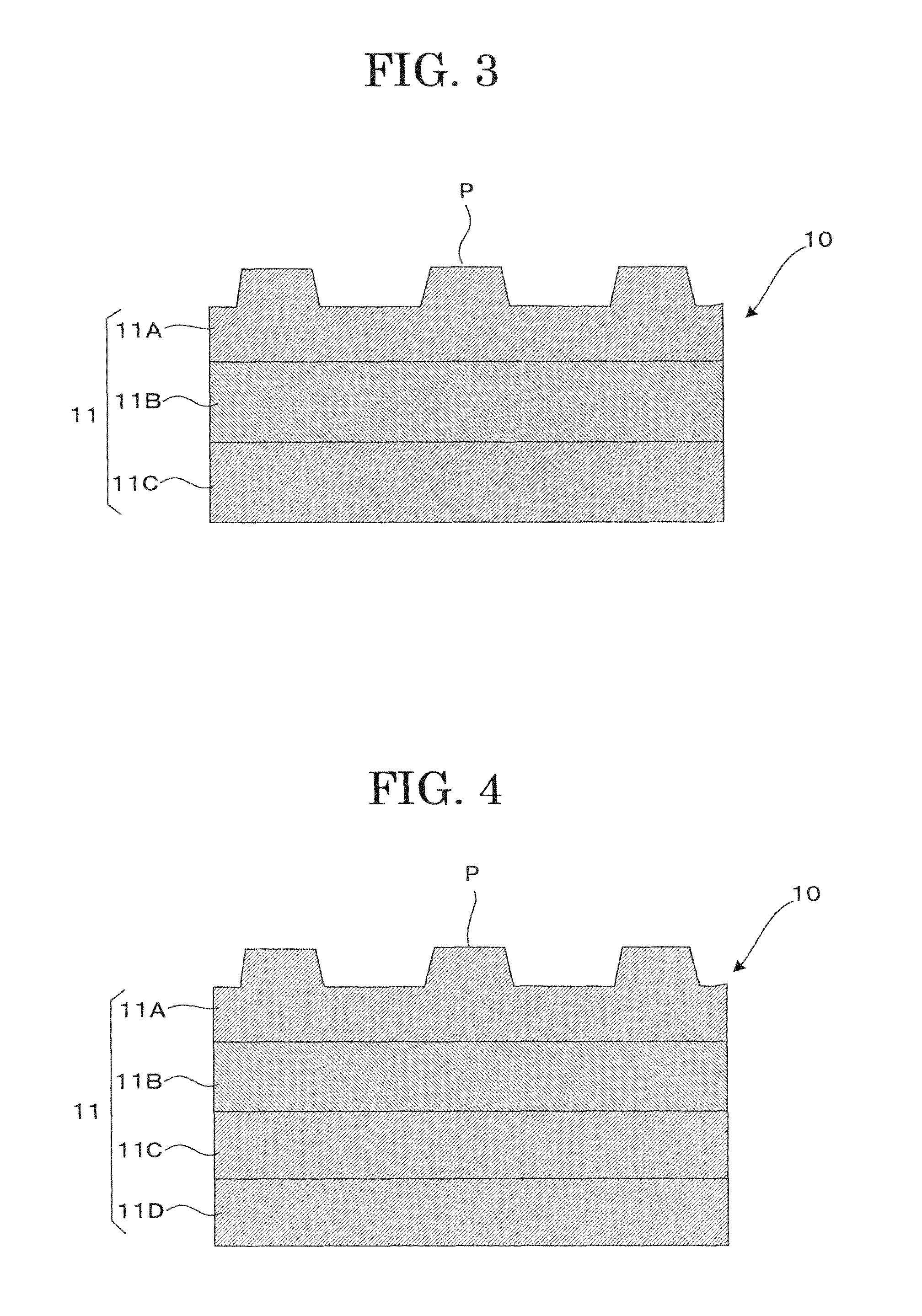
[0145]As a result of an EBSD IPF image whereby the crystal orientation in cross section of the mold of Example 2 was measured, it was confirmed that first, second and third electroforming layers from the concavo-convex pattern side had the same crystal orientation in which Ni (110) was the preferred orientation.

example 3

Production of Mold

[0146]A mold of Example 3 was produced in a similar manner to Example 1, except that the condition of the electroforming process in Example 1 was changed to such a condition that after electroforming was conducted in two cycles at a current density of 6 A / dm2 for 95 min each, the current density was raised to 15 A / dm2 and sustained for 10 min.

[0147]The crystal orientation in cross section of the mold, the amount of warpage (the degree of flatness), and the variation in the amount of warpage were measured in a similar manner to Example 1, with respect to the mold of Example 3 obtained. The results are shown in Table 1.

[0148]As a result of an EBSD IPF image whereby the crystal orientation in cross section of the mold of Example 3 was measured, it was confirmed that first and second electroforming layers from the concavo-convex pattern side had the same crystal orientation in which Ni (110) was the preferred orientation, and that a third electroforming layer from the ...

the structure of the environmentally friendly knitted fabric provided by the present invention; figure 2 Flow chart of the yarn wrapping machine for environmentally friendly knitted fabrics and storage devices; image 3 Is the parameter map of the yarn covering machine
Login to View More

PUM

PropertyMeasurementUnit
total thicknessaaaaaaaaaa
thicknessaaaaaaaaaa
sizeaaaaaaaaaa
Login to View More

Abstract

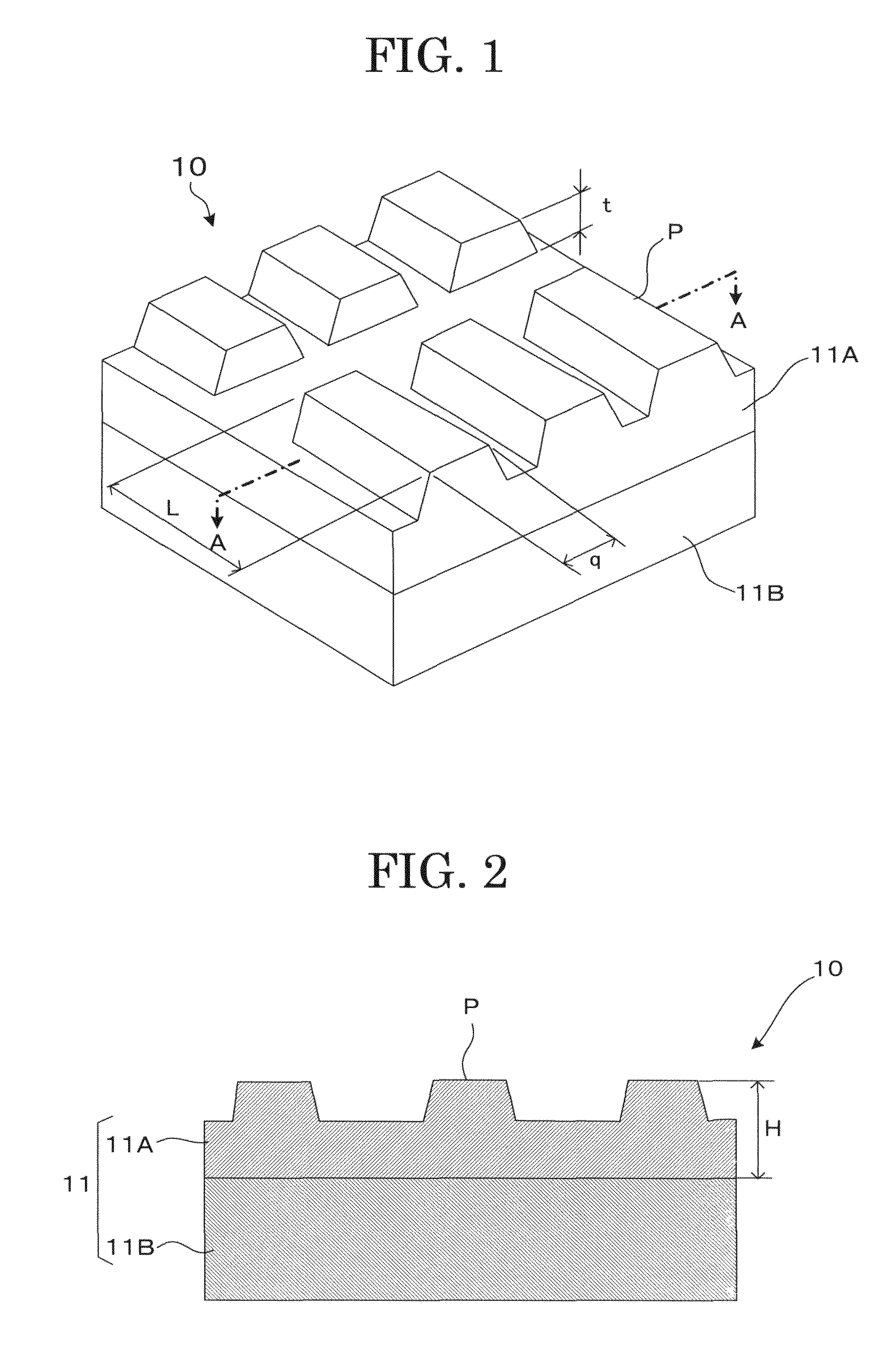
There is provided a mold which contains at least two electroforming layers, wherein the mold has a concavo-convex pattern on a surface thereof, and the electroforming layers include at least two adjacent layers having the same crystal orientation.

Description

BACKGROUND OF THE INVENTION[0001]1. Field of the Invention[0002]The present invention relates to a mold suitable for a stamper for a discrete track medium, a stamper for a patterned medium, a master disk for magnetic transfer, and the like; a method for producing the mold; and a magnetic recording medium.[0003]2. Description of the Related Art[0004]In recent years, for magnetic recording media, remarkable increase in surface recording density has been achieved by means of improvements such as reduction in the size of magnetic particles constituting recording layers thereof, alteration of materials and minuteness in head processing, and, for the future too, further increase in surface recording density is hoped for.[0005]However, problems such as limitations of head processing, incorrect recording of information to another track situated next to a target recording track stemming from the widening of a magnetic field, and crosstalk at the time of reproduction have become conspicuous, ...

Claims

the structure of the environmentally friendly knitted fabric provided by the present invention; figure 2 Flow chart of the yarn wrapping machine for environmentally friendly knitted fabrics and storage devices; image 3 Is the parameter map of the yarn covering machine
Login to View More

Application Information

Patent Timeline
no application Login to View More
Patent Type & Authority Patents(United States)
IPC IPC(8): B29C59/00B29C33/00B81C99/00
CPCB82Y10/00C25D1/10C25D5/10G11B5/743G11B5/855G11B5/865B29L2017/005G11B7/261G11B7/263G11B11/10582C25D5/617
Inventor ICHIKAWA, KENJIKASAHARA, SEIJI
Owner FUJIFILM CORP
Features
  • R&D
  • Intellectual Property
  • Life Sciences
  • Materials
  • Tech Scout
Why Patsnap Eureka
  • Unparalleled Data Quality
  • Higher Quality Content
  • 60% Fewer Hallucinations
Social media
Patsnap Eureka Blog
Learn More