Supercharge Your Innovation With Domain-Expert AI Agents!

Fibrinogen-producing transgenic silkworm

a transgenic silkworm and fibrinogen technology, applied in the field of transgenic silkworms, can solve the problems of fibrinogen secretion by protease, inability to provide a sufficiently efficient and satisfactory method, and difficulty in constant and stable supply of fibrinogen, etc., to achieve the effect of high protein synthetic capacity, convenient preservation, and convenient recovery of active fibrinogen

Active Publication Date: 2016-09-20
IMMUNO BIOLOGICAL LABIRATORIES CO LTD
View PDF19 Cites 0 Cited by
  • Summary
  • Abstract
  • Description
  • Claims
  • Application Information

AI Technical Summary

Benefits of technology

This method enables the safe and cost-effective mass production of fibrinogen with reduced viral contamination risk, as the transgenic silkworms efficiently secrete active fibrinogen into the cocoon filament, facilitating easy recovery and maintaining protein activity.

Problems solved by technology

Furthermore, since supply of human plasma as a raw material is dependent on blood donation, its constant and stable supply is not always easy.
Such attempts have been reported several times so far, but none of them succeeded in providing a sufficiently efficient and satisfactory method.
For example, in Patent Document 1 and Non-patent Document 1, a method for producing a recombinant fibrinogen using a Pichia yeast has been disclosed, but, in this method, fibrinogen secreted into the culture liquid is degraded by protease, so that the production method is not efficient.
However, the production is too costly and laborious to realize commercial production of fibrinogen since, for example, large-scale facilities for cell culture and control of the culture density are required.
Further, since animal cells are used, there is the risk of contamination with animal-derived substances and infectious viruses, so that the method has the same problem as the current method wherein fibrinogen is manufactured from human blood.

Method used

the structure of the environmentally friendly knitted fabric provided by the present invention; figure 2 Flow chart of the yarn wrapping machine for environmentally friendly knitted fabrics and storage devices; image 3 Is the parameter map of the yarn covering machine
View more

Image

Smart Image Click on the blue labels to locate them in the text.
Viewing Examples
Smart Image
  • Fibrinogen-producing transgenic silkworm
  • Fibrinogen-producing transgenic silkworm
  • Fibrinogen-producing transgenic silkworm

Examples

Experimental program
Comparison scheme
Effect test

examples

[0043]The present invention is described below in more detail by way of Examples.

[0044]However, the present invention is not limited to the Examples below. In the Examples below and the drawings, “Aα chain” is also simply referred to as “α chain”, and “Bβ chain” is also simply referred to as “β chain”.

1. Preparation of Human Fibrinogen cDNA Fragment

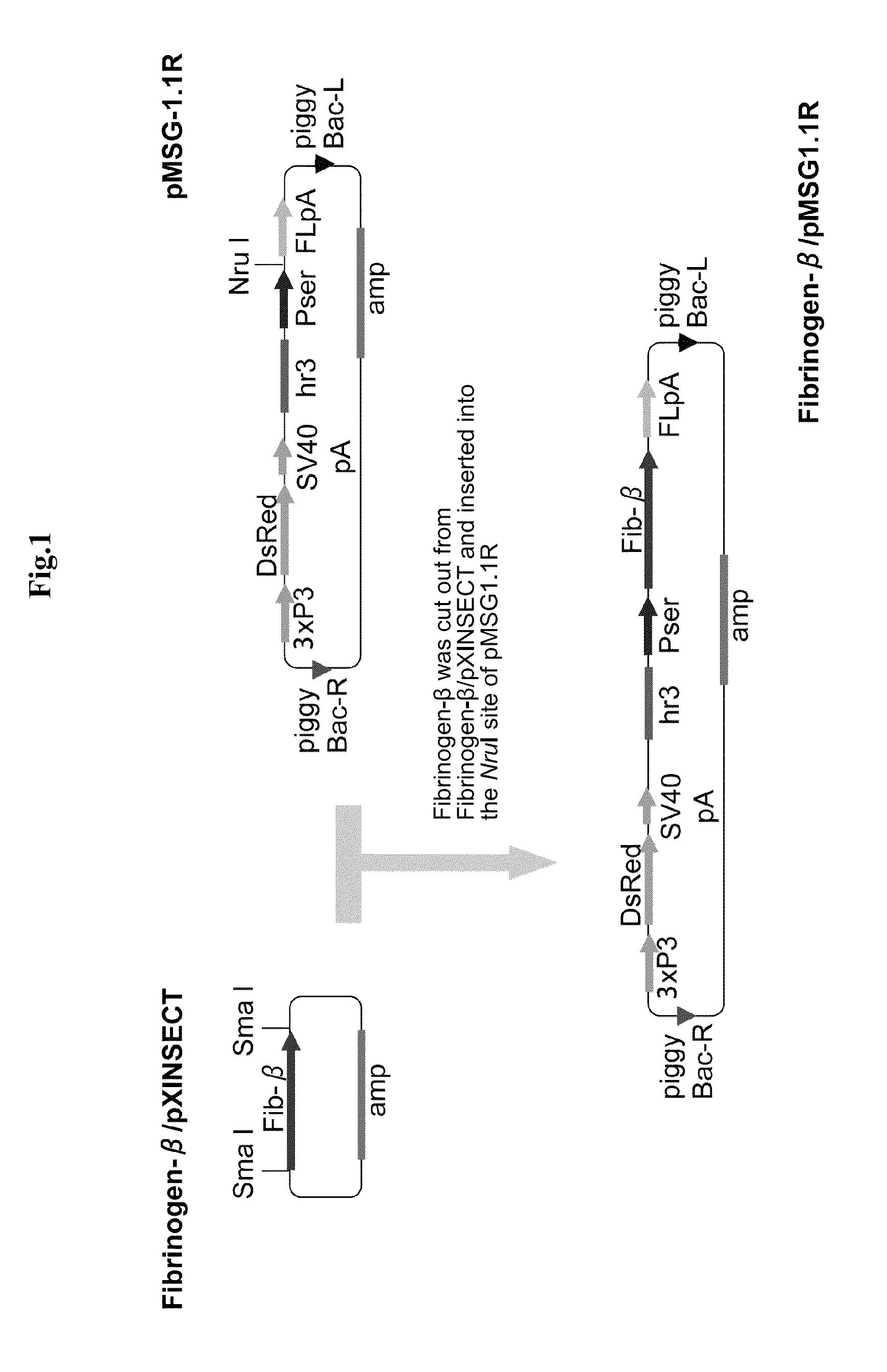
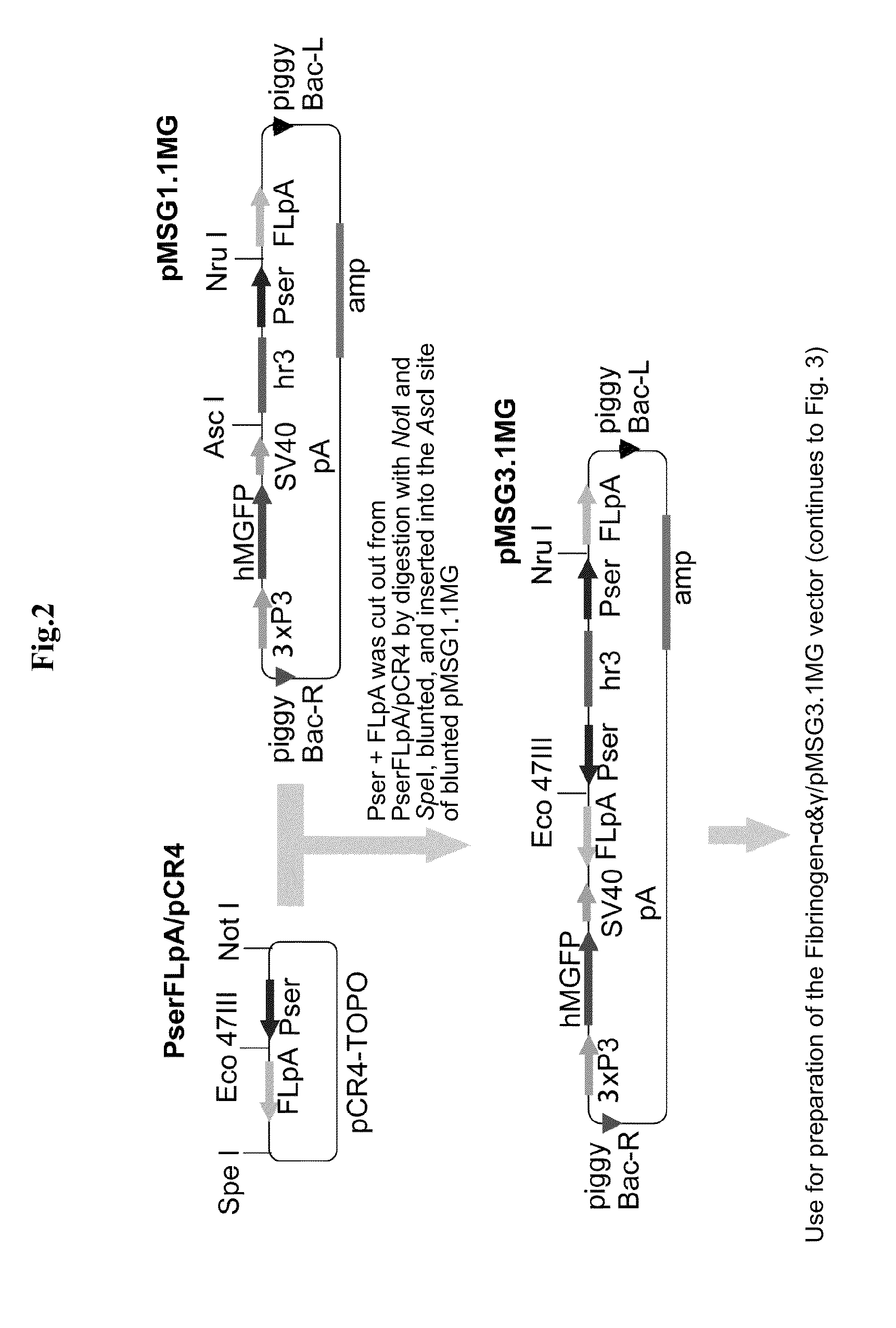
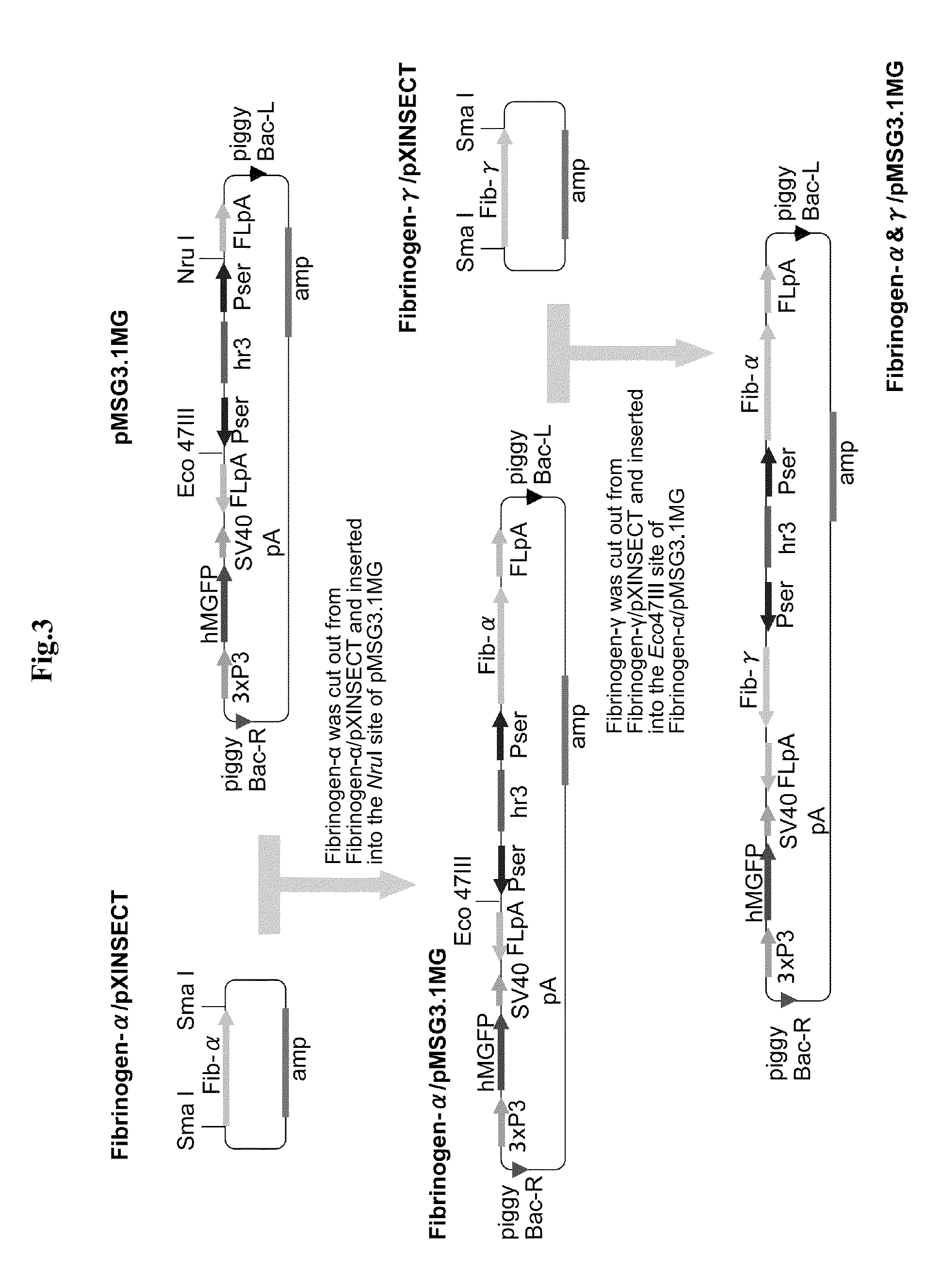
[0045]cDNA fragments of the three subunits of fibrinogen, Aα, Bβ and γ, were amplified by PCR from a cDNA library of human liver. Replacement of the signal sequence, addition of the initiation codon ATG and addition of the UTR sequence were sequentially carried out while subcloning was carried out as appropriate, thereby preparing each subunit cDNA fragment to be inserted into an expression vector for the silkworm middle silk gland. The preparation of the cDNA fragment for each subunit is described in detail below. The PCR reaction was carried out in a volume of 50 μl using 5 units of Ex Taq or 1 unit of KOD.

(1) Obtaining Aα-Chain cDNA

[00...

the structure of the environmentally friendly knitted fabric provided by the present invention; figure 2 Flow chart of the yarn wrapping machine for environmentally friendly knitted fabrics and storage devices; image 3 Is the parameter map of the yarn covering machine
Login to View More

PUM

PropertyMeasurementUnit
molecular weightaaaaaaaaaa
volumeaaaaaaaaaa
concentrationaaaaaaaaaa
Login to View More

Abstract

Disclosed is a novel means that enables mass production of highly safe fibrinogen at low cost. The transgenic silkworm of the present invention expresses the fibrinogen subunit Aα, Bβ and γ chains in the silk gland cells and produces fibrinogen having coagulation activity in the cocoon filament. Preferably, the transgenic silkworm expresses the subunits in the middle silk gland cells and produces fibrinogen in the sericin layer of the cocoon filament. By recovering fibrinogen from the cocoon of the transgenic silkworm of the present invention, highly safe fibrinogen can be mass-produced at low cost.

Description

TECHNICAL FIELD[0001]The present invention relates to a transgenic silkworm that produces fibrinogen having coagulation activity in the cocoon filament, a method for producing the silkworm, and a method for producing fibrinogen.BACKGROUND ART[0002]Fibrinogen is a plasma protein present in blood plasma, and is a glycoprotein with a molecular weight of 340 kDa. Fibrinogen has a hexameric molecular structure wherein three chains, that is, the Aα chain, Bβ chain and γ chain, are bound to one another via disulfide bonds and the resulting complex forms a dimer (Aα-Bβ-γ)2. The Aα chain, with a size of 67 kDa, is composed of 610 amino acid residues and does not have a sugar chain. The Bβ chain, with a size of 56 kDa, is composed of 461 amino acid residues and has a sugar chain at Asn at position 364. The γ chain, with a size of 48 kDa, is composed of 411 amino acid residues and has a sugar chain at Asn at position 52.[0003]Fibrinogen is involved in blood coagulation. In the living body, thr...

Claims

the structure of the environmentally friendly knitted fabric provided by the present invention; figure 2 Flow chart of the yarn wrapping machine for environmentally friendly knitted fabrics and storage devices; image 3 Is the parameter map of the yarn covering machine
Login to View More

Application Information

Patent Timeline
no application Login to View More
Patent Type & Authority Patents(United States)
IPC IPC(8): C12N15/00A01K67/04C07K14/75
CPCC07K14/75A01K67/04A01K2217/052A01K2227/706A01K2267/01
Inventor SEKIGUCHI, SATOSHITAKAHISA, MANABUTOMITA, MASAHIRO
Owner IMMUNO BIOLOGICAL LABIRATORIES CO LTD
Features
  • R&D
  • Intellectual Property
  • Life Sciences
  • Materials
  • Tech Scout
Why Patsnap Eureka
  • Unparalleled Data Quality
  • Higher Quality Content
  • 60% Fewer Hallucinations
Social media
Patsnap Eureka Blog
Learn More