
Graft copolymer of starch and methacrylic dehydrated glyceride
A technology of graft copolymer and methacrylic acid, applied in the field of graft copolymer, can solve the problems of heavy metal ions that need to be improved
- Summary
- Abstract
- Description
- Claims
- Application Information
AI Technical Summary
Problems solved by technology
Method used
Image

Examples
preparation example
[0014] Grafting rate and nitrogen content of following example are all determined by following method:
[0015] Determination of nitrogen content: use the Kjeldahl method to measure the nitrogen content in the sample, and then calculate according to the following formula:
[0016] Nitrogen content% = [(V-V 0 )N / W]×0.014×100
[0017] In the formula: V - the number of milliliters of HCl consumed, mL;
[0018] V 0 - the number of milliliters of HCl consumed by the blank experiment mL;
[0019] Normal concentration of N-HCl
[0020] W-sample weight, g
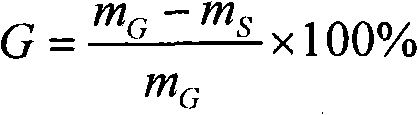
[0021] Determination method of graft rate: measure graft rate (G, %) by gravimetric method. Wrap the dried crude product with filter paper, place it in a 250ml Soxhlet extractor to extract and remove the homopolymer, wash, filter and vacuum dry to constant weight to obtain pure graft copolymer.
[0022] Calculated as follows:
[0023] G = m G ...
example 1
[0027] Take 5g of cornstarch and 50mL of distilled water and put them into a 250mL three-neck flask, stir to form starch milk and blow in nitrogen gas, add 0.1g of ammonium persulfate and 8.5g of dehydrated glyceryl methacrylate, heat up to 45°C and react for 2 hours to obtain starch grafted formazan Dehydrated glyceryl acrylate copolymer is the backbone of the chelating agent. Take 2g of copolymer (dry basis), add 10mL of diethylenetriamine into a 250mL three-neck flask, stir, condense and reflux at 65°C for 20h to obtain a white gel-like product, precipitate and wash the product with absolute ethanol, and vacuum dry at 50°C. The obtained product was tested, and the grafting ratio (G) was 61.68%, and the nitrogen content was 13.8%.
example 2
[0029] Take 10g of cornstarch and 50mL of distilled water and put them into a 250mL three-neck flask, stir to form starch milk and blow in nitrogen gas, add 0.05g of cerium ammonium nitrate and 6.5g of glycidyl methacrylate, heat up to 35°C and react for 2h to obtain starch grafted formazan Glycidyl acrylate copolymer is the backbone of the chelating agent. Take 2g of copolymer (dry basis), add 15mL of hydrazine hydrate into a 250mL three-necked flask, stir, condense and reflux at 85°C for 8h to obtain a white colloidal product, precipitate and wash the product with absolute ethanol, and vacuum dry at 50°C. The obtained product was tested, and the grafting rate (G) was 31.5%, and the nitrogen content was 2.0%.
PUM
| Property | Measurement | Unit |
|---|---|---|
| degree of grafting | aaaaa | aaaaa |
| degree of grafting | aaaaa | aaaaa |
| degree of grafting | aaaaa | aaaaa |
Abstract
Description
Claims
Application Information
 Login to View More