A method for preparing germanium nanotube arrays
A nanotube array, nanotube technology, applied in the fields of nanotechnology, nanotechnology, nanostructure manufacturing, etc., can solve the problem that one-dimensional nanotubes are rarely studied, and achieve controllable diameter, controllable tube wall thickness, and simple method. Effect
- Summary
- Abstract
- Description
- Claims
- Application Information
AI Technical Summary
Problems solved by technology
Method used
Image

Examples
Embodiment 1
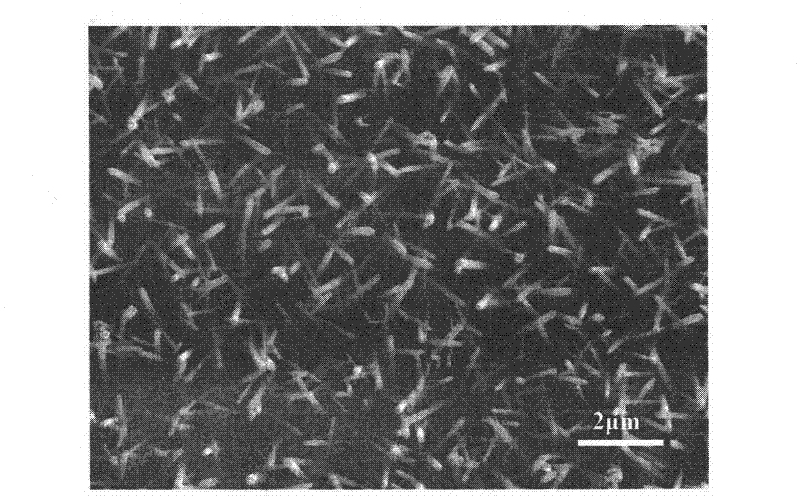
[0025] 1) A platinum sheet was used as the counter electrode, a saturated calomel electrode was used as the reference electrode, and ITO glass was used as the working electrode. The aqueous solution of zinc chloride and potassium chloride is used as the electrolyte, the concentration of potassium chloride in the electrolyte is 0.1mol / L, and the concentration of zinc chloride is 0.05mmol / L. During the experiment, oxygen was continuously delivered through the catheter to the vicinity of the surface of the working electrode in the electrolyte for bubbling. A potential of -0.9 V relative to the reference electrode was applied to the working electrode by an electrochemical analyzer, and the temperature of the electrolyte was maintained at 70 °C. The electrochemical deposition time was 5 hours. The ITO glass was taken out to obtain a one-dimensional array of aligned zinc oxide nanowires grown on the ITO glass, wherein the diameter of the zinc oxide nanowires was about 100 nm and th...
Embodiment 2
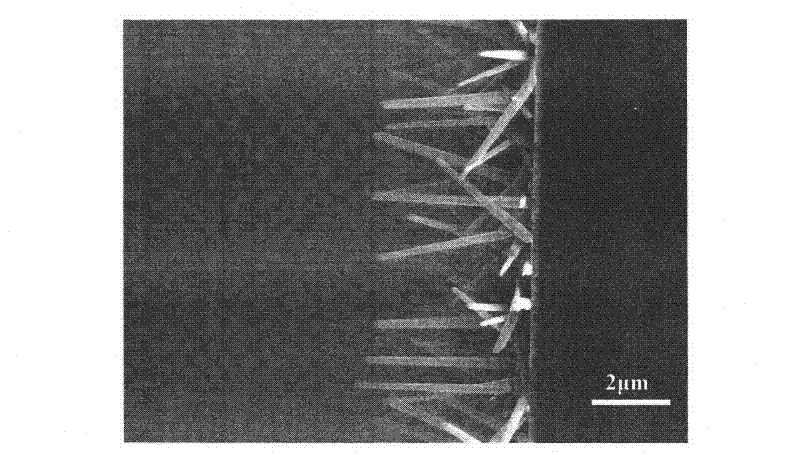
[0028] 1) The platinum sheet was used as the counter electrode, the saturated calomel electrode was used as the reference electrode, and the copper sheet was used as the working electrode. The aqueous solution of zinc chloride and potassium chloride is used as the electrolytic solution, the concentration of potassium chloride in the electrolytic solution is 0.1mol / L, and the concentration of zinc chloride is 0.2mmol / L. During the experiment, oxygen was continuously delivered through the catheter to the vicinity of the surface of the working electrode in the electrolyte for bubbling. A potential of -0.8 V relative to the reference electrode was applied to the working electrode by an electrochemical analyzer, and the temperature of the electrolyte was maintained at 80°C. The electrochemical deposition time was 60 minutes. The copper sheet was taken out to obtain a one-dimensional array of aligned zinc oxide nanowires grown on the copper sheet, wherein the zinc oxide nanowires h...
Embodiment 3
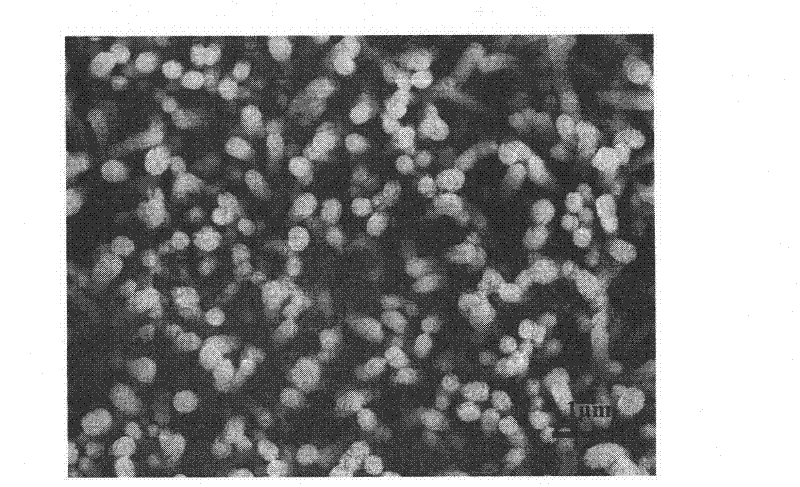
[0031] 1) A platinum sheet is used as a counter electrode, a saturated calomel electrode is used as a reference electrode, and a silicon sheet is used as a working electrode. The aqueous solution of zinc chloride and potassium chloride is used as the electrolytic solution, the concentration of potassium chloride in the electrolytic solution is 0.1mol / L, and the concentration of zinc chloride is 0.1mmol / L. During the experiment, oxygen was continuously delivered through the catheter to the vicinity of the surface of the working electrode in the electrolyte for bubbling. A potential of -0.9 V relative to the reference electrode was applied to the working electrode by an electrochemical analyzer, and the temperature of the electrolyte was maintained at 90°C. The electrochemical deposition time was 3 hours. The silicon wafer was taken out to obtain an aligned one-dimensional array of zinc oxide nanowires grown on the silicon wafer, wherein the diameter of the zinc oxide nanowires...
PUM
| Property | Measurement | Unit |
|---|---|---|
| length | aaaaa | aaaaa |
| diameter | aaaaa | aaaaa |
| thickness | aaaaa | aaaaa |
Abstract
Description
Claims
Application Information
 Login to View More