Supercharge Your Innovation With Domain-Expert AI Agents!

Catalytic polymerization method for lactide

A technology of catalytic polymerization and lactide, which is applied in the field of catalytic polymerization of lactide, can solve the problems of complex structure of rare earth alkoxy complexes, unfavorable catalyst catalytic performance, structure-activity relationship, etc. The effect of clear center and simple operation

Inactive Publication Date: 2012-11-28
NINGBO INST OF TECH ZHEJIANG UNIV ZHEJIANG
View PDF3 Cites 0 Cited by
  • Summary
  • Abstract
  • Description
  • Claims
  • Application Information

AI Technical Summary

Problems solved by technology

However, in general, the complex structures of rare earth alkoxy complexes generated in situ are not conducive to the study of the structure-activity relationship between catalyst microstructure and catalytic performance.

Method used

the structure of the environmentally friendly knitted fabric provided by the present invention; figure 2 Flow chart of the yarn wrapping machine for environmentally friendly knitted fabrics and storage devices; image 3 Is the parameter map of the yarn covering machine
View more

Image

Smart Image Click on the blue labels to locate them in the text.
Viewing Examples
Smart Image
  • Catalytic polymerization method for lactide
  • Catalytic polymerization method for lactide

Examples

Experimental program
Comparison scheme
Effect test

Embodiment 1

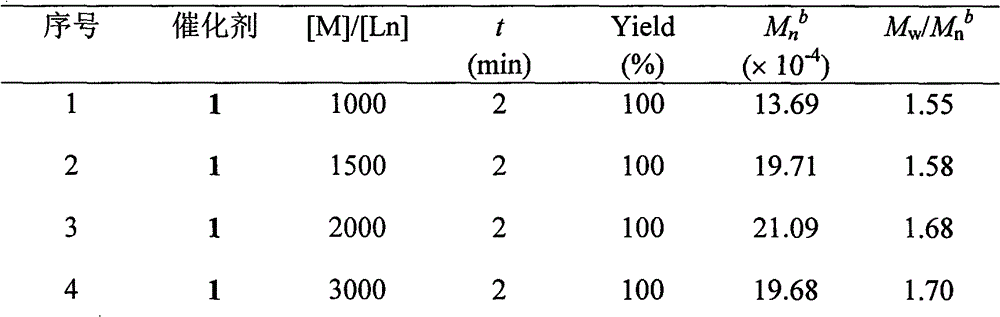
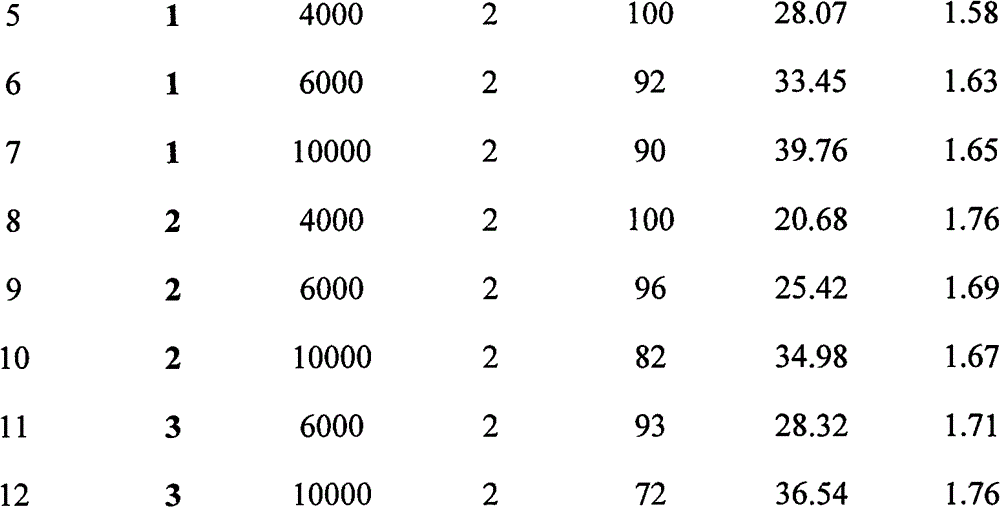
[0025] The rare earth amine complex in this embodiment is a guanidine rare earth diamine complex [(Me 3 Si) 2 NC(NCy) 2 ]Y[N(SiHMe 2 ) 2 ] 2 (THF) (catalyst 1 in the table below), the synthesis process is as follows: adopt Schlenk technique or in a glove box, take 1 mmol of HN(SiMe 3 ) 2 , dissolved in n-hexane, slowly added dropwise to 1mmol n-butyllithium n-hexane solution (concentration: 1.0M) with a volume of 1mL; after stirring for one hour, slowly added dropwise to 1mmol mass of 0.206g N,N'-di In the n-hexane solution of cyclohexylcarbodiimide, react at normal temperature for 0.5 hour; Slowly add dropwise the above-mentioned turbid solution to 1mmol of 0.195g yttrium chloride (YCl 3 ) in THF turbid solution, reacted for 15 minutes; 2mmol of LiN(SiHMe 2 ) 2 Dubbed tetrahydrofuran solution. After reacting at room temperature for 4 hours, the solvent was dried under vacuum, and the residual powder was extracted with n-hexane; the extract was filtered, the supernata...

Embodiment 2

[0028] The rare earth amine complex in this embodiment is a guanidine rare earth diamine complex [(Me 3 Si) 2 NC(NCy) 2 ]Y[N(SiMe 3 ) 2 ] 2 (Catalyst 2 in the table below), its synthesis process is as follows: adopt Schlenk technology or in glove box, take 1mmol quality and be 0.161g HN(SiMe 3 ) 2 , dissolved in n-hexane, slowly added dropwise to 1mmol n-butyllithium n-hexane solution (concentration: 1.0M) with a volume of 1mL; after stirring for one hour, slowly added dropwise to 1mmol mass of 0.206g N,N'-di In the n-hexane solution of cyclohexylcarbodiimide, react at normal temperature for 0.5 hour; Slowly add dropwise the above-mentioned turbid solution to 1mmol of 0.195g yttrium chloride (YCl 3 ) in tetrahydrofuran turbid solution, and reacted for 15 minutes; 2mmol volume of 1.2mL NaN(SiMe 3 ) 2 solution (concentration of 1.67M tetrahydrofuran solution). After reacting at room temperature for 4 hours, the solvent was drained under vacuum, and the residual powder w...

Embodiment 3

[0031] The rare earth amine complex in this embodiment is a guanidine rare earth diamine complex [(Me 3 Si) 2 NC(NCy) 2 ]Lu[N(SiMe 3 ) 2 ] 2 (Catalyst 3 in the table below), its synthesis process is as follows: adopt Schlenk technique or in glove box, take 1mmol quality and be 0.161g HN(SiMe 3 ) 2 , dissolved in n-hexane, slowly added dropwise to 1mmol n-butyllithium n-hexane solution (concentration: 1.0M) with a volume of 1mL; after stirring for one hour, slowly added dropwise to 1mmol mass of 0.206g N,N'-di In the n-hexane solution of cyclohexylcarbodiimide, react at room temperature for 0.5 hours. The above cloudy solution was slowly added dropwise to 1 mmol of 0.281 g of lutetium chloride (LuCl 3 ) in tetrahydrofuran turbid solution, and reacted for 15 minutes; 2mmol volume of 1.2mL NaN(SiMe 3 ) 2solution (concentration of 1.67M tetrahydrofuran solution). After reacting at room temperature for 4 hours, the solvent was drained under vacuum, and the residual powder...

the structure of the environmentally friendly knitted fabric provided by the present invention; figure 2 Flow chart of the yarn wrapping machine for environmentally friendly knitted fabrics and storage devices; image 3 Is the parameter map of the yarn covering machine
Login to View More

PUM

No PUM Login to View More

Abstract

The invention discloses a catalytic polymerization method for lactide, which comprises a step of polymerizing a polymerization system consisting of lactide, a catalyst and a solvent in inert atmosphere at the temperature of between 15 and 100DEG C, wherein the catalyst contains a rare earth diamino complex, and the solvent is an organic solvent without active hydrogen. The rare earth diamino complex is used as the catalyst, is easy to synthesize and high in thermal stability, facilitates synthesis and preservation, and is favorable for not decomposing in a wider polymerization temperature range, and effectively polymerizing; moreover, by regulating the spatial and electron structure of the rare earth complex, namely changing the structure of a ligand connected at the periphery of the central metal, the activity of the catalyst is regulated.

Description

technical field [0001] The invention relates to a method for catalytic polymerization of lactide, in particular to a method for catalytic polymerization of lactide using a highly active rare earth catalyst. Background technique [0002] Polylactide is a degradable polymer material with good biocompatibility and can be widely used in the fields of medicine, medical treatment, agriculture and packaging. Some main group and transition metal complexes can catalyze the polymerization of lactide, but due to the low catalytic activity of these complexes, the residual metal ions usually affect the application range of polymers. In contrast, rare earth complexes have higher catalytic activity for the ring-opening polymerization of lactide, but the catalytic activity can only be significantly improved after in-situ formation of rare earth alkoxy complexes under the action of alcohol. However, in general, the rare earth alkoxy complexes generated in situ are complex in structure, whic...

Claims

the structure of the environmentally friendly knitted fabric provided by the present invention; figure 2 Flow chart of the yarn wrapping machine for environmentally friendly knitted fabrics and storage devices; image 3 Is the parameter map of the yarn covering machine
Login to View More

Application Information

Patent Timeline
no application Login to View More
Patent Type & Authority Patents(China)
IPC IPC(8): C08G63/08C08G63/84
Inventor 罗云杰雷引林陈飞陈珏薛立新陈景
Owner NINGBO INST OF TECH ZHEJIANG UNIV ZHEJIANG
Features
  • R&D
  • Intellectual Property
  • Life Sciences
  • Materials
  • Tech Scout
Why Patsnap Eureka
  • Unparalleled Data Quality
  • Higher Quality Content
  • 60% Fewer Hallucinations
Social media
Patsnap Eureka Blog
Learn More