
Preparation method of chitosan modified graphite oxide functional leather tanning agent
A technology of chitosan modification and oxidized stone, which is applied in small raw hide/big raw hide/leather/fur treatment, small raw hide/large raw hide/leather skin/fur chemical treatment, tanning treatment, etc. It can solve the problems of poor softness, Aluminum tanning agent can solve problems such as flat and thin leather, water pollution, etc., and achieve good social and economic benefits, excellent strength and flexibility, and good filling effect
- Summary
- Abstract
- Description
- Claims
- Application Information
AI Technical Summary
Problems solved by technology
Method used
Image

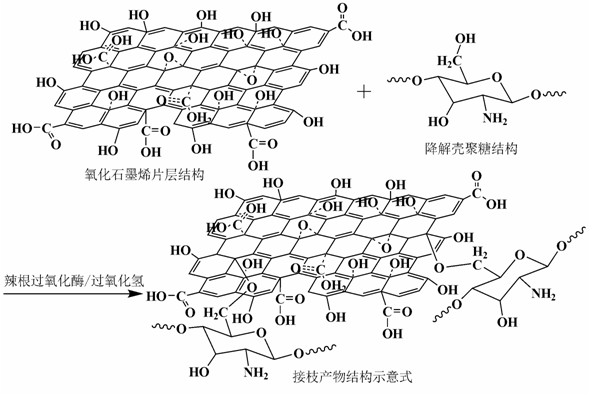
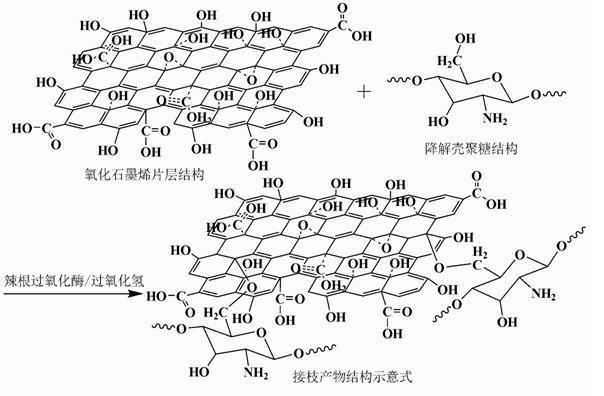
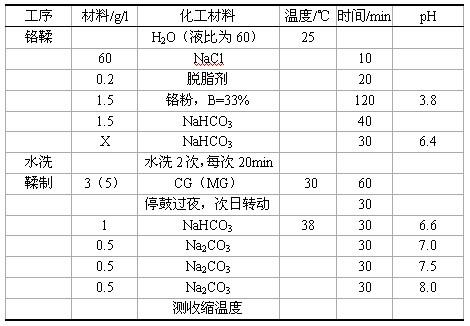
Examples
Embodiment 1
[0031] Step 1: Preparation of graphene oxide suspension:
[0032] Mix and stir 10 parts by weight of graphite powder, 2 parts by weight of sodium nitrate and 80 parts by weight of concentrated sulfuric acid and slowly add 19 parts by weight of potassium permanganate. The temperature of this process is 5°C; then heat up to 45°C for water bath reaction 60min, after gradually adding 360 parts by weight of deionized water, the temperature was raised to 58°C to continue the reaction for 4h; then 24 parts by weight of hydrogen peroxide solution with a mass fraction of 30% was added dropwise, washed 5 times to make 1000 parts by weight of Suspension, after ultrasonic treatment for 30min, set aside;
[0033] Step 2: Preparation of degraded chitosan solution:
[0034] Mix 20 parts by weight of chitosan with 100 parts of deionized water and 0.1 part of high-temperature α-amylase in the reactor and heat it to 80°C for degradation, and measure its viscosity at 80°C with NDJ-5S digital ro...
Embodiment 2
[0038] Step 1: Preparation of graphene oxide suspension:
[0039] Mix and stir 10 parts by weight of graphite powder, 2 parts by weight of sodium nitrate and 80 parts by weight of concentrated sulfuric acid and slowly add 19 parts by weight of potassium permanganate. The temperature of this process is 15°C; then heat up to 45°C for water bath reaction 60min, after gradually adding 360 parts by weight of deionized water, the temperature was raised to 58°C to continue the reaction for 4h; then 24 parts by weight of hydrogen peroxide solution with a mass fraction of 30% was added dropwise, washed 5 times to make 1000 parts by weight of Suspension, after ultrasonic treatment for 30min, set aside;
[0040] Step 2: Preparation of degraded chitosan solution:
[0041] Mix 25 parts by weight of chitosan, 125 parts of deionized water, and 0.3 parts of high-temperature α-amylase in a reactor and heat it to 90°C for degradation, and measure its viscosity with a NDJ-5S digital rotational ...
Embodiment 3
[0045] Step 1: Preparation of graphene oxide suspension:
[0046]Mix and stir 10 parts by weight of graphite powder, 2 parts by weight of sodium nitrate and 80 parts by weight of concentrated sulfuric acid and slowly add 19 parts by weight of potassium permanganate. The temperature of this process is 25°C; then heat up to 45°C for water bath reaction 60min, after gradually adding 360 parts by weight of deionized water, the temperature was raised to 58°C to continue the reaction for 4 hours; then 24 parts by weight of hydrogen peroxide solution with a mass fraction of 30% was added dropwise, washed 5 times to make 1000 parts by weight of Suspension, after ultrasonic treatment for 30min, set aside;
[0047] Step 2: Preparation of degraded chitosan solution:
[0048] Mix 30 parts by weight of chitosan, 150 parts of deionized water, and 0.3 parts of high-temperature α-amylase in a reactor and heat it to 85°C for degradation, and measure its viscosity at 80°C with an NDJ-5S digita...
PUM
| Property | Measurement | Unit |
|---|---|---|
| particle size | aaaaa | aaaaa |
| temperature | aaaaa | aaaaa |
| viscosity | aaaaa | aaaaa |
Abstract
Description
Claims
Application Information
 Login to View More