
Primer and method for identifying low phytic acid rice mutant zju-lpa2 filial generation genetypes
A low phytic acid gene and genotype technology, applied in the field of agricultural bioengineering, can solve the problems of low efficiency, long breeding cycle and high cost, and achieve the effect of improving selection efficiency and speeding up the breeding process
- Summary
- Abstract
- Description
- Claims
- Application Information
AI Technical Summary
Problems solved by technology
Method used
Image

Examples
Embodiment Construction
[0038] 1. Primer design
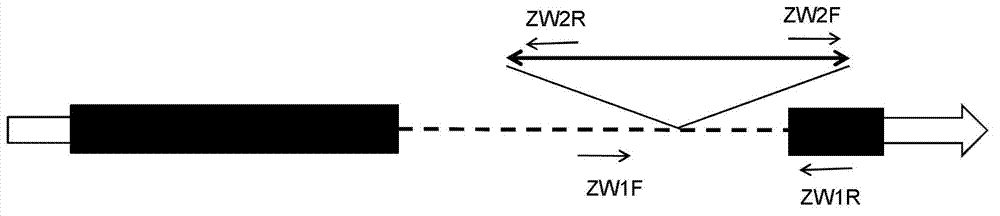
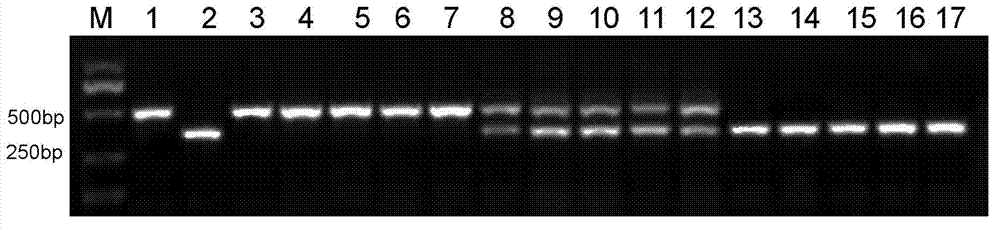
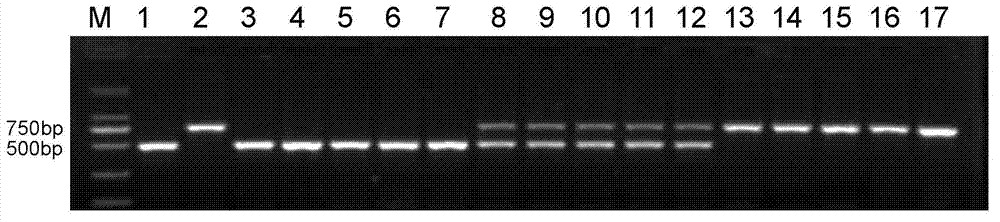
[0039] Rice low phytic acid mutant zju-lpa2 is produced by 137 The japonica rice variety XS110 was obtained by Cs-γ-ray mutagenesis treatment, the phytic acid content decreased by 64%, and the inorganic phosphorus content increased by 5.6 times. Nuclear gene control, localized on the short arm of rice chromosome 3 (Liu, Q.L., Xu, X.H., Ren, X.L., Fu, H.W., Wu, D.X., and Shu, Q.Y. 2007.Generation and characterization of low phytic acid germplasm in rice (Oryza sativa L.). Theoretical and Applied Genetics 114(5): 803-814.). Further research results showed that the low phytic acid content trait of zju-lpa2 was controlled by the MIK allelic mutant gene ZJU-LPA2, and a 6.2 kb retrotransposon was inserted in the intron, which was found in TIGRV7.0 (http: / / rice .plantbiology.msu.edu / ) to download the corresponding nucleotide sequences, and compare and analyze the sequences. Use Primer Premier 5.0 (www.premierbiosoft.com) software to design corresponding p...
PUM
 Login to View More
 Abstract
Description
Claims
Application Information
 Login to View More