Method for enhancing weather resistance of surface of organic material
A technology of organic materials and weather resistance, which is applied in the field of composite coatings, can solve the problems of reducing weather resistance and weakening the protective effect of surface photocatalytic film, and achieves the effect of simple method, good effect and good weather resistance
- Summary
- Abstract
- Description
- Claims
- Application Information
AI Technical Summary
Problems solved by technology
Method used
Image



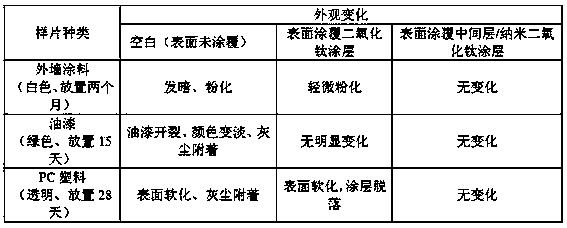
Examples
preparation example Construction
[0015] 1. The preparation of coatings, including the preparation of organic-inorganic hybrid intermediate layer and pure titanium dioxide coating.
[0016] (1) At room temperature, use a small amount of glacial acetic acid as a catalyst in a reaction vessel, add the two raw materials at a volume ratio of ethanol: ethyl orthosilicate = 2-13: 60-100, and stir evenly. After reacting for about 3-6 hours, slowly add γ-aminopropyltriethoxysilane according to the volume ratio of ethanol:γ-aminopropyltriethoxysilane=2-13:1-4, After the solution is fully mixed, it is continuously stirred for about 3-10 hours to fully hydrolyze the raw materials, and the sol is aged for about 12-36 hours.
[0017] (2) Preparation of pure titanium dioxide coating: hydrolyze titanium alkoxide (such as tetraisopropyl titanate, tetrabutyl titanate) under the condition of acidic pH7 to obtain a uniform and transparent sol, The titanium dioxide coating is prepared by adjusting the pH value of the sol to 1-5 ...
Embodiment 1
[0021] Embodiment 1: the preparation of pure titanium dioxide coating
[0022] Under the condition of acidic pH<5, tetraisopropyl titanate was hydrolyzed to obtain a uniform and transparent sol, and the pH value of the sol was adjusted to 3.5 by dialysis to prepare a titanium dioxide coating.
Embodiment 2
[0023] Embodiment 2: Preparation of organic-inorganic hybrid intermediate layer
[0024] At room temperature, add 50mL ethanol, 500mL tetraethyl orthosilicate (TEOS) and 5mL catalyst glacial acetic acid to the beaker successively, and stir evenly. After the water generated by the esterification reaction of ethanol and glacial acetic acid promotes the initial hydrolysis of TEOS for about 5 hours, then slowly add 50mL of γaminopropyltriethoxysilane, and after the solution is fully mixed, keep stirring for about 5 hours to fully hydrolyze the raw materials. Then the stirring was stopped, and the sol was aged for about 24 h.
PUM
 Login to View More
 Abstract
Description
Claims
Application Information
 Login to View More