
A producing process for preparing cerium oxide polishing powder
A production process and cerium oxide technology are applied in the production process field of preparing cerium oxide polishing powder, which can solve the problems of high cost of raw materials, waste of energy resources, short service life, etc. quick effect
Patent Information
- Authority / Receiving Office
- CN · China
- Current Assignee / Owner
- Publication Date
- 2015-01-07
- Estimated Expiration
- Not applicable · inactive patent
Smart Images
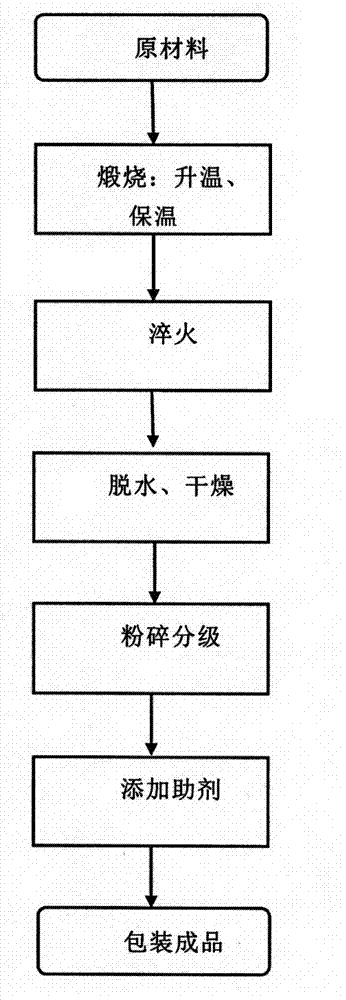
Figure 1
Abstract
Description
technical field
[0001] The invention relates to the technical field of chemical production, in particular to a production process for preparing cerium oxide polishing powder. Background technique
[0002] The application fields of rare earth polishing materials are constantly changing, from traditional TV picture tube glass bulb polishing, rhinestone polishing, etc. to high-performance polishing fields such as liquid crystal display more precise optical instruments and devices. From the perspective of development trend, the field of liquid crystal display and high-grade optical glass processing is the development direction of the application of rare earth polishing materials. High-grade polishing powder has high added value and high profit, and is closely related to the high-tech field with rapid development, so it has broad application prospects. At present, the development and production of high-performance rare earth polishing materials are mainly concentrated in Japan,...
Examples
Embodiment 1
[0038] With a purity of 99.95%, a particle size of 8-20μm, and a bulk density of 1.00-1.40g / cm 3 Cerium oxide is used as the raw material. After 120 minutes in the kiln, it is raised to 650°C and held for 80 minutes; then after 90 minutes, it is raised to 950°C and held for 150 minutes; the cerium oxide is quickly poured into cooling water at a temperature of 25°C, and it takes 0.5 min, complete quenching and calcination; dehydration and drying until the moisture content is less than 0.1%; crushing and grading to control the particle size from 2.4 μm to 2.6 μm; adding 0.4% polyethylene glycol 2000 by weight of polishing powder as a dispersant; packaging the finished product.
Embodiment 2
[0040] Using cerium carbonate with a purity of 99.95% as the raw material, heat it up to 650°C in the kiln for 180 minutes, and keep it for 120 minutes; In water, it took 0.5min to complete quenching and calcination; dehydration and drying until the moisture content was less than 0.1%; crushing and grading to control the particle size of 2.4μm-2.6μm; adding 0.5% of the weight of polishing powder polyethylene glycol 2000 as a dispersant; packaging the finished product.
Embodiment 3
[0042] Using cerium oxalate with a purity of 99.95% as the raw material, heat it to 650°C in the kiln for 110 minutes, and keep it for 90 minutes; In water, it took 0.5min to complete quenching and calcination; dehydration and drying until the moisture content was less than 0.1%; crushing and grading to control the particle size of 2.4μm-2.6μm; adding 0.7% of the weight of polishing powder polyethylene glycol 2000 as a dispersant; packaging the finished product.