
Monofluoroalkyl-containing compound and its preparation method and use
A monofluoroalkyl and compound technology, which is applied in the preparation of carbon-based compounds, the preparation of organic compounds, and steroid compounds, etc., can solve the problems of unsuitability for industrial production, long reaction steps, and low reaction conversion rate.
- Summary
- Abstract
- Description
- Claims
- Application Information
AI Technical Summary
Problems solved by technology
Method used
Image

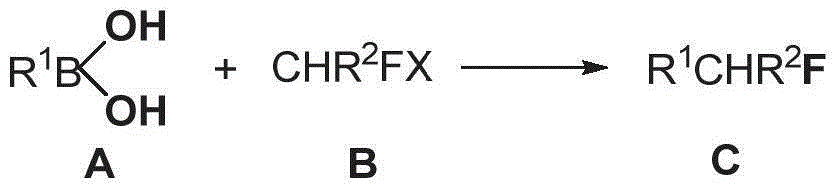
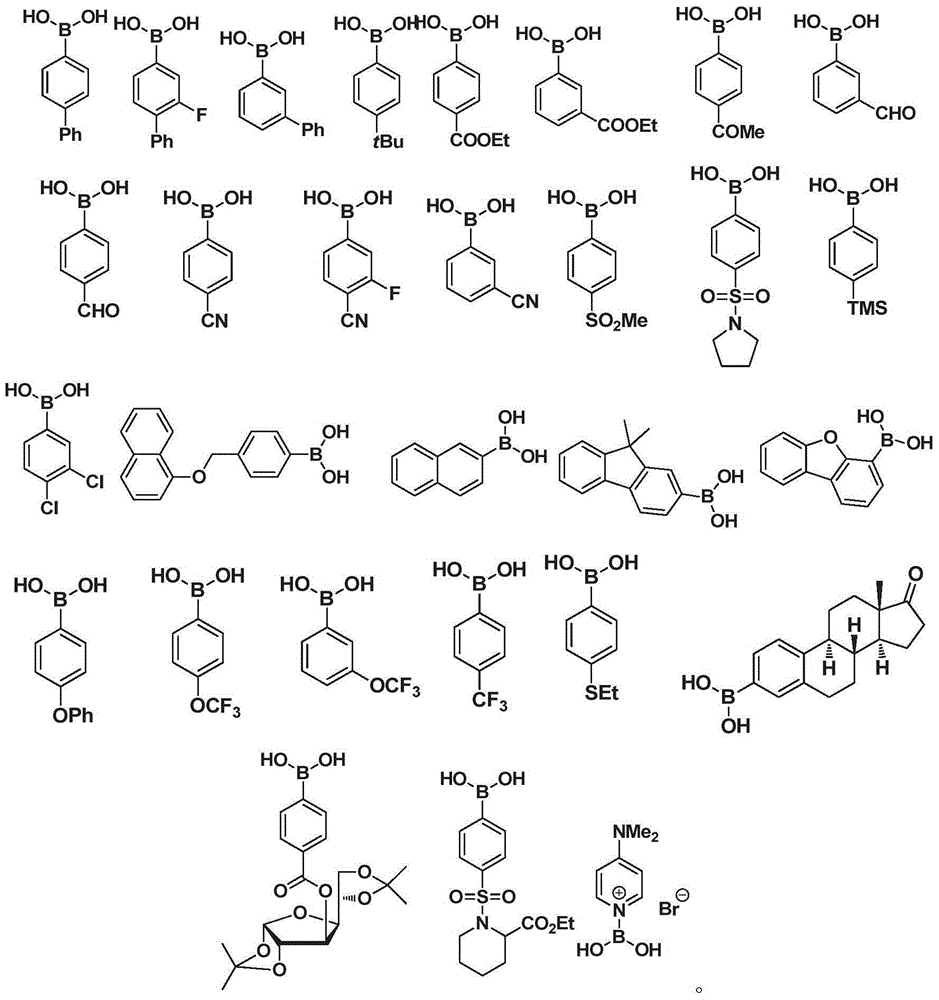

Examples
Embodiment 1
[0055]
[0056] In a 25mL reaction tube, add 178mg (0.9mmol) 4-biphenylboronic acid, 6.6mg (5mol%, mol% refers to NiCl 2 The percentage of DME and the molar weight of compound B) NiCl 2 DME (Nickel Dimethyl Ethylene Ether Chloride), 5.4mg (5mol%, mol% refers to the percentage of phen and compound B molar weight) phen (1,10'-phenanthroline), 7.4mg (5mol %, mol% refers to the percentage of DMAP and compound B molar weight) DMAP (4-dimethylaminopyridine), 166mg (1.2mmol) K 2 CO 3 , 2mL ethylene glycol dimethyl ether, 1.7mL 1,4-dioxane, inject 300uL CH 2 The 1,4-dioxane solution of FBr (concentration: 2M, 0.6mmol), after stirring at 70°C for 24 hours, the isolated yield was 90%, and the purity was greater than 95% as identified by hydrogen spectroscopy. 1 H NMR (400MHz, CDCl 3 )δ7.61-7.69(m, 4H), 7.45-7.52(m, 4H), 7.40(t, J=7.3Hz, 1H), 5.45(d, J=47.9Hz, 2H). 13 C NMR (100MHz, CDCl 3 )δ141.7(d, J=3.2Hz), 140.6(d, J=1.1Hz), 135.1(d, J=17.1Hz), 128.8, 128.0(d, J=5.7Hz), 127....
Embodiment 2
[0058]
[0059] To a 25mL reaction tube, add 195mg (0.9mmol) 2-fluorobiphenyl-4-boronic acid, 6.6mg (5mol%, mol% refers to NiCl 2 The percentage of DME and the molar weight of compound B) NiCl 2 DME (Nickel Dimethyl Ethylene Ether Chloride), 5.4mg (5mol%, mol% refers to the percentage of phen and compound B molar weight) phen (1,10'-phenanthroline), 7.4mg (5mol %, mol% refers to the percentage of DMAP and compound B molar weight) DMAP (4-dimethylaminopyridine), 166mg (1.2mmol) K 2 CO 3 , 2mL ethylene glycol dimethyl ether, 1.7mL 1,4-dioxane, inject 300uL CH 2 The 1,4-dioxane solution of FBr (concentration: 2M, 0.6mmol) was stirred at 70°C for 24 hours, the isolated yield was 83%, and the purity was greater than 95% as identified by hydrogen spectroscopy. 1 H NMR (400MHz, CDCl 3 )δ7.58-7.53 (m, 2H), 7.50-7.44 (m, 3H), 7.43-7.37 (m, 1H), 7.24-7.17 (m, 2H), 5.42 (d, J=47.5Hz, 1H) . 13 C NMR (125.7MHz, CDCl 3 )δ159.7 (d, J=249.0Hz), 137.5 (dd, J=17.6, 7.7Hz), 135.3, 131....
Embodiment 3
[0061]
[0062] In a 25mL reaction tube, add 178mg (0.9mmol) 3-biphenylboronic acid, 13.2mg (10mol%, mol% refers to NiCl 2 The percentage of DME and the molar weight of compound B) NiCl 2 DME (nickel chloride dimethylethylene ether), 10.8mg (10mol%, mol% refers to the percentage of phen and compound B molar weight) phen (1,10'-phenanthroline), 14.4mg (10mol %, mol% refers to the percentage of DMAP and compound B molar weight) DMAP (4-dimethylaminopyridine), 166mg (1.2mmol) K 2 CO 3 , 2mL ethylene glycol dimethyl ether, 1.7mL 1,4-dioxane, inject 300uL CH 2 The 1,4-dioxane solution of FBr (concentration: 2M, 0.6mmol), after stirring at 70°C for 24 hours, the isolated yield was 90%, and the purity was greater than 95% as identified by hydrogen spectroscopy. 1 H NMR (400MHz, CDCl 3 )δ7.67-7.60(m, 4H), 7.54-7.46(m, 3H), 7.44-7.38(m, 2H), 5.48(d, J=47.8Hz, 2H). 13 C NMR (125.7MHz, CDCl 3 )δ141.6 (d, J=1.3Hz), 140.7, 136.7 (d, J=17.1Hz), 129.0 (d, J=1.1Hz), 128.8, 127.56, 12...
PUM
 Login to View More
 Abstract
Description
Claims
Application Information
 Login to View More