Antistatic bacteriostatic acrylic fiber shell fabric
An antistatic and acrylic technology, which is applied in the field of garment processing, can solve problems such as hard texture, and achieve the effect of improving grade, high softness and good stability
- Summary
- Abstract
- Description
- Claims
- Application Information
AI Technical Summary
Problems solved by technology
Method used
Image

Examples
Embodiment 1
[0016] An antistatic antibacterial acrylic fabric, comprising preparation of antistatic suspension, preparation of spinning solution, preparation of antistatic acrylic fiber, preparation of base fabric, post-finishing, and drying treatment. The specific operation steps are:
[0017] 1) Preparation of antistatic suspension: Add AZO powder and 1wt% dispersant to form AZO aqueous suspension with a mass fraction of 20%, and ball mill for 4 hours to obtain an antistatic suspension. The particle size of AZO in the antistatic suspension is The distribution is mainly concentrated at 160~180nm. The dispersant is polyacrylamide and lignosulfonate, and its mass ratio is 2:0.5. The dispersant can combine with the hydroxyl groups on the surface of nano-AZO particles, and when it is adsorbed on the surface of polymer particles, The repulsion between particles is increased, which can effectively stabilize the dispersion. The dissociated small ions change the ionic strength of the dispersion m...
Embodiment 2
[0024] An antistatic antibacterial acrylic fabric, comprising preparation of antistatic suspension, preparation of spinning solution, preparation of antistatic acrylic fiber, preparation of base fabric, post-finishing, and drying treatment. The specific operation steps are:
[0025]1) Preparation of antistatic suspension: Add AZO powder and 1wt% dispersant to form AZO aqueous suspension with a mass fraction of 22%, and ball mill for 5 hours to obtain an antistatic suspension. The particle size of AZO in the antistatic suspension is The distribution is mainly concentrated at 160~180nm. The dispersant is polyacrylamide and lignosulfonate, and its mass ratio is 1~2:0.5~1. The dispersant can combine with the hydroxyl group on the surface of nano-AZO particles and be adsorbed on the polymer When on the surface of the particles, the repulsion between the particles is increased, which can effectively stabilize the dispersion. The dissociated small ions change the ionic strength of the...
Embodiment 3
[0032] Antistatic and antibacterial performance test:
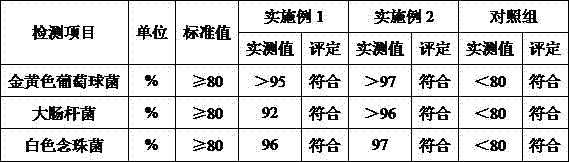
[0033] The fabrics of Example 1 and Example 2 were set as the test group, and the acrylic fabrics without any treatment were set as the control group, and the antistatic test and the antibacterial test were carried out respectively. The antistatic test results are shown in Table 1, and the results show that the antistatic properties of the fabrics of the present invention meet the requirements of national regulations. As shown in the antibacterial test result 2, the result shows that the antibacterial property of the fabric of the present invention meets the requirements stipulated by the state.
[0034] Table 1: Antistatic performance test results
[0035]
Volume resistivity (Ω·cm)
Example 1
10 8
Example 1
10 8
control group
10 14
[0036] Table 2 Antibacterial test results
[0037]
[0038] Conventional operations in the operation steps of the present invention ar...
PUM
 Login to View More
 Abstract
Description
Claims
Application Information
 Login to View More
 - R&D
- Intellectual Property
- Life Sciences
- Materials
- Tech Scout
- Unparalleled Data Quality
- Higher Quality Content
- 60% Fewer Hallucinations
Browse by: Latest US Patents, China's latest patents, Technical Efficacy Thesaurus, Application Domain, Technology Topic, Popular Technical Reports.
© 2025 PatSnap. All rights reserved.Legal|Privacy policy|Modern Slavery Act Transparency Statement|Sitemap|About US| Contact US: help@patsnap.com