
Catalytic cracking catalyst and preparation method thereof
A catalytic cracking and catalyst technology, applied in catalytic cracking, physical/chemical process catalysts, molecular sieve catalysts, etc., can solve the problem of low selectivity of propylene
- Summary
- Abstract
- Description
- Claims
- Application Information
AI Technical Summary
Problems solved by technology
Method used
Image

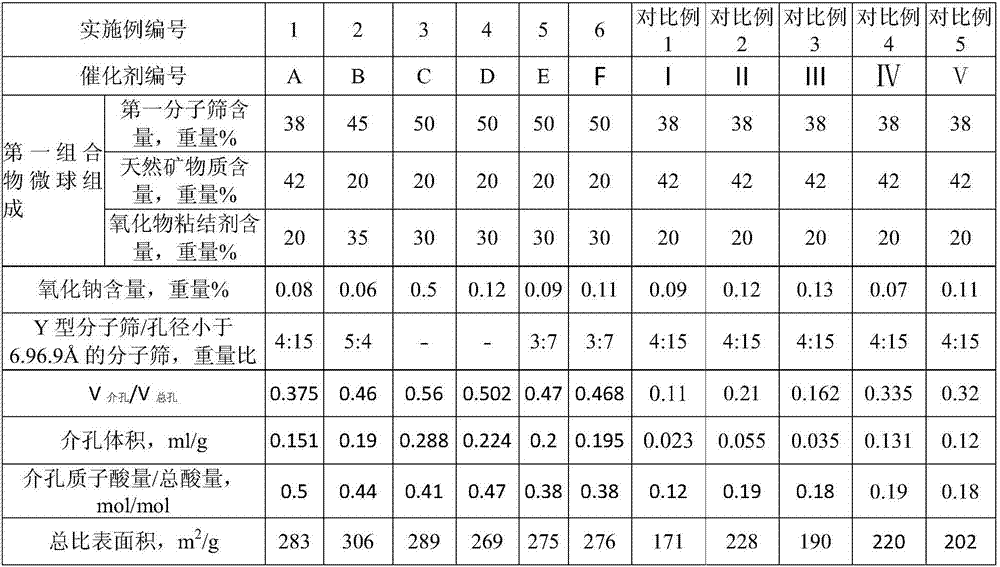
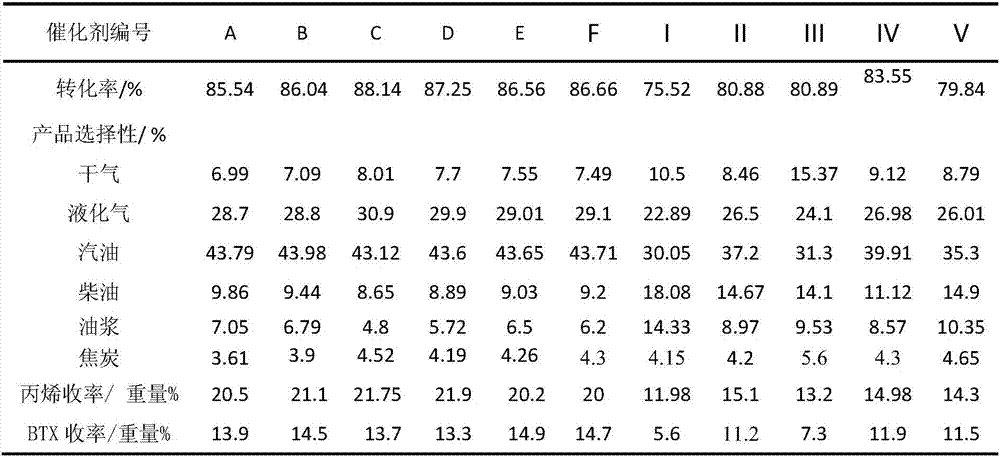
Examples
preparation example Construction
[0046] The preparation method of the catalytic cracking catalyst provided by the present invention includes mixing and beating natural minerals, the first molecular sieve, an oxide binder such as oxide sol and / or oxide gel, and water. The amount of each component is such that the final catalyst contains, based on the total weight of the catalyst, 5% to 65% by weight of natural minerals, 10% to 60% by weight of oxides and 24% to 75% by weight of the second A molecular sieve. More preferably, the amount of each component is such that the composition of the final catalyst includes: the natural mineral content is 5% to 50% by weight on a dry basis, such as 8 to 45% by weight, and the content of the first molecular sieve on a dry basis 30% to 65% by weight, such as 30 to 55% by weight, the content of the oxide binder in terms of oxides is 15 to 55% by weight, such as 25 to 50% by weight or 15 to 45% by weight or 20 to 35% by weight % or 12% to 28% by weight.
[0047] The preparat...
Embodiment 1
[0068] 267g aluminum sol was mixed with 168g kaolin, and it was formulated with decationized water into a slurry with a solid content of 31% by weight. After stirring for 0.5 hours, the molecular sieve slurry containing 24gUSY, 45gβ molecular sieve and 45g ferrierite was added to form a composition slurry ( solid content is 35% by weight), stirred evenly, and spray-dried to make composition microspheres, and then calcined the composition microspheres at 500° C. for 1 hour to obtain the first composition microspheres A1.
[0069] Take 200 g of the first composition microsphere A1 (dry basis mass, the same below) prepared above, add water and beat to obtain a slurry with a solid content of 10% by weight, add 11.4 g of high alkali sodium metaaluminate solution (Na 2 O is 290g / L, Al 2 o 3 40g / L, the solution density is 1.353g / mL), heated up to 50°C and stirred at constant temperature for 0.5h, filtered and washed to neutral (washing to neutral means that the washing solution afte...
Embodiment 2
[0071] Mix 411.8g silica sol with 80g montmorillonite, and use decationized water to prepare it into a slurry with a solid content of 30% by weight. After stirring for 2 hours, add the slurry formed by 75gREY molecular sieve and 60gZSM-5 molecular sieve and water, stir Uniform, form the first composition slurry (solid content is 35% by weight), spray-dry to make composition microspheres, then bake the composition microspheres at 350° C. for 2 hours to obtain the first composition microspheres B1.
[0072] Take 200 g of the first composition microsphere B1 (mass on a dry basis) prepared above, add water to prepare the first composition microsphere slurry with a solid content of 10% by weight, add 16 g of NaOH (purity 96%), heat up to 70° C. and stir at a constant temperature for 0.3 h, filter and wash to neutrality; the filter cake is beaten with water to obtain a slurry with a solid content of 10% by weight, add 16g oxalic acid in the stirring, then add 38g hydrochloric acid (H...
PUM
| Property | Measurement | Unit |
|---|---|---|
| Total specific surface area | aaaaa | aaaaa |
| Surface | aaaaa | aaaaa |
| Mesopore volume | aaaaa | aaaaa |
Abstract
Description
Claims
Application Information
 Login to View More