
PLA-PBSA blown film and preparation method thereof
A technology of film and formulation, applied in the field of PLA biodegradable film and its preparation, can solve the problems of non-tear resistance flexibility, unstudied method of improving the tear strength of PLA film, affecting polylactic acid film, etc., to achieve good biological Compatibility, good bioabsorbability, and the effect of solving white pollution
Patent Information
- Authority / Receiving Office
- CN · China
- Patent Type
- Applications(China)
- Current Assignee / Owner
- Publication Date
- 2018-05-11
- Estimated Expiration
- Not applicable · inactive patent
Smart Images
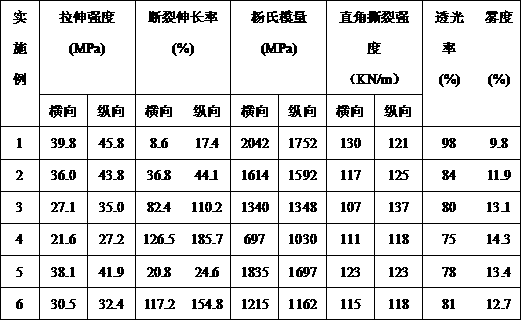
Figure 1
Abstract
Description
technical field
[0001] The invention belongs to the field of polymer materials, and relates to a PLA biodegradable film and a preparation method thereof. Background technique
[0002] Unlike traditional petroleum-based plastics, PLA is polymerized from lactic acid fermented from plant starch. This is a renewable resource and has biodegradable properties, which is of great significance to protecting the environment. In the increasingly tense situation of petroleum energy, the development and research of PLA resin is particularly important. The properties of PLA itself are similar to the general-purpose plastic polypropylene, such as high modulus, high tensile strength and good processability. However, the brittleness of PLA is serious, and the impact strength is less than 5 KJ / m 2 , seriously restricting its wide application.
[0003] PLA also has good processing performance and transparency, and can be applied to traditional extrusion, injection molding, blow molding and ...
Examples
Embodiment 1
[0027] Embodiment 1: the present invention provides a kind of PLA biodegradable film, and the composition of its formula and the proportioning of mass parts are:
[0028] PLA 80 copies;
[0029] 10 copies of PBSA;
[0030] 9 parts of plasticizer diethylene glycol monobutyl adipate;
[0031] 0.4 part of lubricant ethylene bis stearic acid amide;
[0032] Opening agent erucamide 0.4 parts;
[0033] Antioxidant 168 and 1010 blend 0.2 part by mass ratio 1:1.
[0034] Weigh PLA, PBSA, ethylene bisstearamide, erucamide, 168 and 1010 according to the above formula, mechanically blend each component for 5 minutes, add the mixed raw materials into a twin-screw extruder, and extrude Add the above-mentioned diethylene glycol monobutyl ether adipate quantitatively with a peristaltic pump to the side line of the extruder during the extrusion process. The conditions for extrusion and granulation are: the set temperature of the twin-screw extruder is: Zone 1: 140 o C, District 2: 165 o...
Embodiment 2
[0035] Embodiment 2: each component is taken by following formula and quality:
[0036] 70 copies of PLA;
[0037] 20 copies of PBSA;
[0038] 9 parts of plasticizer diethylene glycol monobutyl adipate;
[0039] 0.4 part of lubricant ethylene bis stearic acid amide;
[0040] Opening agent erucamide 0.5 parts;
[0041] Antioxidant 168 and 1010 blend 0.1 part by mass ratio 1:1.
[0042] This step of extrusion granulation and film blowing process is the same as that of Example 1, the thickness of the film is controlled at 0.04mm, and the mechanical properties and light transmittance of the film are tested. The test results are listed in Table 1.
Embodiment 3
[0043] Embodiment 3: each component is taken by following formula and quality:
[0044] 60 copies of PLA;
[0045] 30 copies of PBSA;
[0046] 9 parts of plasticizer diethylene glycol monobutyl adipate;
[0047] 0.4 part of lubricant ethylene bis stearic acid amide;
[0048] Opening agent erucamide 0.5 part;
[0049] Antioxidant 168 and 1010 blend 0.1 part by mass ratio 1:1.
[0050] This step of extrusion granulation and film blowing process is the same as that of Example 1, the thickness of the film is controlled at 0.04mm, and the mechanical properties and light transmittance of the film are tested. The test results are listed in Table 1.