
A class of flame retardant containing melamine structure, preparation method and application thereof
A melamine and flame retardant technology, applied in the field of flame retardants, can solve the problems of slow application and development of flame retardants, complex synthesis process, low yield, etc., and achieve high use value, high reaction efficiency, and low preparation cost Effect
- Summary
- Abstract
- Description
- Claims
- Application Information
AI Technical Summary
Problems solved by technology
Method used
Image

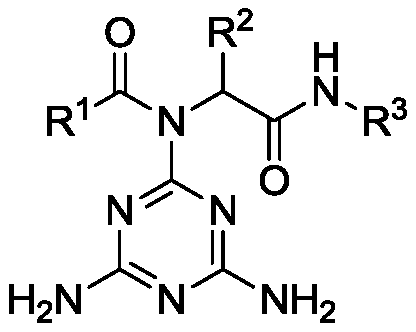
Examples
specific Embodiment approach
[0032] The present invention will be further described below in conjunction with the examples, but the protection scope of the present invention is not limited to the scope expressed in the examples.
[0033] Instruments and reagents:
[0034] The melting point was measured with an X4 melting point apparatus (produced by Beijing Third Optical Instrument Factory), and the thermometer was not calibrated; 1 H NMR and 13 C NMR is measured with Varian Mercury 400 type 400MHz nuclear magnetic resonance instrument or Varian Mercury 600 type 600MHz nuclear magnetic resonance instrument, deuterated chloroform (CDCl 3 ) or deuterated dimethyl sulfoxide (DMSO-d 6 ) as the solvent and TMS as the internal standard; MS was determined using a FinniganTrace mass spectrometer; elemental analysis was determined using a Vario EL III elemental analyzer; the reagents used were domestic (or imported) chemically pure or analytically pure. Solvents methanol and isopropanol were dried.
Embodiment 1
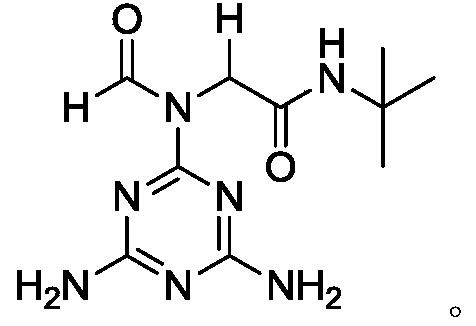
[0036] A method for preparing N-(tert-butyl)-2-(N-(4,6-diamino-1,3,5-triazin-2-yl)formamido)acetamide flame retardant, comprising the following experimental steps:
[0037] Under nitrogen protection, compound melamine 1 (0.378g, 3mmol, 3.0eqv.), formic acid 2a (0.046g, 1.0mmol, 1.0eqv.), formaldehyde 3a (0.030g, 1.0mmol, 1.0eqv.) were added to the reactor successively. ), tert-butylisonitrile 4a (0.091g, 1.1mmol, 1.1eqv.), MeOH:i-PrOH=2:1 (10ml), heated to 50°C and stirred for 30 minutes to dissolve it. After dissolving, add the copper complex (0.025g) supported by the catalyst MCM-41, MIL-101 (0.025g) and p-toluenesulfonic acid (0.017g) and continue to stir while the temperature drops to 40°C. After continuing the reaction for 24h, TLC After the detection reaction was completed, the solvents methanol and ethanol were removed under reduced pressure, and the residue was filtered, extracted and column chromatographed to obtain the target flame retardant Ia with a yield of 57.01%...
Embodiment 2
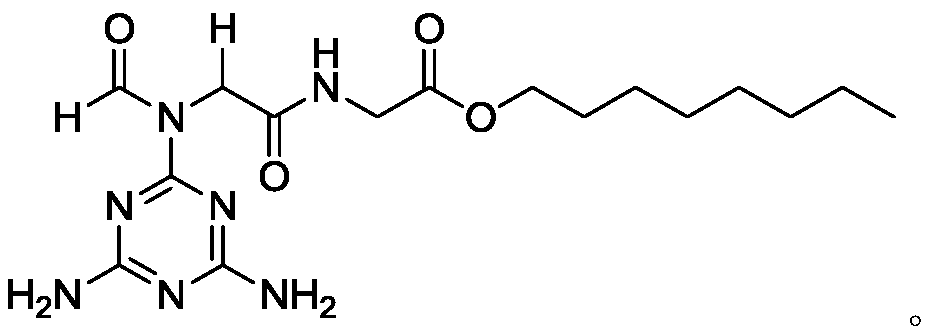
[0045] A method for preparing octyl 2-(2-(N-(4,6-diamino-1,3,5-triazin-2-yl)formamido)acetamido)acetate flame retardant, comprising the following experimental steps:
[0046]Under the protection of nitrogen, compound melamine 1 (0.378g, 3mmol, 3.0eqv.), formic acid 2a (0.046g, 1.0mmol, 1.0eqv.), formaldehyde 3a (0.030g, 1.0mmol, 1.0eqv.) were added to the reactor successively. ), n-octyl acetate isonitrile 4b (0.22 g, 1.1 mmol, 1.1 eqv.), MeOH:i-PrOH=2:1 (10 ml), heated to 50°C and stirred for 30 minutes to dissolve it. After dissolving, add the copper complex (0.025g) supported by the catalyst MCM-41, MIL-101 (0.025g) and p-toluenesulfonic acid (0.017g) and continue stirring while the temperature drops to 40°C. After continuing the reaction for 24h, TLC After the detection reaction was completed, the solvents methanol and ethanol were removed under reduced pressure, and the residue was filtered, extracted and column chromatographed to obtain the target flame retardant Ia with...
PUM
 Login to View More
 Abstract
Description
Claims
Application Information
 Login to View More