
Method for preparing diethylstilbestrol molecularly imprinted electrochemical sensor based on electropolymerization of p-aminothiophenol film and application thereof
A technology of mercaptoaniline membrane and diethylstilbestrol, which is applied in scientific instruments, material analysis through electromagnetic means, instruments, etc., to achieve the effects of short time consumption, good stability and fast response
- Summary
- Abstract
- Description
- Claims
- Application Information
AI Technical Summary
Problems solved by technology
Method used
Image

Examples
Embodiment 1
[0055] Example 1 A preparation method of diethylstilbestrol molecularly imprinted electrochemical sensor
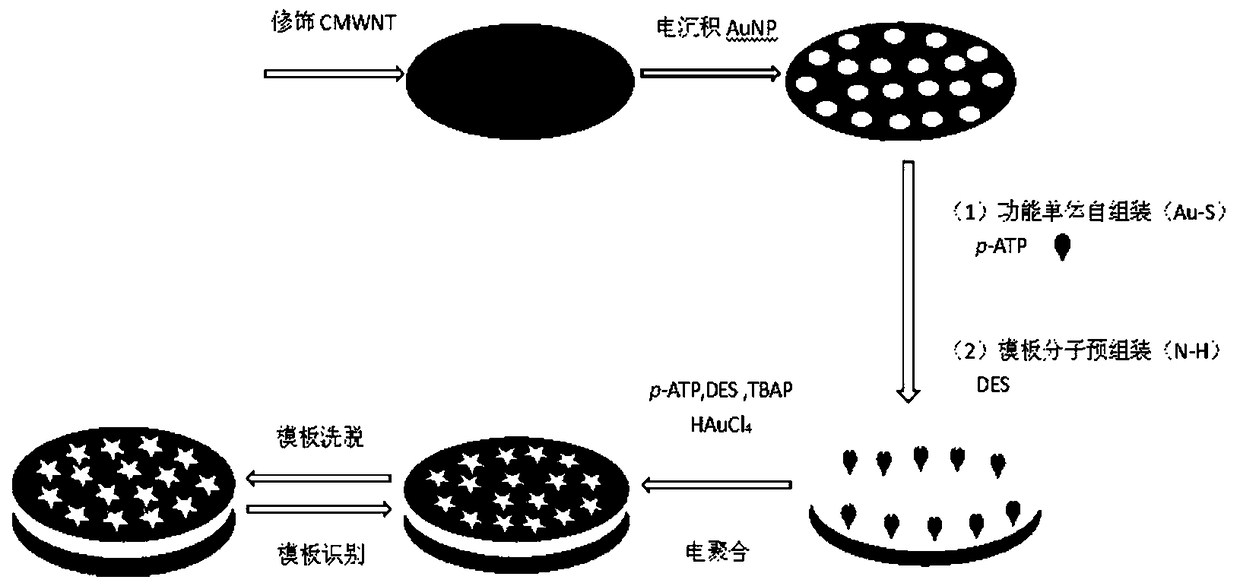
[0056] A preparation method of diethylstilbestrol molecularly imprinted electrochemical sensor in this embodiment, such as figure 1 As shown, follow the steps in sequence as follows:
[0057] (11) Glassy carbon electrode pretreatment
[0058] The glassy carbon electrodes were sequentially coated with 0.5 μm, 0.3 μm, 0.05 μm Al 2 o 3 The powder was polished on suede, rinsed with ultrapure water and ultrasonically washed in absolute ethanol and ultrapure water, and then the electrode was placed in 0.5mol / L H 2 SO 4 In solution, cycle scan;
[0059] After taking out the electrode and rinsing, place it in the electroactive probe solution, wherein the electroactive probe is potassium ferricyanide / potassium ferrocyanide, and the electroactive probe solution is 5mmol / L potassium ferricyanide / ferrocyanide Potassium and 1mol / L potassium chloride solution are prepared accordi...
Embodiment 2-6
[0074] Example 2-6 Preparation method of diethylstilbestrol molecularly imprinted electrochemical sensor
[0075] This example is a preparation method of a diethylstilbestrol molecularly imprinted electrochemical sensor. The preparation steps and technical parameters are the same as those in Example 1. The only difference is that the corresponding technical parameters in the preparation process are different. The specific results are shown in Table 1.
[0076] Table 1 Technical parameter list of the preparation process
[0077]
[0078] The potential intervals of the cyclic scanning in step (x1) (x=2-6) and step (x2) (x=2-6) in the above-mentioned embodiment 2-6 are both -0.3~1.2V; wherein the multi-walled carbon nanotube The method and dosage of modifying the electrode with gold nanoparticles are the same as in Example 1.
[0079] The sensor prepared in Examples 2-6 has strong selectivity, good stability, high sensitivity, low cost, fast response, simple preparation steps...
Embodiment 7
[0080] Example 7 Carboxylated multi-walled carbon nanotube modification condition selection experiment
[0081] In order to achieve the best modification effect of multi-walled carbon nanotubes, this embodiment studies the dosages of multi-walled carbon nanotube dispersing agents and modifiers. Among them, the reagent DMF with good dispersion effect on MWCNTs was combined with chitosan with good cross-linking effect, and the MWCNTs-DMF dispersion liquid was mixed with CS-1%CH 3 Equal volumes of the COOH solution were mixed to obtain the CMWCNTs modifier, and an appropriate amount of the CMWCNTs modifier was drip-coated on the electrode surface, and the CMWCNTs could be evenly distributed.
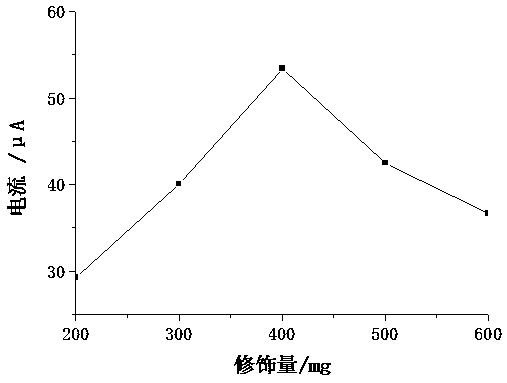
[0082]In order to enable the CMWCNTs modifier to adhere stably to the surface of glassy carbon without affecting the catalytic effect of CMWCNTs, this example uses CS-1%CH 3 The concentration of CS in COOH solution was studied. Such as figure 2 Shown, respectively compared 200mg, 300mg,...
PUM
 Login to View More
 Abstract
Description
Claims
Application Information
 Login to View More