

Inhibitor-resistant saccharomyces cerevisiae and selective culture method and application thereof
A technology of Saccharomyces cerevisiae and Saccharomyces cerevisiae is applied in the field of Saccharomyces cerevisiae to achieve the effects of improving utilization rate and short fermentation time
- Summary
- Abstract
- Description
- Claims
- Application Information
AI Technical Summary
Problems solved by technology
Method used
Image

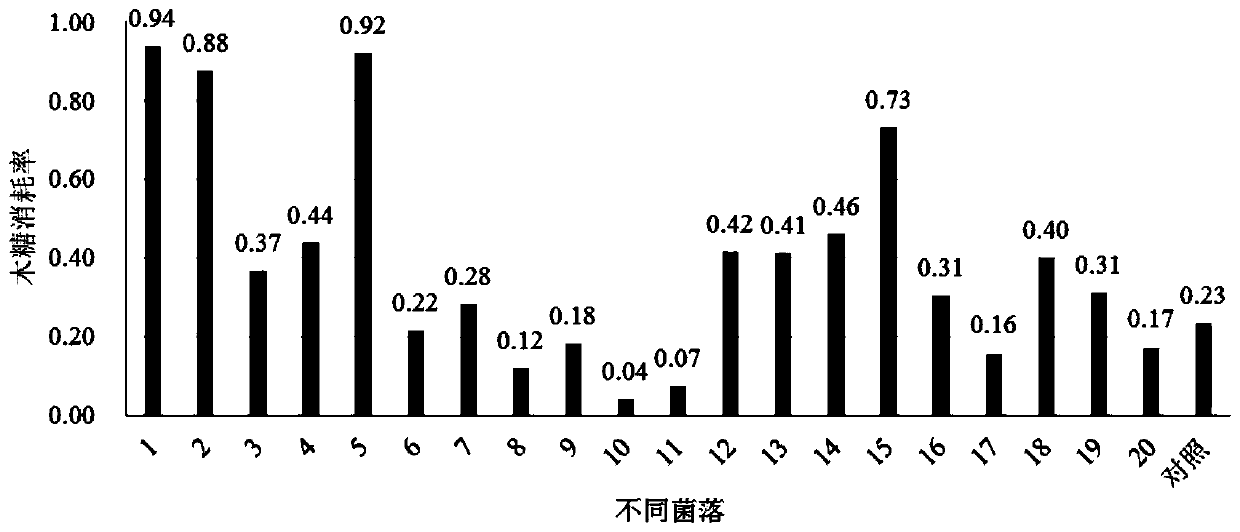
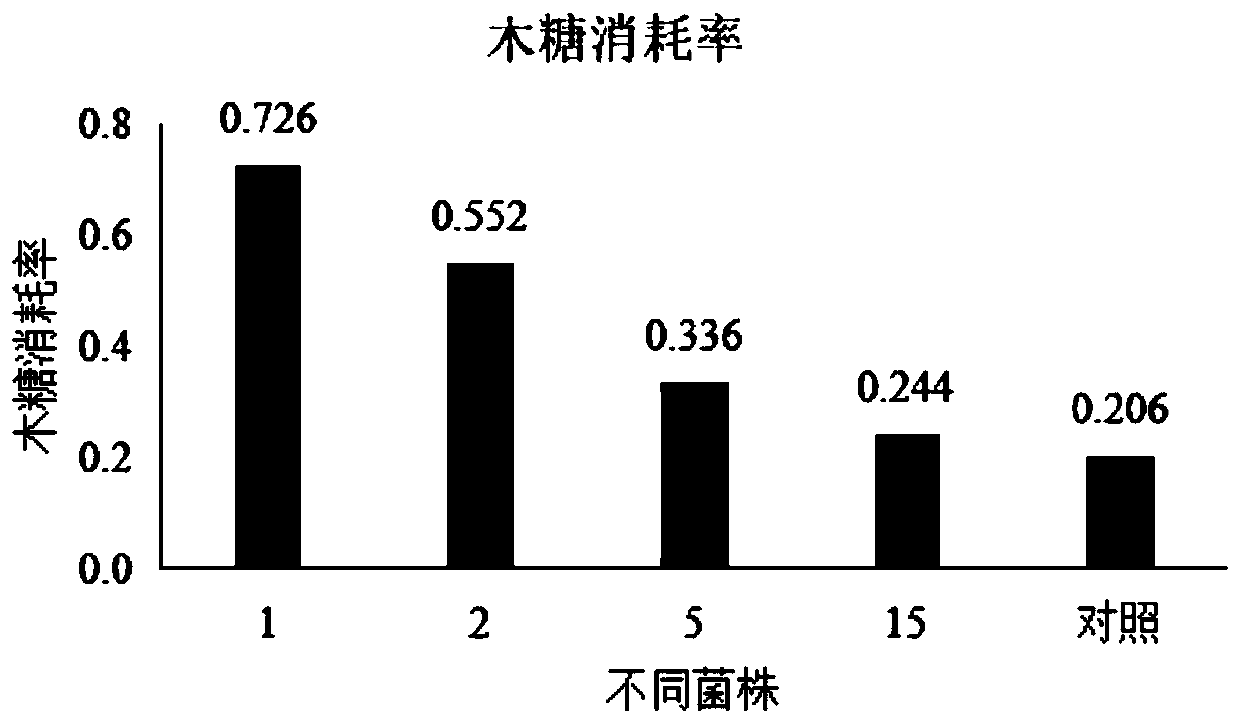
Examples
Embodiment 1
[0042] An inhibitor-resistant Saccharomyces cerevisiae, named ZR / SC-UV-2, classified as: Saccharomyces cerevisiae, was preserved in the General Microbiology Center of China Microbiological Culture Collection Management Committee on June 13, 2019 , the deposit number is: CGMCC No.17924, and the deposit address is: No. 3, Yard No. 1, Beichen West Road, Chaoyang District, Beijing.
[0043] The inhibitors include one or more of weak acid substances, furan substances or phenol substances. The weak acid substances include formic acid, acetic acid, levulinic acid and the like. The furan substances include furfural, 5-hydroxymethylfurfural and the like. The phenolic substances include syringaldehyde, vanillin and phenol.
[0044] The Saccharomyces cerevisiae resistant to inhibitors in this example is the Saccharomyces cerevisiae strains capable of utilizing xylose as the starting strain, and the Saccharomyces cerevisiae resistant to inhibitors was obtained through ultraviolet mutage...
Embodiment 2
[0060] In this example, the starting strain is strain ZR-1, and the classification of strain ZR-1 is named: Saccharomyces cerevisiae, which was deposited in the General Microorganism Center of China Committee for Microbial Culture Collection on July 08, 2019, with the accession number It is: CGMCC No.18090, and the deposit address is: No. 3, Yard No. 1, Beichen West Road, Chaoyang District, Beijing.
[0061] The present embodiment provides a kind of breeding method of Saccharomyces cerevisiae resistant to inhibitors, comprising the following steps:
[0062] 1. Preparation of medium or culture medium used in the breeding process
[0063] The YPD medium is a general-purpose medium, and its composition in mass percent is: 2% glucose, 2% peptone, 1% yeast extract, and the balance is water, with a pH of 4.8-5.0; an additional 2% is required for solid plates of agar.
[0064] The molar concentration of EDTA aqueous solution is 0.5mol / L;
[0065] Inhibitor plate medium includes th...
Embodiment 3
[0076] In this example, the starting strain is strain ZR-1, and the classification of strain ZR-1 is named: Saccharomyces cerevisiae, which was deposited in the General Microorganism Center of China Committee for Microbial Culture Collection on July 08, 2019, with the accession number It is: CGMCC No.18090, and the deposit address is: No. 3, Yard No. 1, Beichen West Road, Chaoyang District, Beijing.
[0077] The present embodiment provides a kind of breeding method of Saccharomyces cerevisiae resistant to inhibitors, comprising the following steps:
[0078] 1. Preparation of medium or culture medium used in the breeding process
[0079] The YPD medium is a general-purpose medium, and its composition in mass percent is: 2% glucose, 2% peptone, 1% yeast extract, and the balance is water, with a pH of 4.8-5.0; an additional 2% is required for solid plates of agar.
[0080] The molar concentration of EDTA aqueous solution is 0.5mol / L;
[0081] Inhibitor plate medium comprises the...
PUM
 Login to View More
 Abstract
Description
Claims
Application Information
 Login to View More