Photocatalyst composite material and preparation method thereof
A technology of composite materials and photocatalysts, applied in chemical instruments and methods, physical/chemical process catalysts, organic compounds/hydrides/coordination complex catalysts, etc., can solve problems, serious ecological and health and safety problems
- Summary
- Abstract
- Description
- Claims
- Application Information
AI Technical Summary
Problems solved by technology
Method used
Image



Examples
Embodiment 1
[0036] Example 1, Preparation of polymer beads. Include steps:
[0037] Preparation of polysulfone solution: Dissolve 10 g of polysulfone (PSF) in 100 mL of n-methyl-2-pyrrolidone (NMP) and stir vigorously at 60 ° C for 3 hours to obtain (10% w / v) homogeneous polysulfone solution;
[0038] Preparation of polysulfone-alginate solution: After the polysulfone solution was vigorously stirred for 24 hours, sodium alginate (Alg) and titanium dioxide (TiO 2 ) nanoparticles, stirred until a uniform polysulfone-alginate solution was obtained; the addition of Alg was 0%, 2%, 4%, 6%, 8% and 10% respectively; TiO 2 The amount of addition is 0%, 2%, 4%, 6%, 8%, 10% and 12% respectively;
[0039] Forming of the carrier: drop polysulfone-alginate solution to 4% (w / v) CaCl 2 The solution was made into beads and stirred gently for 24 hours to ensure complete phase inversion. The shape and size of the droplet are adjusted by conditions such as extrusion speed, nozzle size, and nozzle heigh...
Embodiment 2
[0045] Example 2, Analysis of Screening, Morphology and Characterization.
[0046] filter:
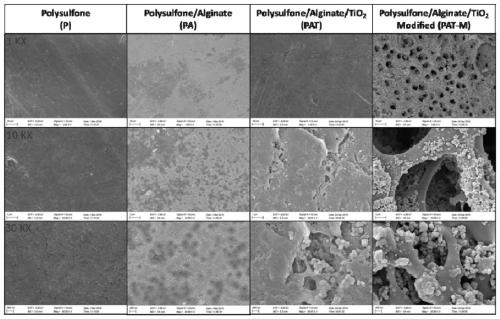
[0047] Get the beads prepared in Example 1, use SEM to analyze the beads form ( figure 1 ). Three different beads were prepared using needles of different sizes, which were spherical in shape with mean diameters of 1.0 mm, 3.0 mm, and 6.0 mm, respectively. The photodegradation rate was faster for smaller beads due to their larger specific surface area. However, the smallest bead size (1 mm) tended to clog valves and tubes more than other sizes; while the largest bead size (6 mm) was difficult to maintain in suspension, resulting in lower mass-to-weight ratio and adsorption capacity (data not shown) . Therefore, based on the better buoyancy characteristics, the ability to maintain suspension at low injection rates and better adsorption performance, the polymer beads with an average size of 3.0 mm were selected for further exploration.
[0048] form:
[0049] SEM analysis showed th...
Embodiment 3
[0053] Embodiment 3, adsorption performance analysis.
[0054] The photocatalytic activity depends on the ability of the catalyst to generate electron-hole pairs, thereby generating free radicals and initiating secondary reactions. Therefore, the adsorption capacity of the polymer beads is crucial to the overall degradation efficiency. It is generally believed that if the photocatalyst has a strong adsorption capacity, it will help to preferentially bring the pollutants to the vicinity of the active center of the photocatalytic substrate for final degradation. Different immobilization material combinations were prepared with various polymer beads prepared in Example 1, and their ability to adsorb methylene blue (MB) from aqueous solution was tested. The results show that adding Alg to PSF can greatly improve its adsorption capacity. The increase of Alg content significantly increased the adsorption capacity, up to 6%. Due to the high internal and external porosity of PA-6 c...
PUM
| Property | Measurement | Unit |
|---|---|---|
| The average diameter | aaaaa | aaaaa |
| Adsorption rate | aaaaa | aaaaa |
| Adsorption rate | aaaaa | aaaaa |
Abstract
Description
Claims
Application Information
 Login to View More
PatSnap Eureka turns technology decisions into work you can execute. Powered by our Innovation Knowledge Graph, it runs expert workflows across engineering, life sciences, materials and intellectual property. Get your review-ready output in minutes.


