
Synthesis method of sulfur-free 2-bromo-4-fluoroacetanilide
The technology of a fluoroacetanilide and a synthesis method is applied in the field of synthesis of sulfur-free 2-bromo-4-fluoroacetanilide, can solve the problems of inconvenience in subsequent use, consumes a lot of washing water, and is not environmentally friendly, and achieves fewer reaction steps and higher yield High, reaction time reduction effect
Patent Information
- Authority / Receiving Office
- CN · China
- Current Assignee / Owner
- Publication Date
- 2020-06-02
Smart Images
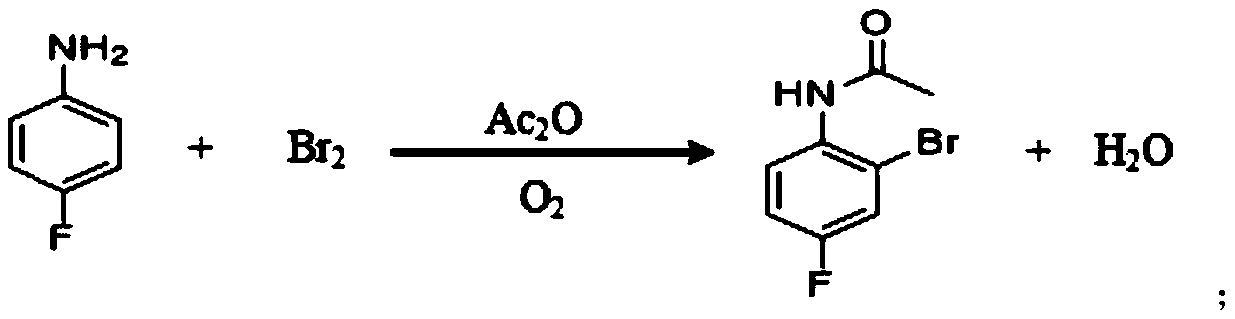
Figure 1 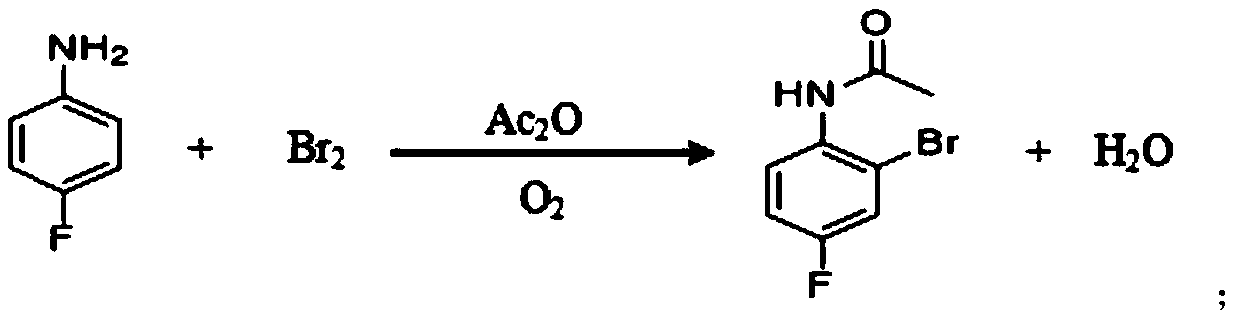
Figure 2
Abstract
Description
technical field
[0001] The invention relates to a technology in the field of chemical industry, in particular to a method for synthesizing sulfur-free 2-bromo-4-fluoroacetanilide. Background technique
[0002] 2-Bromo-4-fluoroacetanilide (BFA) is an important fluorine-containing fine chemical intermediate. It is not only the raw material of sulfa drugs, but also used as an analgesic and antipyretic. A new type of fluorine-containing pesticide with high efficiency, non-toxicity and low residue.
[0003] There are many synthetic methods of 2-bromo-4-fluoroacetanilide, among which there are mainly three synthetic methods of bromination, acetylation, fluorination, acetylation and bromination. These three synthetic methods are used to improve bromine Efficiency requires the use of oxidants, so subsequent use requires the use of sulfur-containing reducing agents, so sulfur is inevitably contained in the product. If the content of sulfur in the product cannot be effectively contr...
Examples
Embodiment 1
[0022] Add 200L of chlorobenzene, 100L of p-fluoroaniline, and 1kg of palladium catalyst in a 1000L kettle, stir evenly for use, raise the temperature to 50 degrees Celsius, add acetic anhydride dropwise through the high-level tank, and bromine passes through the vaporizer and gas distributor to control the concentration of acetic anhydride and bromine. The adding speed is a molar ratio of 1:2, the molar ratio of acetic anhydride to p-fluoroaniline is 1:1.05, and the molar ratio of bromine to p-fluoroaniline is 1:2.1. After the dropwise addition, the temperature was raised to 70 degrees centigrade and kept for 4 hours to react. During the reaction, air was bubbled at a rate of 0.5 L / min to replenish oxygen. After the reaction, the palladium catalyst was removed by filtration. Then add 200L of 10% sodium formate, and more precipitates are generated at this time. After solid-liquid separation, the solid is 2-bromo-4-fluoroacetanilide, and the content of 2-bromo-4-fluoroacetanilid...
Embodiment 2
[0024] Add 200L of chlorobenzene, 100L of p-fluoroaniline, and 1kg of palladium catalyst in a 1000L kettle, stir evenly for use, raise the temperature to 50 degrees Celsius, add acetic anhydride dropwise through the high-level tank, and bromine passes through the vaporizer and gas distributor to control the concentration of acetic anhydride and bromine. The adding speed is a molar ratio of 1:2, the molar ratio of acetic anhydride to p-fluoroaniline is 1:1.05, and the molar ratio of bromine to p-fluoroaniline is 1:2.1. After the dropwise addition, the temperature was raised to 70 degrees centigrade and kept for 4 hours to react. During the reaction, air was bubbled at a rate of 0.5 L / min to replenish oxygen. After the reaction, the palladium catalyst was removed by filtration. Then add 200L of 10% sodium oxalate, more precipitates are generated at this time, after solid-liquid separation, the solid is 2-bromo-4-fluoroacetanilide, the content of 2-bromo-4-fluoroacetanilide is hig...
Embodiment 3
[0026] Add 200L of chlorobenzene, 100L of p-fluoroaniline, and 1kg of palladium catalyst in a 1000L kettle, stir evenly for use, raise the temperature to 50 degrees Celsius, add acetic anhydride dropwise through the high-level tank, and bromine passes through the vaporizer and gas distributor to control the concentration of acetic anhydride and bromine. The adding speed is a molar ratio of 1:1, the molar ratio of acetic anhydride to p-fluoroaniline is 1:1.05, and the molar ratio of bromine to p-fluoroaniline is 1:1.05. After the dropwise addition, the temperature was raised to 70 degrees centigrade and kept for 4 hours to react. During the reaction, air was bubbled at a rate of 0.5 L / min to replenish oxygen. After the reaction, the palladium catalyst was removed by filtration. Then add 200L of 10% sodium formate, and more precipitates are generated at this time. After solid-liquid separation, the solid is 2-bromo-4-fluoroacetanilide, and the content of 2-bromo-4-fluoroacetanili...