Homogeneous chemiluminiscence detection method and application thereof
A homogeneous chemiluminescence and chemiluminescence technology, which is applied in the direction of chemiluminescence/bioluminescence, analysis by making materials undergo chemical reactions, and measurement devices, can solve the problems of extremely high sensitivity requirements, achieve high sensitivity, low production cost, The effect of detecting performance improvements
- Summary
- Abstract
- Description
- Claims
- Application Information
AI Technical Summary
Problems solved by technology
Method used
Image



Examples
Embodiment approach
[0089] The present invention will be described in more detail below in conjunction with examples.
[0090] The existing common knowledge is: the more uniform the particle size of the microspheres, the better the performance of homogeneous chemiluminescent detection using the microspheres. Therefore, the current research on microspheres used in homogeneous chemiluminescence tends to obtain microspheres with more uniform particle size. The inventors of the present application found through research that when using microspheres with uniform particle size for homogeneous chemiluminescence detection, the sensitivity and detection range of the detection results cannot be guaranteed at the same time. However, by using microspheres with suitable particle size uniformity (eg, the coefficient of variation of microsphere particle size distribution > 5%), the sensitivity of photochemiluminescence detection can be guaranteed, and the detection range can be broadened.
[0091] The inventor...
Embodiment 1
[0150] Example 1: Preparation of the receptor particle solution of conjugated antibody I (PCT antibody)
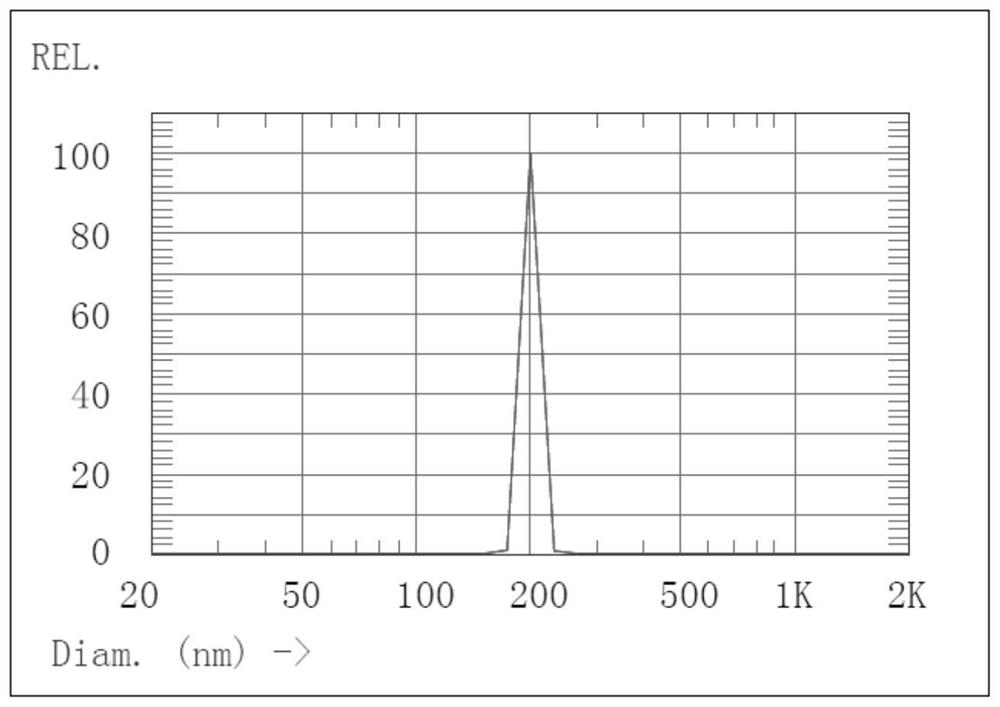
[0151] (1) Preparation of antibody-coupled receptor particles with an average particle size of about 250 nm
[0152] 1.1 Preparation and characterization process of aldehyde-based polystyrene latex microspheres
[0153] 1) Prepare a 100ml three-neck flask, add 40mmol styrene, 5mmol acrolein, and 10ml water, stir for 10min, and pass N 2 30min;
[0154] 2) Weigh 0.11g of ammonium persulfate and 0.2g of sodium chloride, dissolve them in 40ml of water to form an aqueous solution. This aqueous solution is added in the reaction system of step 1, continues to pass through N 2 30min;
[0155] 3) The temperature of the reaction system was raised to 70° C., and the reaction was carried out for 15 hours;
[0156] 4) Cool the emulsion after the reaction to room temperature, and filter with a suitable filter cloth. The obtained emulsion is washed with deionized water by centrif...
Embodiment 2
[0184] Embodiment 2: the mensuration of method sensitivity and detection limit of the present invention
[0185] The sensitivity point is defined as when the signal of concentration Cx is higher than the signal of twice the concentration of C0, that is, RLU(Cx)>2RLU(C0), then the sensitivity of the corresponding detection reagent is Cx. Define the detection limit point as the upper limit of the range determined using the method in the National Committee for Clinical Laboratory Standardization (NCCLS) Evaluation Protocol (EP) Series 6 document.
[0186] (1) Dilute the PCT antigen to 20pg / ml, 30pg / ml, 40pg / ml, 50pg / ml, 60pg / ml, 80pg / ml, 160pg / ml, 500pg / ml, 1000pg / ml, 5000pg / ml, 20000pg / ml ml, 50000pg / ml, 100000pg / ml and 200000pg / ml series concentration, the acceptor reagent ( The concentration is 100ug / ml), and then with the same biotin-labeled PCT monoclonal antibody 2 (diluted to 2ug / ml) and universal solution (reagent containing donor particles) to detect the above concentra...
PUM
| Property | Measurement | Unit |
|---|---|---|
| size | aaaaa | aaaaa |
| size | aaaaa | aaaaa |
| wavelength | aaaaa | aaaaa |
Abstract
Description
Claims
Application Information
 Login to View More