Silicon dioxide nano particles with bent spikes and preparation method thereof
A nanoparticle and silicon dioxide technology, applied in the field of biomedical chemistry, can solve the problems of slow biodegradation, single function, and uncontrollable number and shape of spikes, and achieve high cell survival rate, high transfection efficiency, and improved reliability. Applied Effects
- Summary
- Abstract
- Description
- Claims
- Application Information
AI Technical Summary
Problems solved by technology
Method used
Image

Examples
Embodiment 1
[0050] Example 1: Preparation of silica nanoparticles with different numbers of nanospikes
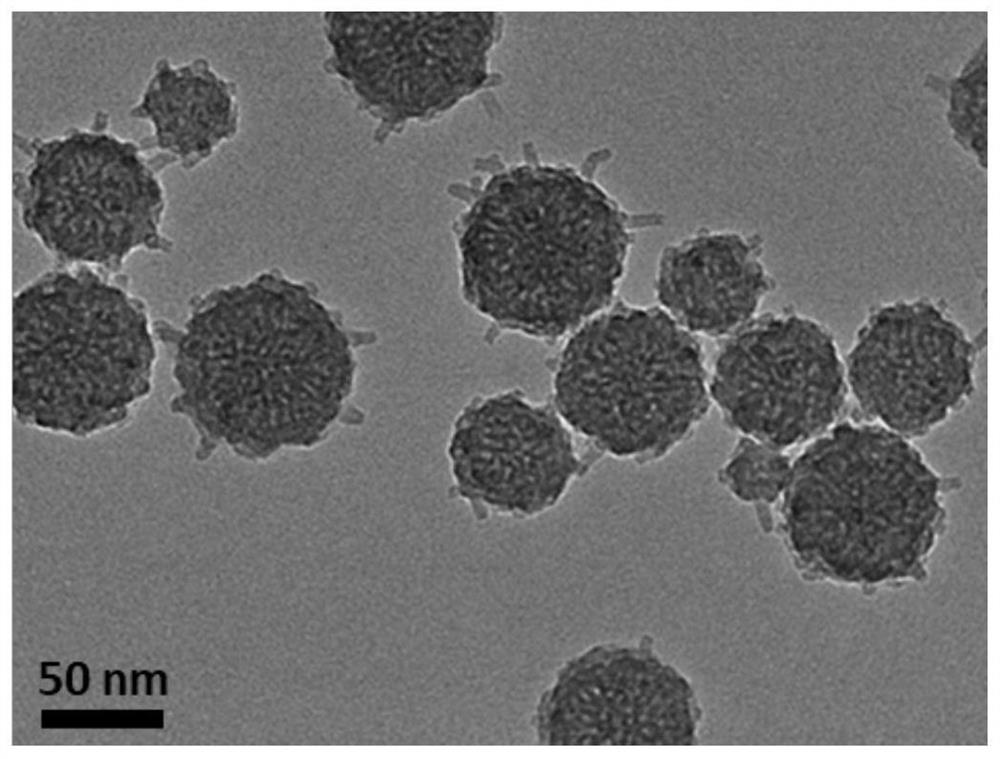
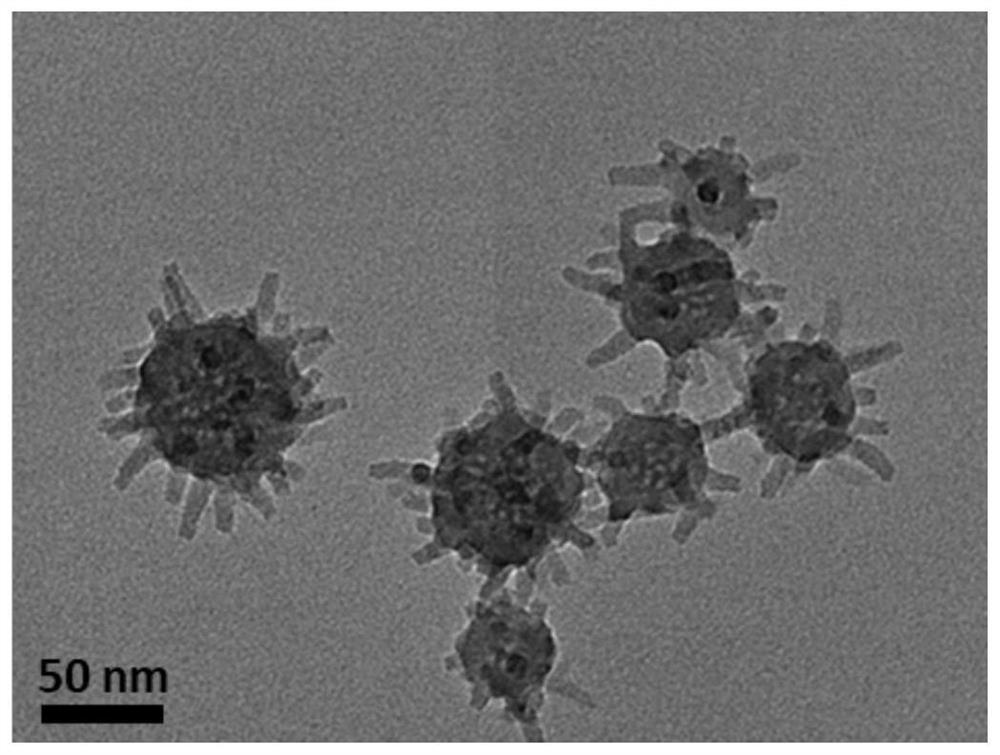
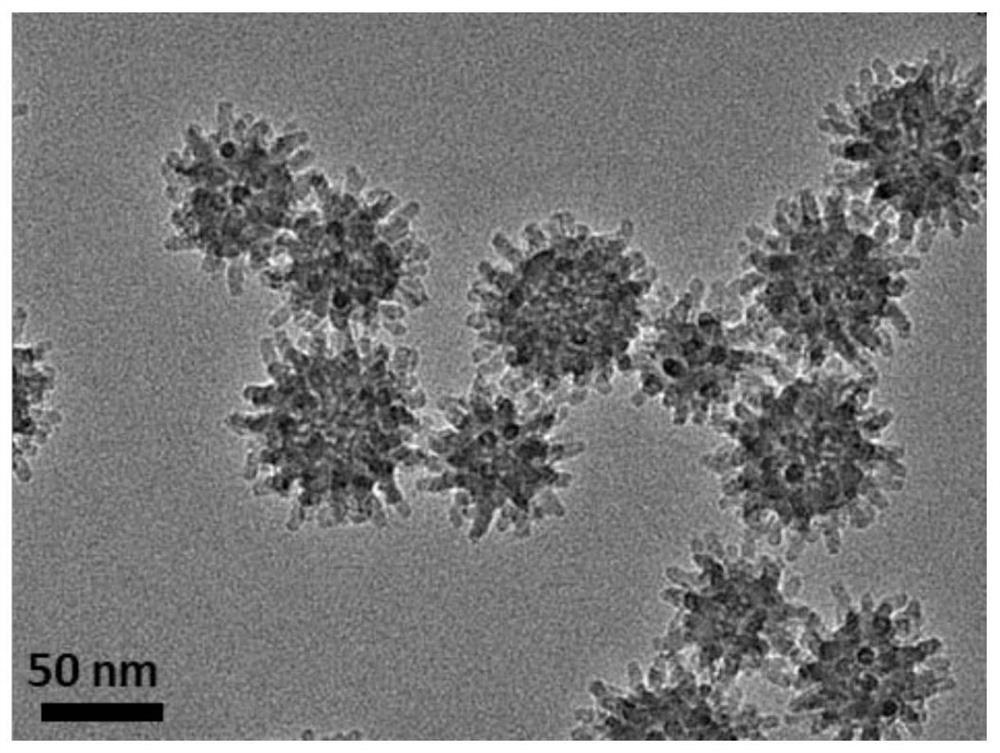
[0051] In 20 mL of water, CTAB was added, the stirring speed was 500 rpm, and the temperature was 60 °C, stirring until CTAB was fully dissolved, then 0.01 g of NaOH was added, and stirring was continued for 30 minutes, and then a mixed solution of cyclohexane and TEOS (4.68 g of cyclohexane was added) was added. alkane and 1.4 g TEOS), and continued to react at 60° C. with stirring for 48 hours to obtain a silica nanomaterial with a virus-like structure. In this specific reaction process, when the amount of CTAB is 0.15g, 0.2g, and 0.3g respectively (when the CTAB concentration is 0.75wt%, 1.0wt%, and 1.5wt%, respectively), the obtained virus-like structure silica nanoparticles The number of surface nanopillars is: 10 to 15 (such as figure 1 shown), 30 to 35 (such as figure 2 shown), 50 to 60 (such as image 3 shown).
Embodiment 2
[0052] Example 2: Preparation of silica nanoparticles with different core diameters
[0053] 1. Obtain small size (30-80nm) silica nanoparticles: by mass ratio, CTAB:NaOH:H 2 O=(0.1~2): 0.05:100, CTAB, NaOH mixed aqueous solution was prepared at 60 degreeC. Then add TEOS and cyclohexane, according to the mass ratio, CTAB:NaOH:TEOS:cyclohexane:H 2 O=(0.1~2): 0.05:7:23:100, at 60°C, with rapid stirring (400~1500rpm), a stable microemulsion system is formed. The stirring reaction was continued for 48 hours to obtain a silica nanomaterial with a virus-like structure.
[0054] The size of the virus-like silica nanoparticles can be precisely tuned by adjusting the stirring speed, while simultaneously adjusting the initial concentration of CTAB. The control parameters, corresponding kernel size and corresponding diagram are shown in Table 1.
[0055] Table 1 Silica nanoparticles size control comparison table
[0056]
[0057]
[0058] We found that if only the stirring spe...
Embodiment 3
[0066] Example 3: Preparation of silica nanoparticles with special shaped spikes
[0067] 1. Control the shape of the spike by changing the reaction temperature.
[0068] In 20mL of water, add 0.4g CTAB, stir at a speed of 600rpm and a temperature of 70°C, stir until CTAB is fully dissolved, then add 0.01g of NaOH, continue stirring for 30 minutes, and then add a mixed solution of cyclohexane and TEOS (4.68g cyclohexane and 1.4g TEOS), continue to react at 70° C. with stirring for 48 hours, and obtain a silica nanomaterial with a virus-like structure with obvious curved spikes. Electron microscope scan as Figure 14 shown.
[0069] 2. Control the shape of the spike by changing the catalyst.
[0070] In 20mL of water, add 0.4g CTAB, stir at a speed of 600rpm and a temperature of 60°C, stir until CTAB is fully dissolved, then add 0.056g of tetrapropylammonium hydroxide, continue stirring for 30 minutes, and then add a mixture of cyclohexane and TEOS. The mixed solution (4.68...
PUM
 Login to View More
 Abstract
Description
Claims
Application Information
 Login to View More