
High-efficiency water decomposition catalyst hollow cobalt phosphide and preparation method thereof
A technology of cobalt phosphide and catalyst, applied in the field of preparation of hollow cobalt phosphide, can solve the problems of low specific surface area, few active sites, and inability to achieve commercial use, and achieves large specific surface area, flat particle surface, excellent electrical The effect of chemical stability
- Summary
- Abstract
- Description
- Claims
- Application Information
AI Technical Summary
Problems solved by technology
Method used
Image

Examples
Embodiment 1
[0036] A method for preparing hollow cobalt phosphide as an efficient water splitting catalyst, the preparation steps are as follows:
[0037] S1. Prepare the required materials: Na 2 MoO 4 2H 2 O, Co (NO 3 ) 2·6H 2 O (98%), 2-methylimidazole (2-MIM, 95%), KOH (85%), methanol, ethanol, Nafion (5 wt%) and IrO 2 , the prepared chemicals were used as received without further purification, and the water used in the experiment was purified by filtration through ion-exchange membranes.
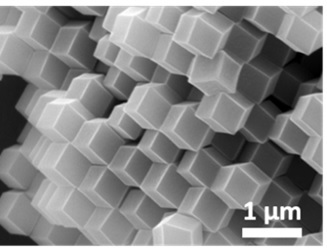
[0038] S2. Synthesis of ZIF-67: Take 30 mL of 20 mM Co(NO 3 ) 2 ·6H 2 O was added to the methanol solution and ultrasonically mixed, then 50 mL of 160 mM 2-MIM methanol solution was added; the mixture was reacted at room temperature for 24 hours without stirring, after the reaction, the precipitate was recovered by centrifugation and washed with excess methanol The precipitate was washed and dried in air at 60° C. to obtain ZIF-67.
[0039] S3.Co(OH) 2 Synthesis of: Take 40mg of ZIF-67 pre...
PUM
| Property | Measurement | Unit |
|---|---|---|
| diameter | aaaaa | aaaaa |
Abstract
Description
Claims
Application Information
 Login to View More