
Preparation method and application of lycium barbarum polysaccharide oversized mesoporous silica nano adjuvant
A super-large mesoporous, silicon dioxide technology, applied in medical preparations containing active ingredients, pharmaceutical formulations, allergic diseases, etc., can solve the problems of large dosage, fast metabolism, poor targeting, etc., achieve effective stimulation, optimal Immunity, enhance phagocytosis effect
- Summary
- Abstract
- Description
- Claims
- Application Information
AI Technical Summary
Problems solved by technology
Method used
Image

Examples
Embodiment 1
[0025] Example 1: Preparation of UCMS and physical loading of LBP
[0026] Accurately mix 4.8mL of 25wt% CTAC solution, 0.04g of TEA and 7.2mL of deionized water to make an aqueous phase. Secondly, accurately measure 3.5mL chlorobenzene and 0.5mL TEOS and mix evenly to make the oil phase. The oil phase was slowly added dropwise into the water phase, and then stirred in a water bath at 60°C for 12 hours at a constant speed of 500 r / min. After the precipitate was collected by high-speed centrifugation, it was washed three times with absolute ethanol and deionized water, and then air-dried in an oven at 60°C. The obtained product was ground and then calcined in a muffle furnace at 550° C. for 5 h to obtain UCMS. Accurately weigh 20mgLBP and 5mg UCMS, and disperse in 2mL deionized water. After sonication, stir at room temperature for 12 h to obtain LBP-UCMS solution.
Embodiment 2
[0027] Example 2: Characterization assays
[0028] (1) Analysis of TEM results
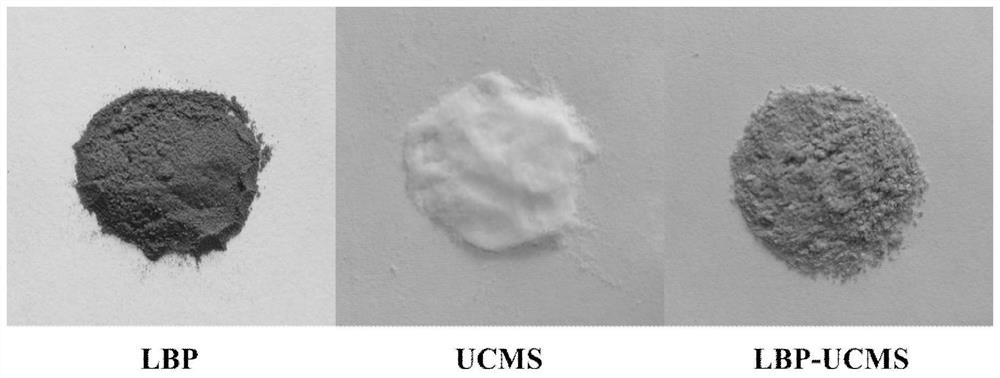
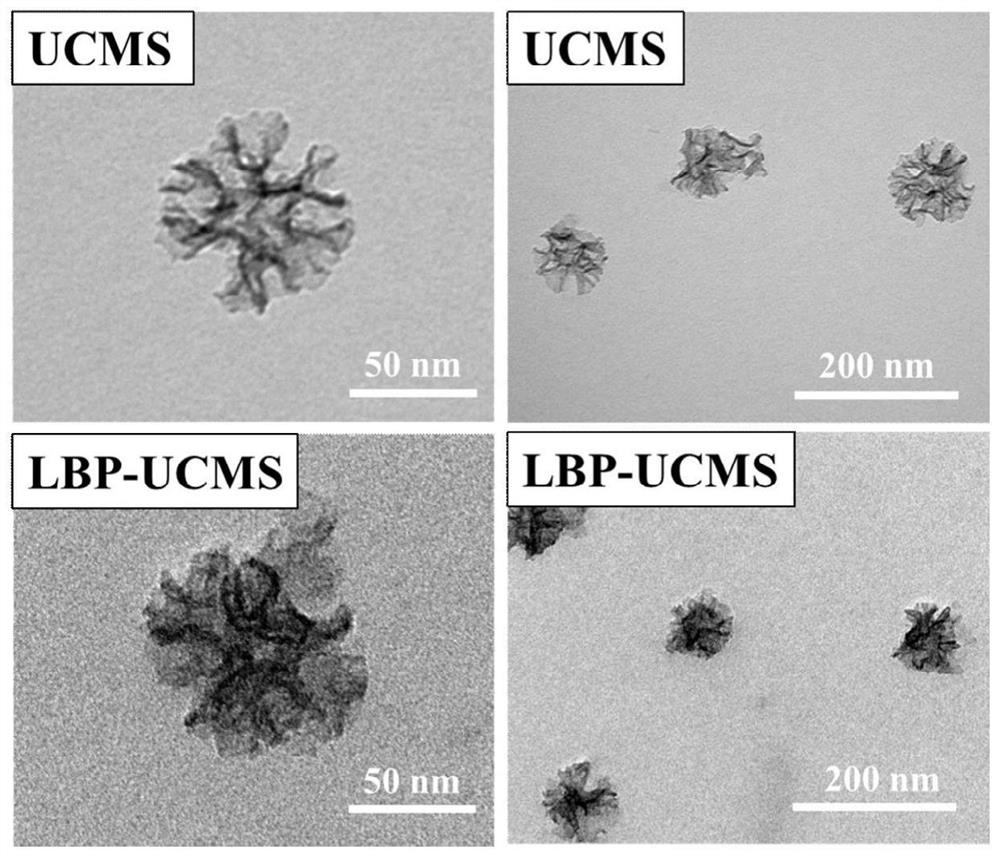
[0029] The prepared LBP-UCMS solid powder is as figure 1 shown. Transmission electron microscopy (TEM) observed the morphology of LBP-UCMS as figure 2 shown. Observation under a high-magnification electron microscope shows that UCMS is uniform in size, with a particle size of about 80-100nm. There are folded pores leading directly to the interior, and the folds are thinner, providing more space for physical adsorption and loading of polysaccharides. The LBP-UCMS nanoparticles were also spherical and uniformly distributed, and the mesoporous gaps of UCMS were filled, indicating that LBP was successfully loaded in the mesoporous gaps of UCMS.
[0030] (2) Particle size, Zeta potential analysis
[0031] As shown in Table 1, the particle size of UCMS increased after loading LBP measured by dynamic light scattering (DLS). The average particle size of LBP-UCMS is 493.4±14.17nm (n=3), which is bas...
Embodiment 3
[0036] Embodiment 3: performance test
[0037] (1) Effect of LBP-UCMS on RAW264.7 cytokine secretion
[0038] Plant polysaccharides can activate macrophages, and play an immune regulatory role by promoting macrophage proliferation, improving phagocytosis, and producing cytokines such as TNF-α, IL-6, and IL-1β, thereby improving immunity. qRT-PCR results such as Figure 4 As shown, the content of TNF-α secreted by macrophages stimulated by LBP-UCMS (250 μg / mL) was significantly different from the Control group (P<0.001), but compared with the LBP group, it was slightly higher than the LBP group but had no significant difference. LBP-UCMS (250μg / mL) stimulated macrophages to secrete IL-1β and IL-6 levels significantly higher than LBP group (P<0.0001). It shows that LBP-UCMS can stimulate macrophages to produce corresponding inflammatory factors more than LBP alone.
[0039] (2) Effect of LBP-UCMS on costimulatory molecules on the surface of RAW264.7
[0040] After phagocytos...
PUM
| Property | Measurement | Unit |
|---|---|---|
| particle size | aaaaa | aaaaa |
Abstract
Description
Claims
Application Information
 Login to View More