Check patentability & draft patents in minutes with Patsnap Eureka AI!

1,4-substituted isoquinoline inhibitors of KEAP1/NRF2 protein-protein interaction

a technology of keap-1/nrf2 and isoquinoline, which is applied in the field of 1,4-substituted isoquinoline inhibitors of keap-1/nrf2 proteinprotein interaction, can solve the problems of mutagenic properties, poor solubility and/or metabolic stability of compounds, and difficult to achieve the effect of inhibiting the keap-1/nrf2 interaction and accelerating the healing of wounds

Active Publication Date: 2022-07-26
THE BOARD OF TRUSTEES OF THE UNIV OF ILLINOIS
View PDF2 Cites 0 Cited by
  • Summary
  • Abstract
  • Description
  • Claims
  • Application Information

AI Technical Summary

Benefits of technology

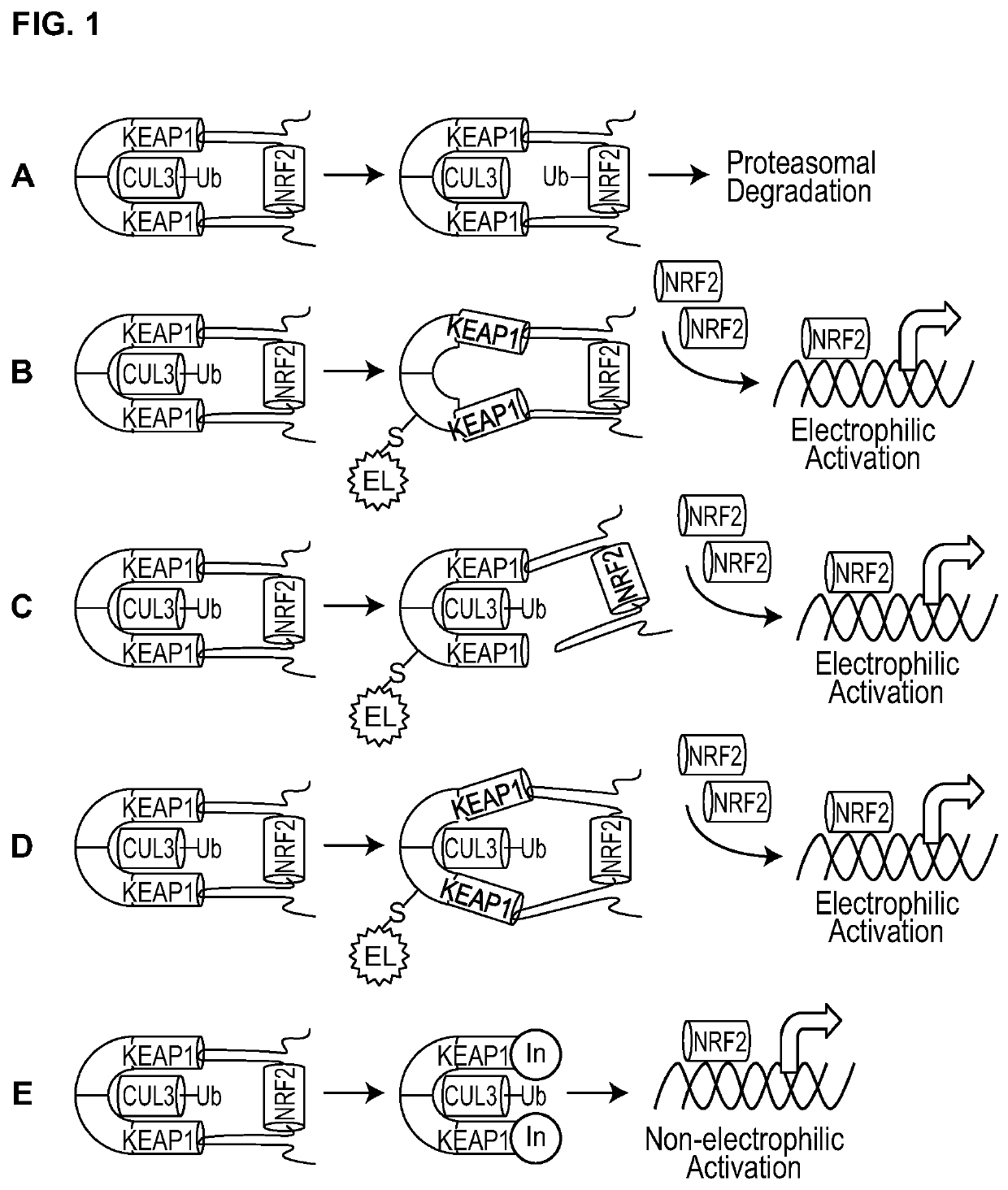
The patent describes compounds that can inhibit the KEAP-1 / NRF2 interaction, which is involved in the regulation of various genes involved in disease states such as Alport syndrome, amyotrophic lateral sclerosis, autosomal dominant polycystic kidney disease, bone disease, blood disease, chronic kidney disease, chronic obstructive pulmonary disease, connective tissue disease, dry eye macular degeneration, estrogen receptor-positive breast cancer, eye disease, focal segmental glomerulosclerosis, Friedreich ataxia, immunoglobulin A nephropathy, interstitial lung disease, lung diseases, multiple sclerosis, kidney disease, neurodegenerative disease, primary focal segmental glomerulosclerosis, psoriasis, pulmonary arterial hypertension, retinovascular disease, subarachnoid hemorrhage, type 1 diabetes, and type 2 diabetes mellitus. The compounds can be used as pharmaceutical compositions or in the treatment of these diseases or disorders.

Problems solved by technology

This approach can be problematic as potent electrophiles are traditionally seen as promiscuous in vivo and their lack of specificity may obscure their true mechanism of action.
It has been found, however, that these compounds suffer from poor solubility and / or poor metabolic stability, and also exhibit mutagenic properties.
Older adults and diabetic patients are especially prone to developing these types of wounds.
Given the aging of the American population and increases in age-related diabetes and obesity, treatment of chronic wounds will place an even larger burden on the US healthcare system.
However, an aberrant and prolonged inflammatory response is one of the most common contributors to the progression of chronic, non-healing wounds.
2007; 25(1):19-25), but there are currently no good ways of pharmacologically reducing inflammation in chronic wounds.
Thus, accelerating wound healing with pharmaceutical therapies is a major unmet medical need.
However, these modifications significantly diminished the binding affinity of these inhibitors.

Method used

the structure of the environmentally friendly knitted fabric provided by the present invention; figure 2 Flow chart of the yarn wrapping machine for environmentally friendly knitted fabrics and storage devices; image 3 Is the parameter map of the yarn covering machine
View more

Image

Smart Image Click on the blue labels to locate them in the text.
Viewing Examples
Smart Image
  • 1,4-substituted isoquinoline inhibitors of KEAP1/NRF2 protein-protein interaction
  • 1,4-substituted isoquinoline inhibitors of KEAP1/NRF2 protein-protein interaction
  • 1,4-substituted isoquinoline inhibitors of KEAP1/NRF2 protein-protein interaction

Examples

Experimental program
Comparison scheme
Effect test

example 1

of 2,2′-(isoquinoline-1,4-diylbis(((4-methoxyphenyl)sulfonyl) azanediyl))diacetate

Preparation of Boc-4-pyridin-4-yl-piperidine (2)

[0112]

1,4-dibromoisoquinoline (1)

[0113]In a 50 mL round-bottom flask, isocarbostyril (0.50 g, 3.4 mmol) and phosphorus pentabromide (2.7 g, 9.8 mmol) were heated at 140-145° C. for 10 min. The solid melted and lightened in color. The liquid solidified, and the reaction was stirred for an additional 10 min. On completion, the reaction mixture was cooled to room temperature, and ice / H2O (10 mL) was poured into the flask. The solid precipitate was collected by filtration, washed with H2O (2×50 mL), and dried under vacuum to obtain 860 mg (89% yield) of (1) as a buff-colored solid.

[0114]

[0115]A solution of 1,4-dibromoisoquinoline (230 mg, 0.8 mmol), 4-methoxybenzene sulfonamide (300 mg, 1.6 mmol), CuI (60 mg, 0.3 mmol), K2CO3 (1.18 g, 8.5 mmol), and N1,N2-dimethylethane-1,2-diamine (142 mg, 1.6 mmol) in MeCN (6 mL) was heated at 70° C. for 7 days. On completi...

example 2

of 2,2′-(isoquinoline-1,4-diylbis(((4-methoxyphenyl)sulfonyl) azanediyl))diacetate

[0116]

[0117]Potassium carbonate (83 mg, 0.17 mmol) and ethyl bromoacetate (70 mg, 0.4 mmol) were added to a solution of N,N′-(isoquinoline-1,4-diyl)bis(4-methoxybenzenesulfonamide) (100 mg, 0.20 mmol) in anhydrous DMF (2 mL), and the reaction was stirred overnight at room temperature. On completion, the reaction was quenched with H2O (10 mL), and the solid was collected by filtration to yield a brown solid. The crude product was purified by column chromatography (silica gel; EtOAc / Hexanes, 0:100 to 50:50) to obtain diethyl 2,2′-(isoquinoline-1,4-diylbis(((4-methoxyphenyl)sulfonyl)azanediyl))diacetate.

[0118]

2,2′-(isoquinoline-1,4-diylbis(((4-methoxyphenyl)sulfonyl)azanediyl))diacetic acid

[0119]In a 20 mL screw cap vial diethyl 2,2′-(isoquinoline-1,4-diylbis(((4-methoxyphenyl)sulfonyl)azanediyl))diacetate (42 mg, 0.06 mmol) was dissolved in MeOH (2 mL) and 15% NaOH (0.5 mL) was added. The resulting solut...

example 3

of N-(1-((4-methoxyphenyl)sulfonamido)isoquinolin-4-yl)-N-((4-methoxyphenyl)sulfonyl)glycine

[0120]

ethyl N-(1-((4-methoxyphenyl)sulfonamido)isoquinolin-4-yl)-N-((4-methoxyphenyl)sulfonyl) glycinate (5)

[0121]In a 4 mL screw cap vial N,N′-(isoquinoline-1,4-diyl)bis(4-methoxybenzenesulfonamide) (200 mg, 0.40 mmol), and K2CO3 (66 mg, 0.48 mmol), were dissolved in DMF and cooled to 0° C. and ethylbromoacetate (48 μL, 0.44 mmol) was added to the cold solution. The reaction was stirred for 6 hours maintaining 0° C. the entire time. After 6 hours, the reaction was diluted with water and extracted with ethyl acetate (3×10 mL) the combined organics were washed with water (2×20 mL), brine (2×20 mL), dried over Na2SO4, and concentrated under reduced pressure to yield an orange oil. The crude product was purified by column chromatography (silica gel; EtOAc / Hexanes, 0:100 to 40:60) afford 59.6 mg (25% yield) of (5) as an off yellow solid.

[0122]

N-(1-((4-methoxyphenyl)sulfonamido)isoquinolin-4-yl)-N...

the structure of the environmentally friendly knitted fabric provided by the present invention; figure 2 Flow chart of the yarn wrapping machine for environmentally friendly knitted fabrics and storage devices; image 3 Is the parameter map of the yarn covering machine
Login to View More

PUM

No PUM Login to View More

Abstract

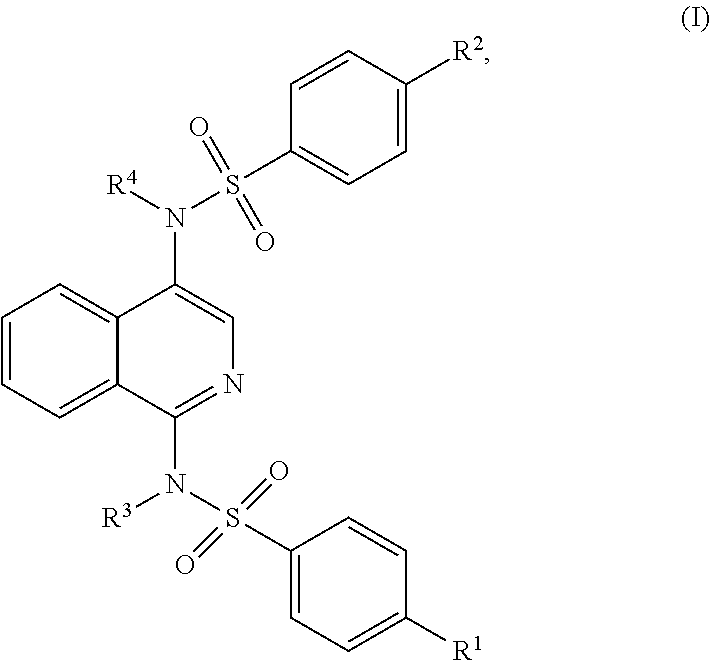
Disclosed herein are compounds that can act as inhibitors of the Kelch-like ECH-associated protein 1 / nuclear factor (erythroid-derived 2)-like 2 (“KEAP1 / NRF2”) protein-protein interaction, and methods of using the compounds to treat and prevent diseases and disorders, such as COPD, multiple sclerosis, and diabetes, and in the promotion of wound healing. The compounds described herein can include compounds of Formula (I) and pharmaceutically acceptable salts thereof: formula (I), wherein the substituents are as described.

Description

CROSS REFERENCE TO RELATED APPLICATION[0001]This application is the U.S. national phase of International Application No. PCT / US2019 / 025464, filed Apr. 2, 2019, which claims priority to U.S. Provisional Patent Application No. 63 / 653,650, filed Apr. 6, 2018, the disclosure of which is hereby incorporated by reference in its entirety.STATEMENT OF GOVERNMENT SUPPORT[0002]This invention was made with government support under R01 AR069541 awarded by the National Institutes of Health. The government has certain rights in the invention.BACKGROUNDField of the Invention[0003]The present disclosure relates to compounds that can act as inhibitors of the Kelch-like ECH-associated protein 1 / nuclear factor (erythroid-derived 2)-like 2 (“KEAP1 / NRF2”) protein-protein interaction, and methods of using the compounds to treat and prevent diseases and disorders, such as COPD, multiple sclerosis, and diabetes, and to accelerate wound healing.Description of Related Technology[0004]Chronic oxidative stress...

Claims

the structure of the environmentally friendly knitted fabric provided by the present invention; figure 2 Flow chart of the yarn wrapping machine for environmentally friendly knitted fabrics and storage devices; image 3 Is the parameter map of the yarn covering machine
Login to View More

Application Information

Patent Timeline
no application Login to View More
IPC IPC(8): C07D217/22
CPCC07D217/22C07D401/04
Inventor MOORE, TERRYLAZZARA, PHILLIPDAVID, BRIANRICHARDSON, BENJAMINJAIN, ATUL D.
Owner THE BOARD OF TRUSTEES OF THE UNIV OF ILLINOIS
Features
  • R&D
  • Intellectual Property
  • Life Sciences
  • Materials
  • Tech Scout
Why Patsnap Eureka
  • Unparalleled Data Quality
  • Higher Quality Content
  • 60% Fewer Hallucinations
Social media
Patsnap Eureka Blog
Learn More