[0006] Therefore, an object of the invention is to provide a method for continuously producing hydrogen with
high selectivity and high yield by reforming a diesel fuel with high efficiency under a same condition as that of
gasoline or the like.
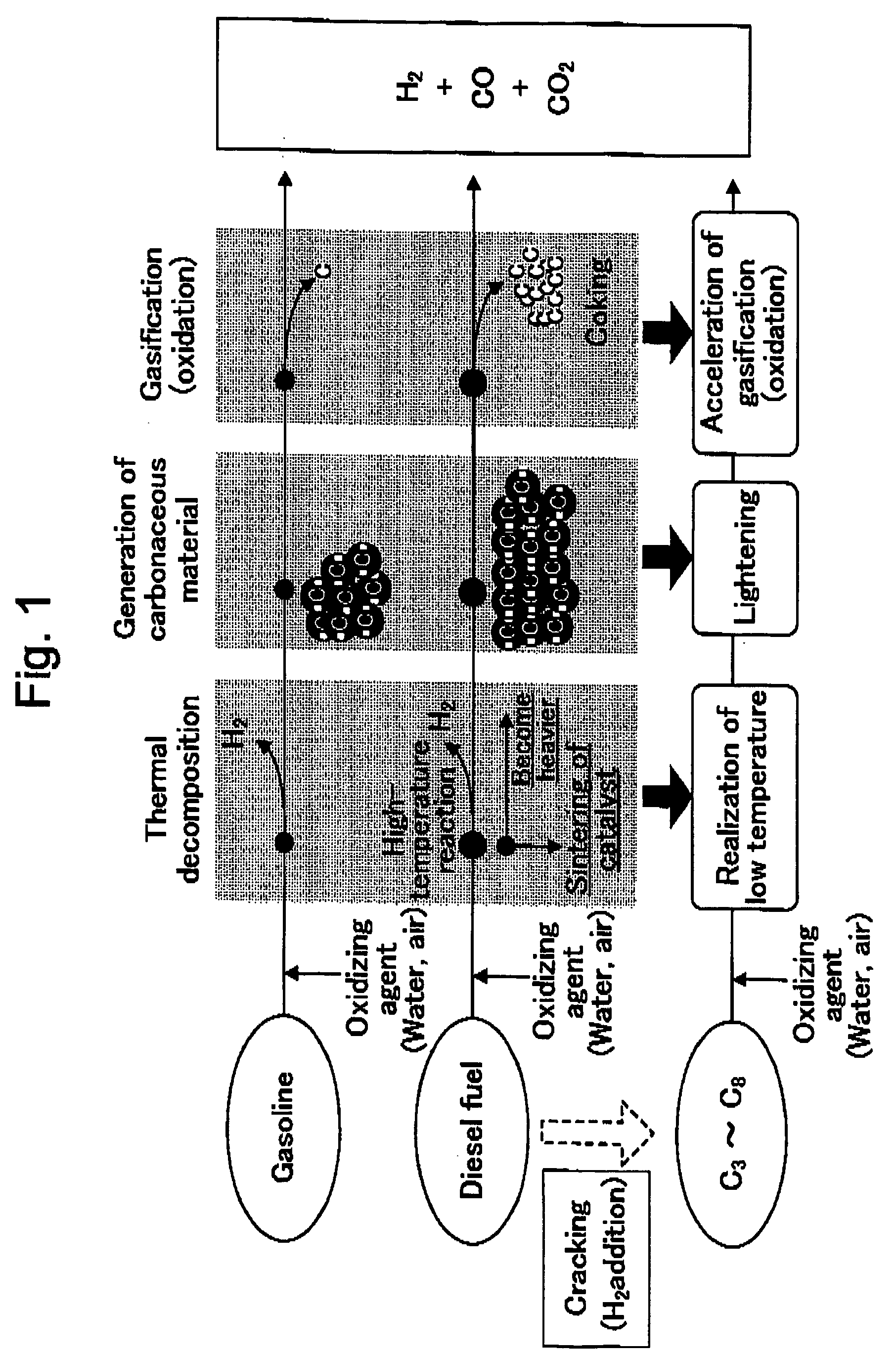
[0025] A method for producing hydrogen according to the invention is schematically shown in FIG. 1. As is shown in FIG. 1, in the method for producing hydrogen according to the invention, after lightening of the diesel fuel, that is, conversion thereof into hydrocarbons which are easily reformed, is performed, hydrogen can continuously be produced with
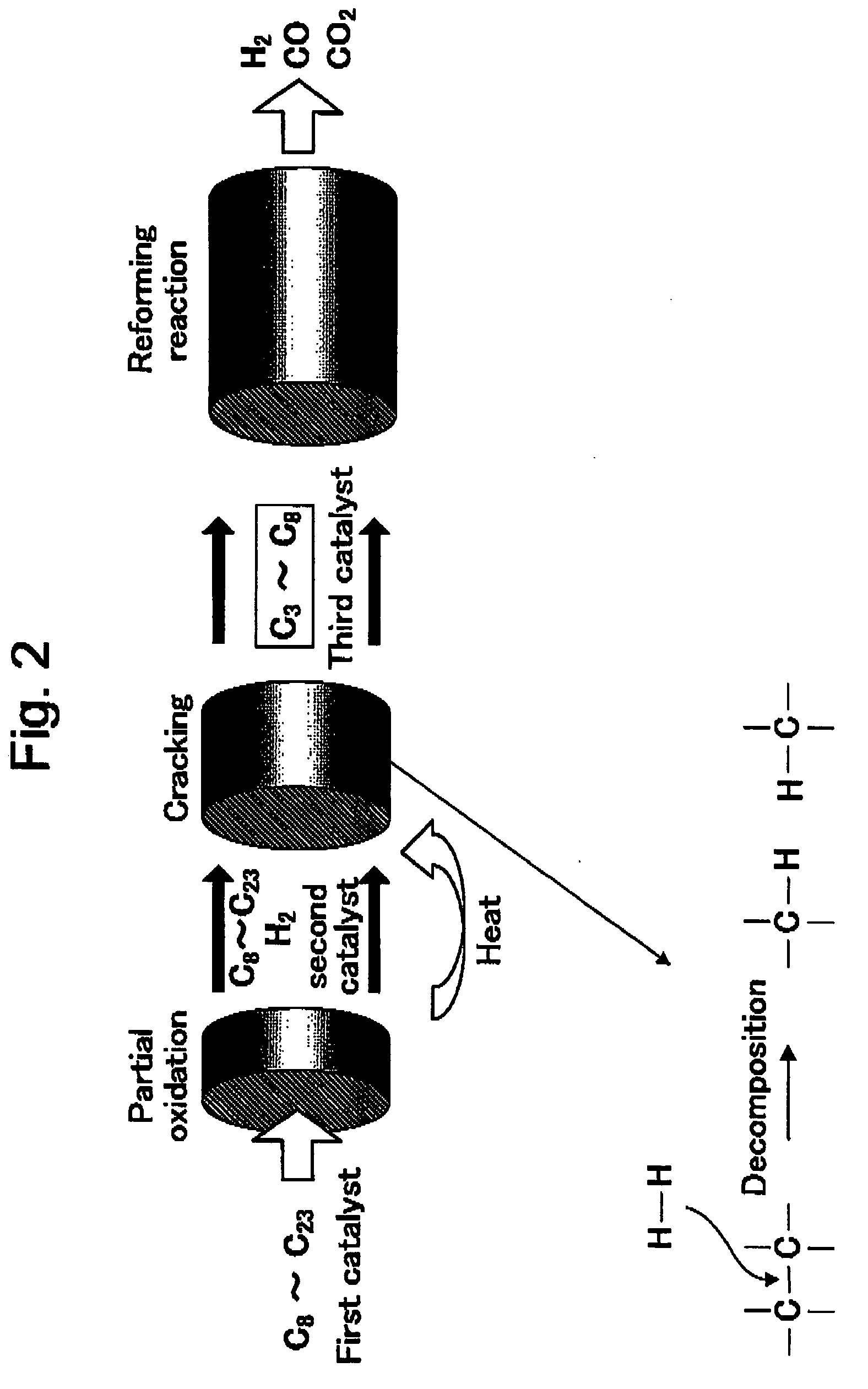
high selectivity and high yield by subjecting the converted hydrocarbons to reforming with high efficiency under a same condition as that of gasoline or the like. Therefore, the method for producing hydrogen according to the invention makes it possible to efficiently produce hydrogen by performing reforming of the diesel fuel which has conventionally been difficult. In more detail, as shown in FIG. 2, in the method for producing hydrogen according to the invention, a reforming catalyst is designed in view of lightening of the diesel fuel and a high efficient reforming of the lightened diesel fuel and is characterized in that hydrogen is produced via a
partial oxidation to be performed by using a first catalyst,
cracking to be performed by using a second catalyst and a reforming reaction to be performed by using a third catalyst. Namely, according to the invention, by allowing three catalysts having different functions from one another to be in a composite state and controlling the reforming reaction of the diesel fuel, the diesel fuel is reformed with high efficiency under the same condition as that of the gasoline or the like, to thereby produce hydrogen with high selectivity and high yield. Further, in the method for producing hydrogen according to the invention, a reaction is, as a whole, progressed in accordance with a
chemical reaction formula (1) as described below, to thereby produce hydrogen. Still further, at the time of designing the reforming catalyst, it can be expected to realize a low temperature of the reforming reaction by increasing a degree of dispersion of carried metals or allowing them to be in a composite state and to lighten a carbonaceous material by adjusting acidity-
alkalinity of a catalyst carrier. Furthermore, an acceleration of gasification and an acceleration of oxidation can be expected by adding, as a third component, at least one of an
oxide of an
alkali metal, such as
potassium (K) or cesium (Cs), an
oxide of an
alkaline earth metal, such as
calcium (Ca) or
strontium (Sr) and an
oxide of a
rare earth metal, such as
lanthanum (La). CnHm+½(n+1)H2O+¼nO2→½(2n−1)CO+½CO2+½(n+m+1)H2 Formula 1, Partially Oxidizing Step
[0032] As has been described above, by performing the method for producing hydrogen according to the invention, the diesel fuel can be reformed with high efficiency under a same condition as that of gasoline or the like, to thereby continuously produce hydrogen with high selectivity and high yield. Further, reforming of the diesel fuel can be performed at a low temperature, to thereby reduce an amount of an
oxidizing agent such as water or air to be used. In addition to these features, various types of effects as described below can be attained. Firstly, such problems as
sintering of the catalyst and coking on the catalyst can be reduced and, then, deterioration of activity of the catalyst is suppressed and, accordingly, an extension of a service life of the catalyst can be attained. For this reason, an amount of the catalyst to be used can be suppressed and, accordingly, a realization of a low cost can be expected. Further, since coking on the catalyst can be suppressed, a pressure loss of the catalyst can be suppressed and, accordingly, a liquid hourly
space velocity (LHSV) can be increased. Secondly, a general-purpose material can be used in a reaction apparatus and, accordingly, a fabrication cost of the reactor can be reduced. Still further, it becomes possible to design a compact reaction apparatus. Thirdly, since reforming is performed after lightening of the diesel fuel is performed, a
molar ratio among hydrogen,
carbon monoxide and
carbon dioxide can be controlled. Fourthly, not only a start-up time of the reforming reaction can be shortened, but also energy to be consumed at the start-up time of the reforming reaction can be small compared with a conventional method.
[0034] According to the invention, the diesel fuel is reformed with high efficiency under a same condition as that of gasoline or the like and, accordingly, hydrogen can continuously be produced with high selectivity and high yield.


 Login to View More