
Soluble recombinant botulinum toxin proteins
a technology of botulinum toxin and soluble recombinant, which is applied in the field of soluble recombinant botulinum toxin proteins, can solve the problems of insufficient heating of food, flaccid paralysis, and association with very serious problems
- Summary
- Abstract
- Description
- Claims
- Application Information
AI Technical Summary
Benefits of technology
Problems solved by technology
Method used
Image

Examples
example 1
Production of High-Titer Antibodies to Clostridium difficile Organisms in a Hen
[0173] Antibodies to certain pathogenic organisms have been shown to be effective in treating diseases caused by those organisms. It has not been shown whether antibodies can be raised, against Clostridium difficile, which would be effective in treating infection by this organism. Accordingly, C. difficile was tested as immunogen for production of hen antibodies.
[0174] To determine the best course for raising high-titer egg antibodies against whole C. difficile organisms, different immunizing strains and different immunizing concentrations were examined. The example involved (a) preparation of the bacterial immunogen, (b) immunization, (c) purification of anti-bacterial chicken antibodies, and (d) detection of anti-bacterial antibodies in the purified IgY preparations.
[0175] a) Preparation of Bacterial Immunogen
[0176]C. difficile strains 43594 (serogroup A) and 43596 (serogroup C) were originally obta...
example 2
Treatment of C. difficile Infection with Anti-C. difficile Antibody
[0189] In order to determine whether the immune IgY antibodies raised against whole C. difficile organisms were capable of inhibiting the infection of hamsters by C. difficile, hamsters infected by these bacteria were utilized. [Lyerly et al., Infect. Immun., 59:2215-2218 (1991).] This example involved: (a) determination of the lethal dose of C. difficile organisms; and (b) treatment of infected animals with immune antibody or control antibody in nutritional solution.
[0190] a) Determination of the Lethal Dose Of C. difficile Organisms
[0191] Determination of the lethal dose of C. difficile organisms was carried out according to the model described by D. M. Lyerly et al., Infect. Immun., 59:2215-2218 (1991). C. difficile strain ATCC 43596 (serogroup C, ATCC) was plated on BHI agar and grown anaerobically (BBL Gas Pak 100 system) at 37° C. for 42 hours. Organisms were removed from the agar surface using a sterile dac...
example 3
Production of C. botulinum Type A Antitoxin in Hens
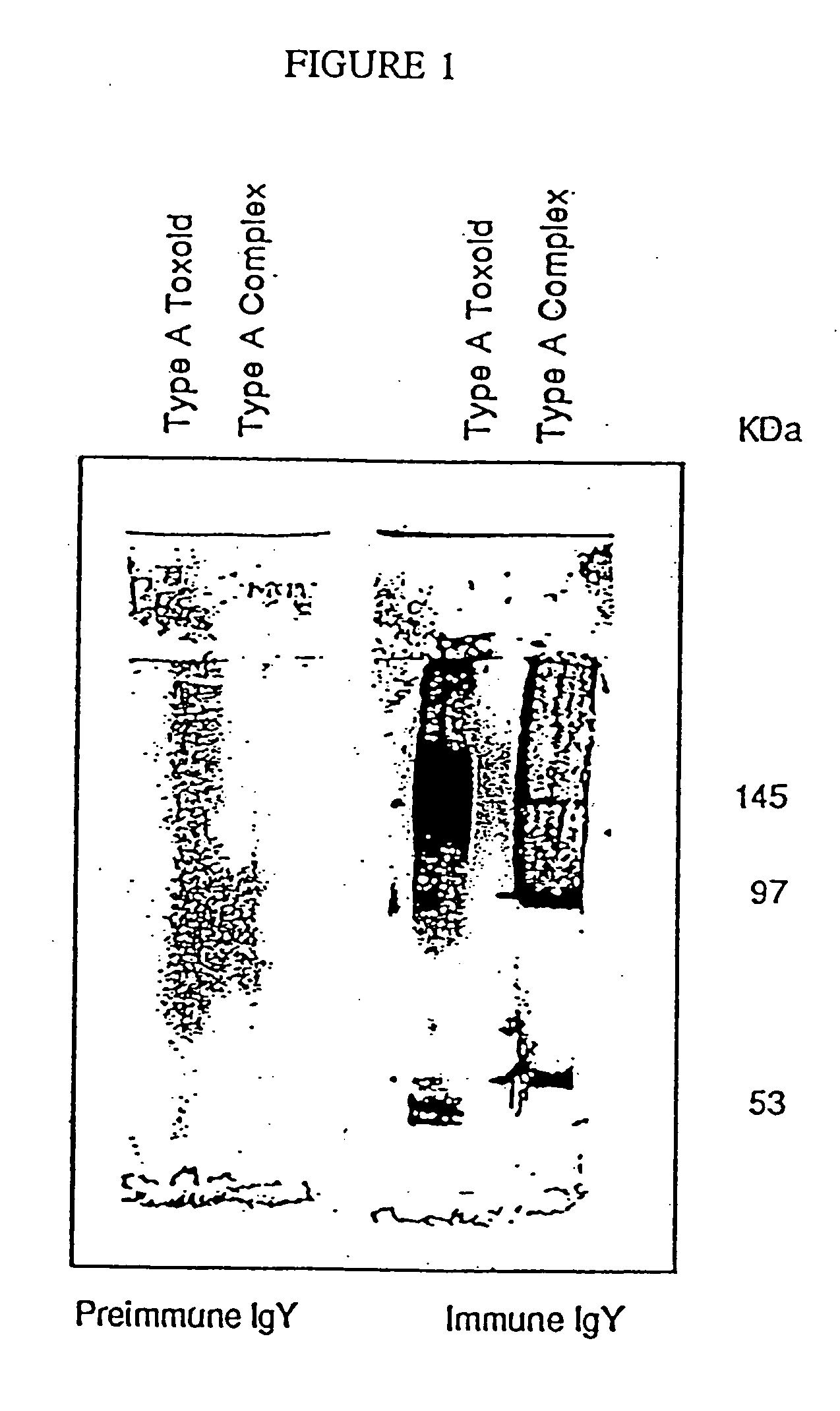
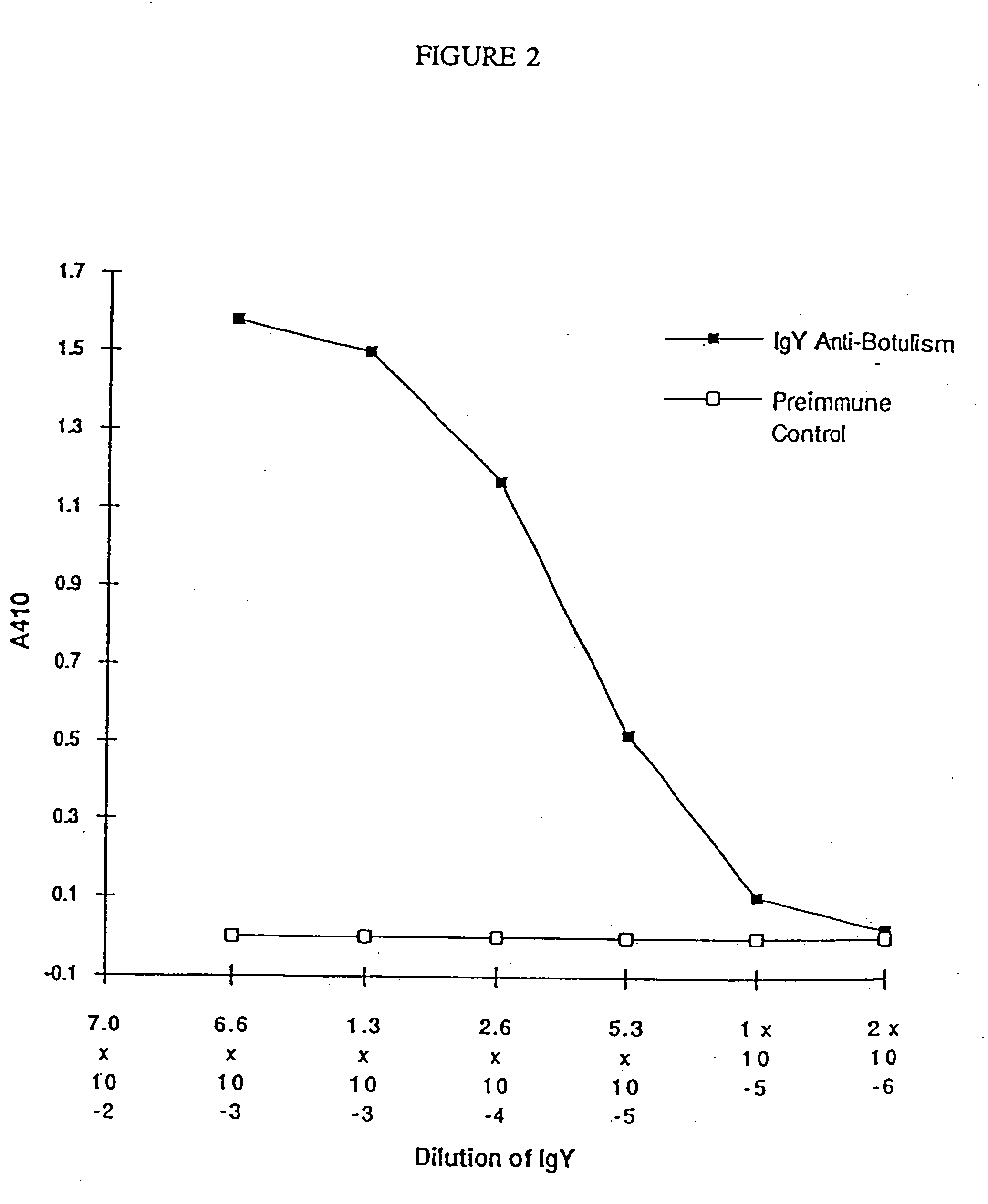
[0199] In order to determine whether antibodies could be raised against the toxin produced by clostridial pathogens, which would be effective in treating clostridial diseases, antitoxin to C. botulinum type A toxin was produced. This example involves: (a) toxin modification; (b) immunization; (c) antitoxin collection; (d) antigenicity assessment; and (e) assay of antitoxin titer.
[0200] a) Toxin Modification
[0201]C. botulinum type A toxoid was obtained from B. R. DasGupta. From this, the active type A neurotoxin (M. W. approximately 150 kD) was purified to greater than 99% purity, according to published methods. [B. R. DasGupta & V. Sathyarnoorthy, Toxicon, 22:415 (1984).] The neurotoxin was detoxified with formaldehyde according to published methods. [B. R. Singh & B. R. DasGupta, Toxicon, 27:403 (1989).]
[0202] b) Immunization
[0203]C. botulinum toxoid for immunization was dissolved in PBS (1 mg / ml) and was emulsified with an app...
PUM
| Property | Measurement | Unit |
|---|---|---|
| Solubility (mass) | aaaaa | aaaaa |
Abstract
Description
Claims
Application Information
 Login to View More