
Human stem cell materials and methods
a technology of stem cells and materials, applied in the field of human stem cell materials and methods, can solve the problems of ineffective transmission of infections, difficult and costly process of bone marrow sample collection, and ineffective so as to reduce the risk of immune rejection and disease transmission, expand the number and variety of disorders, and be effective and versatil
- Summary
- Abstract
- Description
- Claims
- Application Information
AI Technical Summary
Benefits of technology
Problems solved by technology
Method used
Image


Examples
example 1
Isolation and Culturing of Adult Human MDSC from Peripheral Blood
[0108] Peripheral blood monocyte (PBM) preparations from about 50 ml buffy coats samples (each from 500 ml peripheral blood) of healthy individuals (LifeSource Blood Services, Glenview, Ill.) were obtained by a selective attachment method as previously described (Hoklland, M. et al., Cell Biology, a laboratory handbook, Celis J. E. ed., Academic Press, 1: 179-181 (1994)). Buffy coat cell samples of 20-25 ml, which were diluted earlier with an equal volume of RPMI 1640 medium (Life Technologies, Inc.), were carefully layered over 20 ml Ficoll-Hypaque (γ=1.077) in 50 ml centrifuge tubes and then centrifuged using a Beckman CPKR centrifuge and a GH-3.7 horizontal rotor at 3,500 rpm (2700 g) for 25 minutes at 4° C. After carefully harvesting the mononuclear cells at the interface, cells were washed 2-3 times with RPMI 1640 medium by centrifugation using a Beckman CPKR centrifuge and a GH-3.7 horizontal rotor at 1,000 rpm...
example 2
Verification of s-MΦ and MDSCs as Two Distinct Cell Types
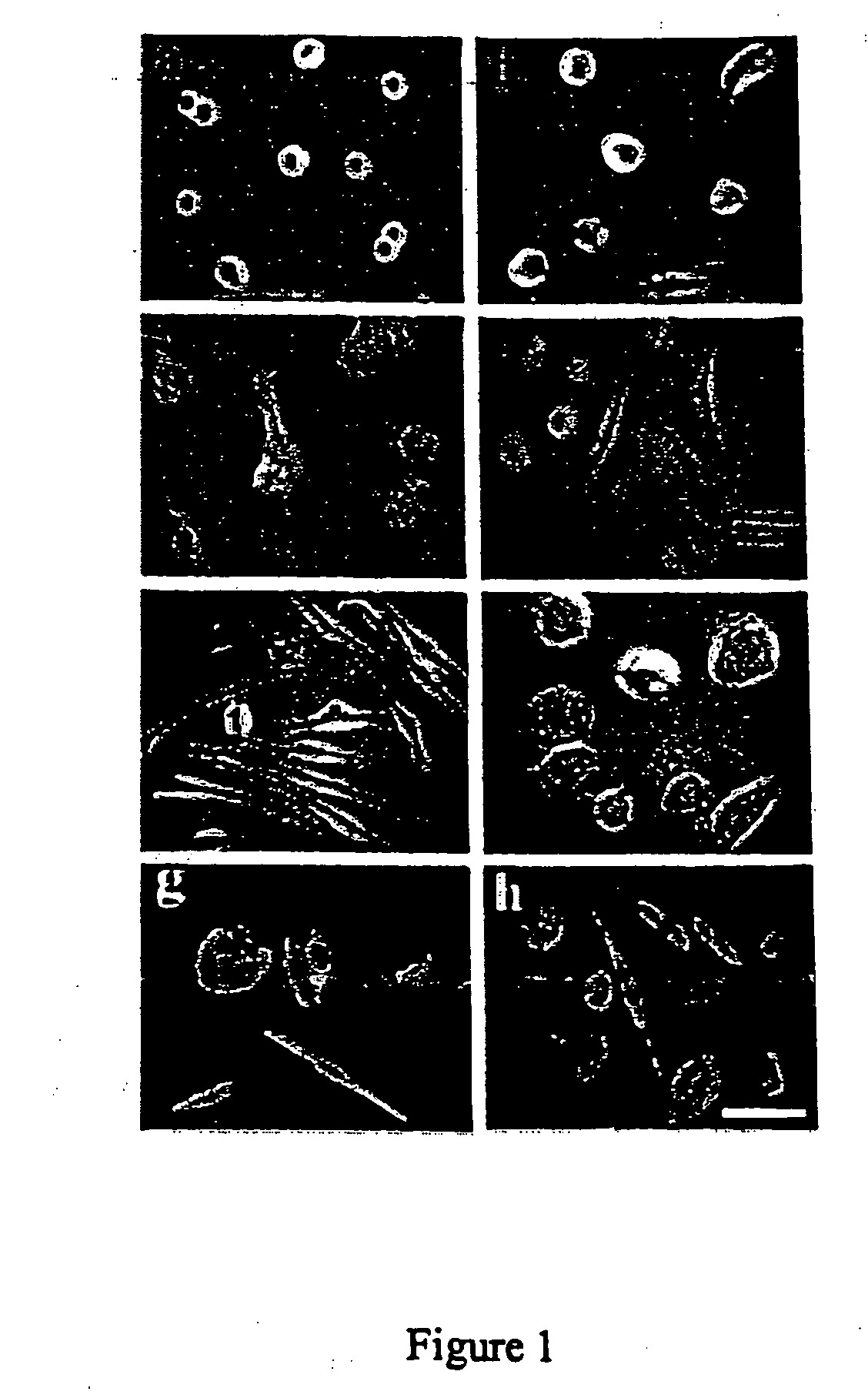
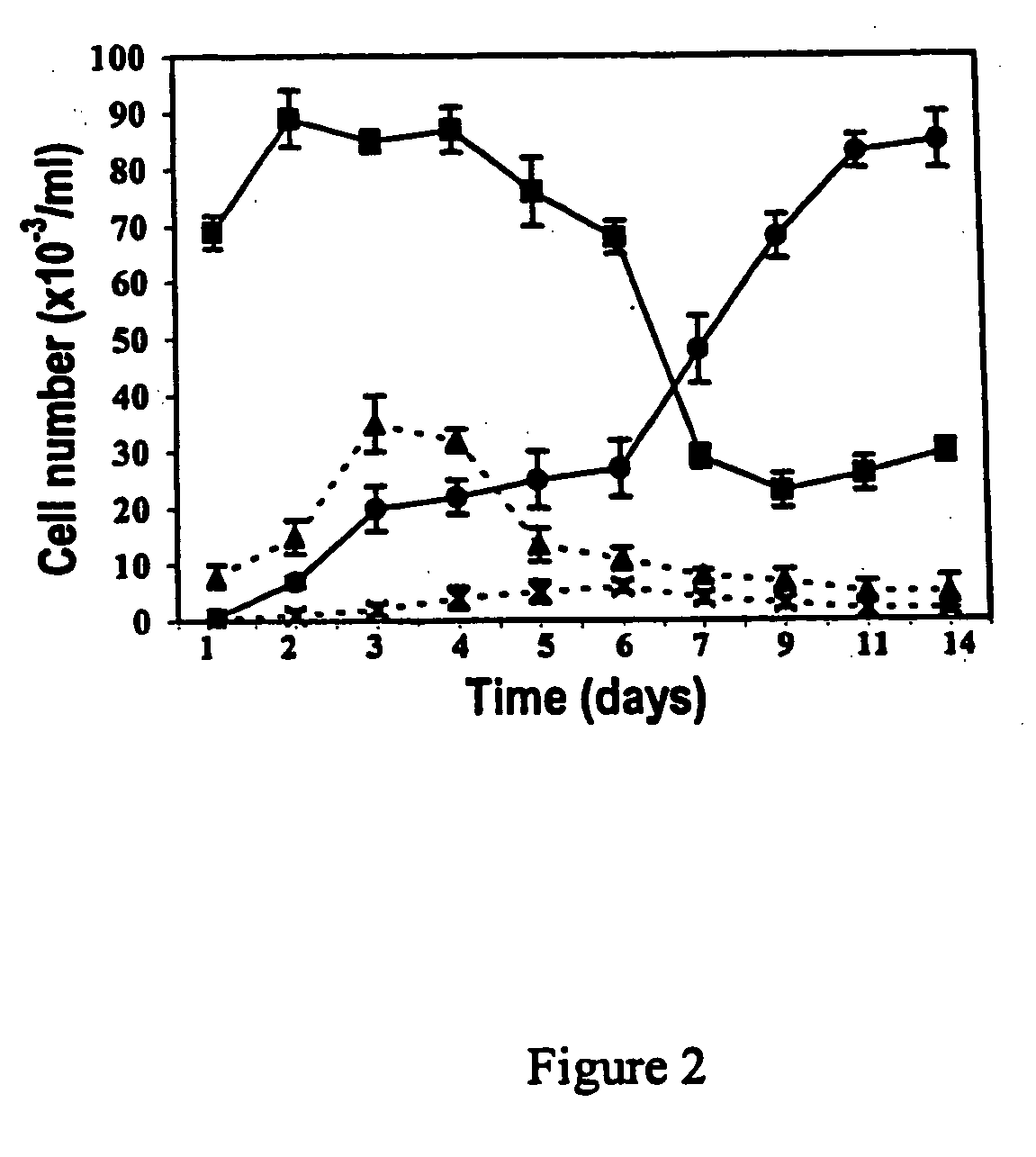
[0115] Unlike s-MΦ, MDSCs contained dividing cells (FIG. 1e) and displayed elevated levels of the hematopoietic stem cell marker CD34 (Randall et al., Stem Cells, 16:38-48 (1998))) (Table 1). In order to determine whether the MDSCs were simply replicating progenitors of s-MΦ, five preparations of cultured peripheral blood monocytes, each from a different human, were treated with 50 ng / ml M-CSF and the number of MDSCs and s-MΦ were determined over a period of 14 days by morphological examination. The results indicated that after 6 days, the number of MDSC increased while the number of s-MΦ decreased (FIG. 2). Based on the growth curve during this time, it was estimated that the MDSC population replicated about every three days. After day 10, the confluent cultures were composed of 80-90% MDSCs (FIG. 2). No such increase was observed in cultures untreated with M-CSF (FIG. 2). Replenishing the cultures with fresh M-CSF on days ...
example 3
Macrophage and T-Lymphocyte Cell Differentiation
[0118] To confirm their progenitor nature (i.e., their pluripotency), preparations of 12-14-day-old, M-CSF-treated, monocyte cultures containing 80-90% MDSCs, from each of four different humans (MDSC cultures), were incubated with 1 μg / ml LPS, a macrophage activator (Vadiveloo et al., J. Leukoc. Biol., 66:579-582 (1999)). This treatment transformed the MDSCs into standard macrophages. This transformation was verified by characterization of morphology, lipid staining, increased HLA-DR, HLA-DQ, IL-10 and TNF-α immunostaining (FIG. 3), and cytotoxicity (Table 1).
[0119] To determine whether the MDSCs could also be induced to mature along another blood lineage, the ability of IL-2 to induce T-lymphocyte differentiation was tested. Treatment of four MDSC cultures with 1200 units / ml IL-2 for 4 days induced the cells to acquire a round morphology. This treatment also caused about 90% of the treated cells to express CD3, which is a defining ...
PUM
| Property | Measurement | Unit |
|---|---|---|
| volume | aaaaa | aaaaa |
| volume | aaaaa | aaaaa |
| volume | aaaaa | aaaaa |
Abstract
Description
Claims
Application Information
 Login to View More