
Stacked via-stud with improved reliability in copper metallurgy
a copper metallurgy and via-stud technology, applied in the direction of semiconductor/solid-state device details, thin material processing, semiconductor devices, etc., can solve the problems of increasing crack propensity, increasing crack generation, and increasing the proneness of stacked via-studs to cracks, so as to facilitate redundant paths and increase the flexibility of stacked via-studs
- Summary
- Abstract
- Description
- Claims
- Application Information
AI Technical Summary
Benefits of technology
Problems solved by technology
Method used
Image

Examples
Embodiment Construction
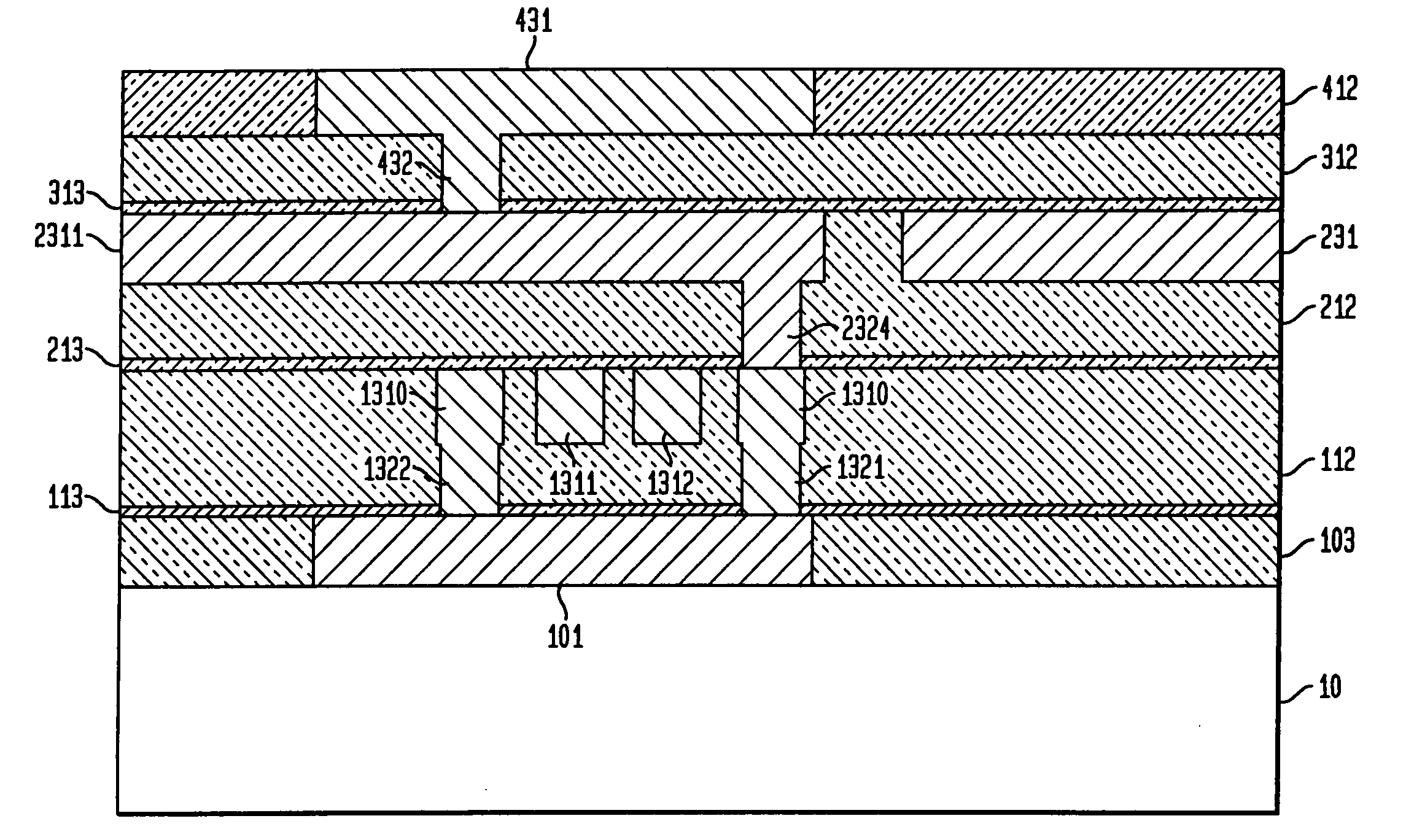
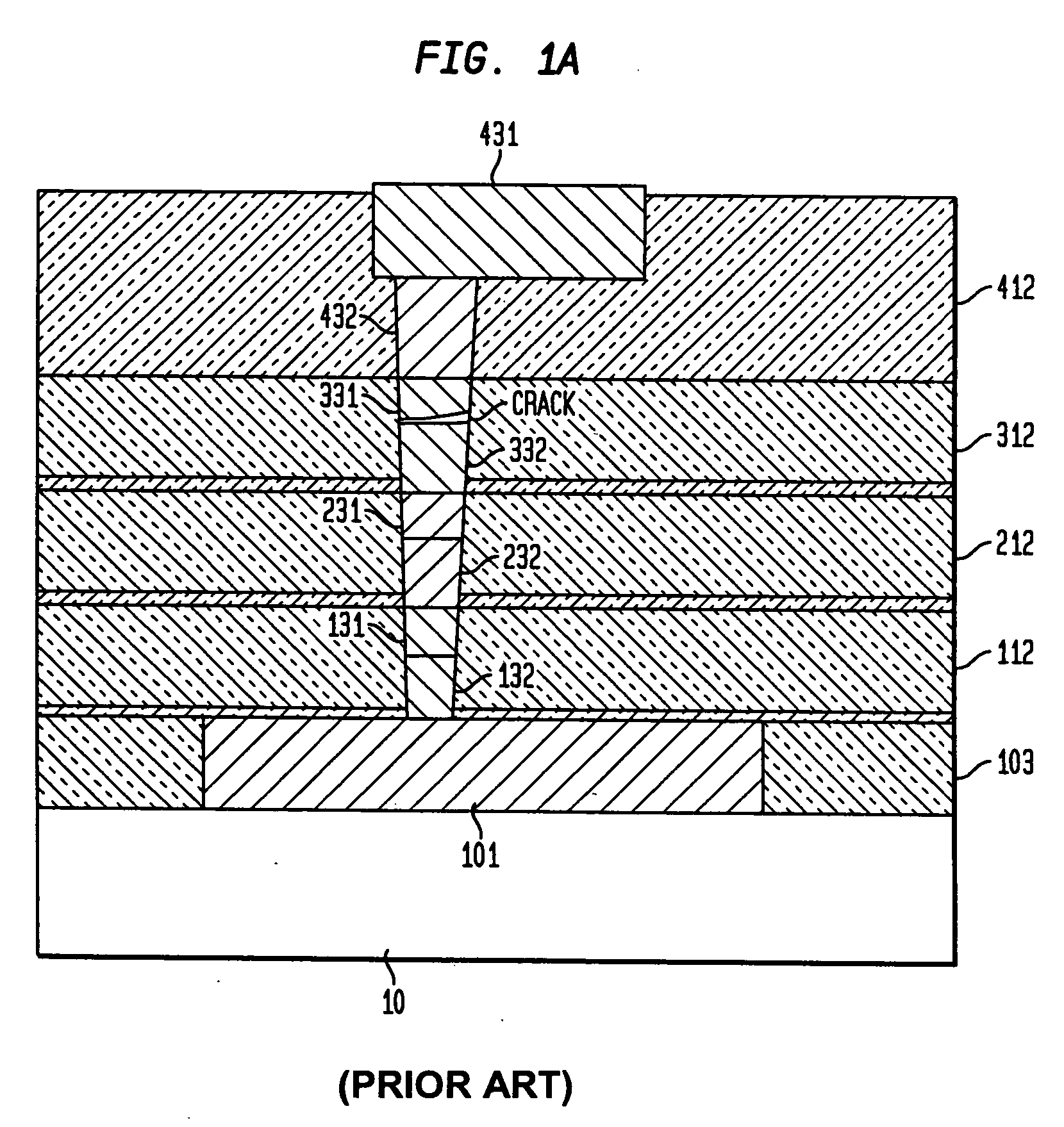
[0048] The present invention is generally related to methods for forming metal filled via-studs and conductor lines on a substrate where the via-studs and conductor lines are formed using a dual damascene method, and preferably copper metallurgy and low-k dielectric material. The present invention has particular relevance to stacked via-stud schemes which particularly use low strength low-k dielectric materials and incorporate a cantilever structure within the stacked via-stud which may serve as an effective thermal fatigue crack stop.
[0049] Particularly referring to FIG. 2, there is shown a semiconductor substrate 10 above which a sequence of dielectric layers 111, 112, 113 is deposited, subsequently patterned and metallized to form a first level of interconnection. It should be understood that a plurality of semiconductor devices may be formed in the substrate and, although not shown, are provided with a local interconnect line 101, typically tungsten with underlayers of titanium...
PUM
| Property | Measurement | Unit |
|---|---|---|
| thickness | aaaaa | aaaaa |
| thickness | aaaaa | aaaaa |
| thickness | aaaaa | aaaaa |
Abstract
Description
Claims
Application Information
 Login to View More