[0014] The invention is directed to compositions that are easily pumped or sprayed by
high pressure pumping equipment and / or that can be applied by small, low pressure, individual back tanks that firstly, prevents the expansion of fire, secondly, suppresses existing fire and thirdly, the present invention includes the methods of preparing and using such compositions.
[0015] The inventive compositions are used as an augmentation for water, and are environmentally
inert. The compositions have pseudo-plastic, high yield hydraulic properties with a
specific gravity very similar to water. The inventive compositions use pseudo-plastic high yield
suspending agents,
starch, both swelled and / or suspended,
rheology modifiers,
wetting agents, foaming or
defoaming agents,
coloring agents, antimcrobials and stabilizers added to water to produce a stable, nonsettling composition that is easily pumped or sprayed and gives sag resistance when applied on vertical or overhead surfaces. The inventive composition starves a fire of its supply of fuel and cools the
substrate surface.
Wetting agents help the composition penetrate into porous combustible surfaces and, with a unique combination of suspending agent and starch,
resist the exiting of water via means of tack and
rheology. The unique composition containing pseudo-plastic high yield suspending agent and suspended starch results in a composition that is
shear thinning and, therefore, can be sprayed into a fire, with the composition holding instantly on vertical or overhead surfaces. Then, as heat from the fire raises the temperature of the composition driving off more water, the composition swells and associates more starch, raising the
viscosity and making the composition even more resistant to flow.
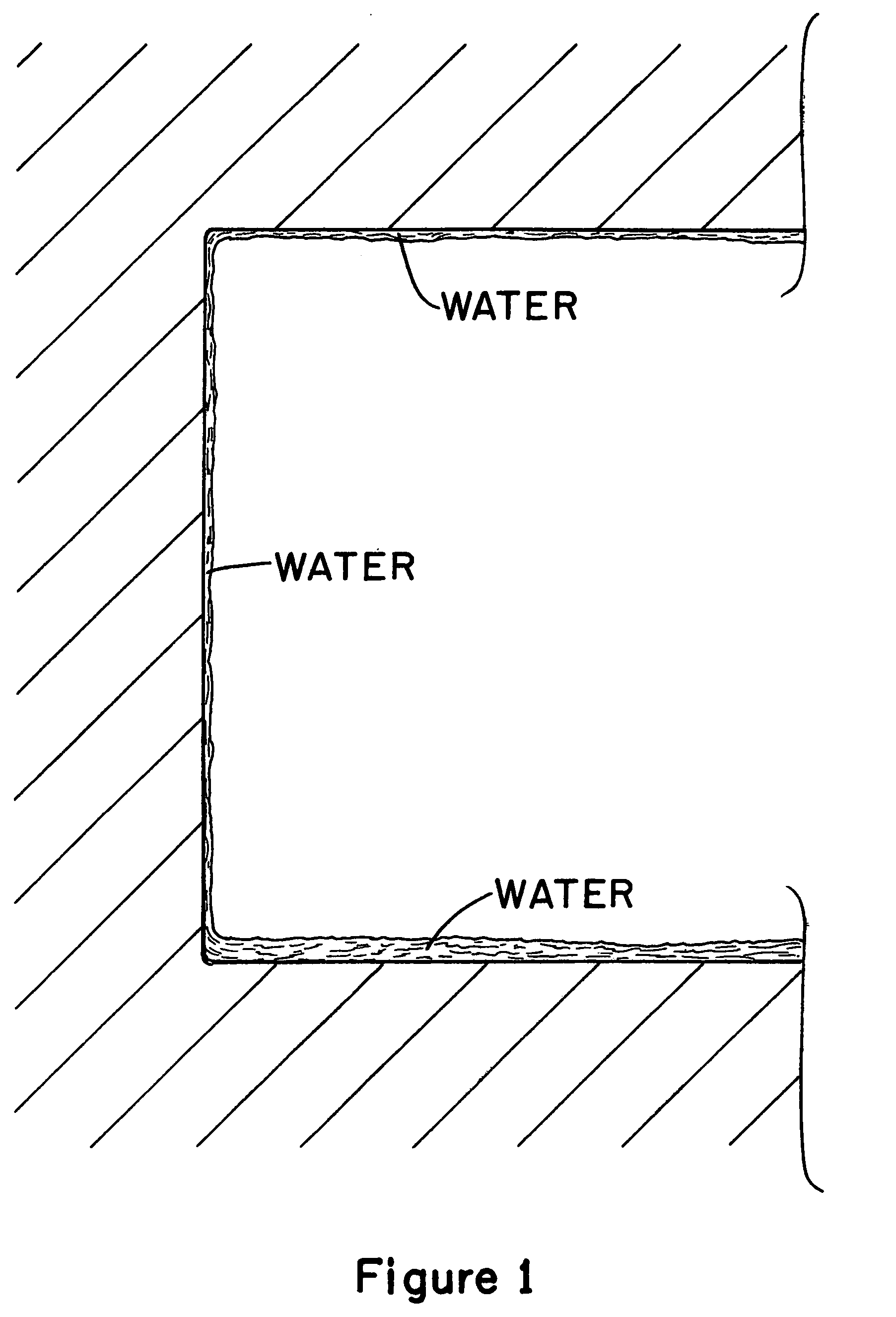
[0016] Commonly, water is used to reduce heat and suffocate a fire, but this only occurs while the water coats the combustible surface. Typically, more than 95% of the water is lost immediately from vertical or overhead surfaces due to gravity, as depicted in FIG. 1. At this point, water loses its ability to fight the fire as it runs down the wall of a building or off the
vegetation of a field or forest and into the soil. The inventive composition, with its unique combination of starch and high yield suspending agent, when exposed to the heat of a fire, does not lower in viscosity and run off, but actually increases in viscosity and becomes more tacky. Therefore, much less of the inventive composition is needed to fight the fire.
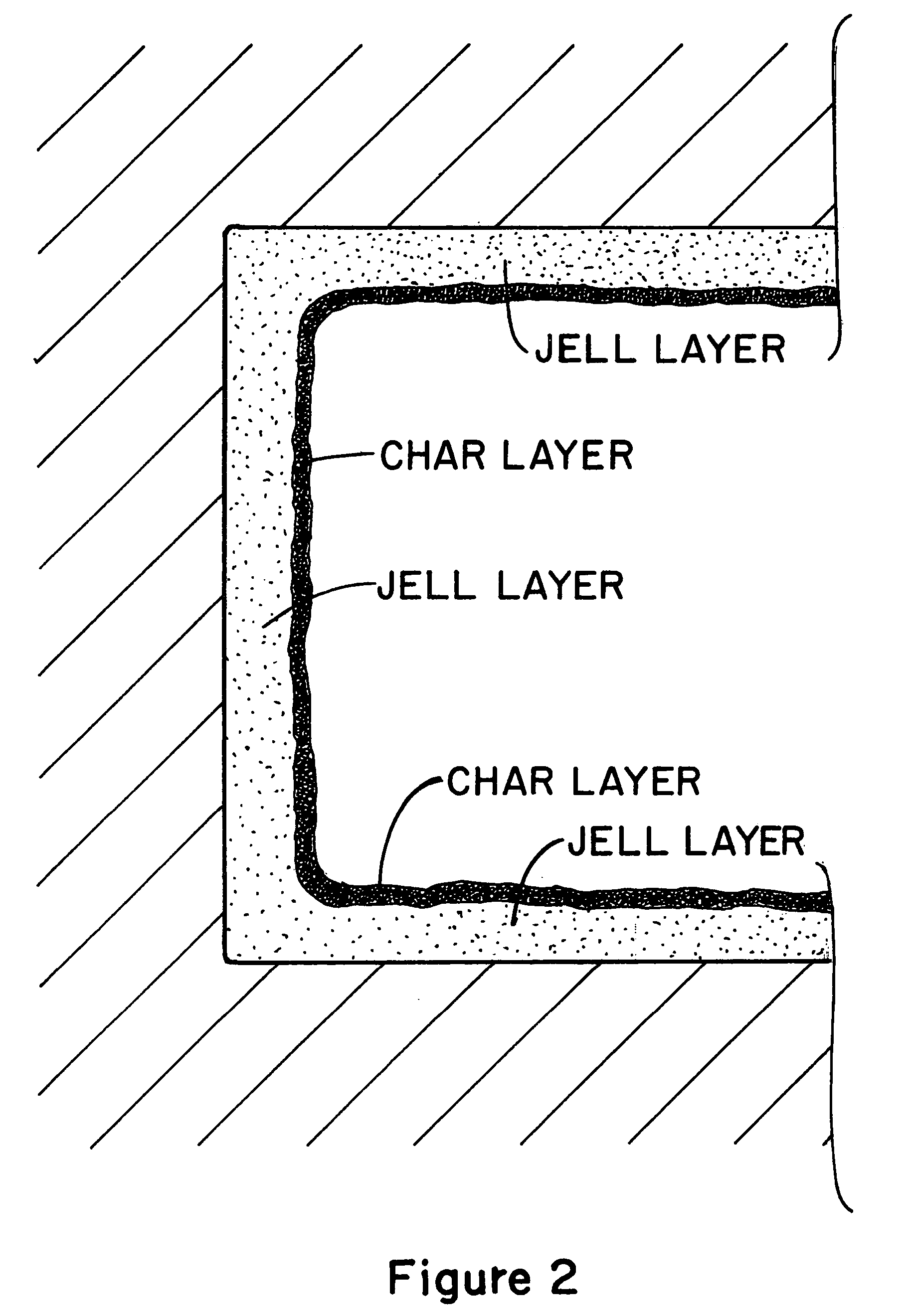
Firefighting personnel now have the ability to coat a surface with a layer of augmented water, an aqueous gel of the inventive composition, which becomes stickier and more thixotropic the instant it is exposed to heat. The inventive composition eventually forms a crust as the surface dries, which is, in turn, carbonized to a
char forming,
intumescent coating, remaining in place regardless of the orientation of the substrate, as depicted in FIG. 2. The inventive composition uses less water to control or extinguish a fire, thereby reducing the damage caused by the run off of water after the fire is extinguished.
[0017] When applied to a fire, the inventive composition takes two forms. On the surface is the thin hard carbonized
char, forming the
intumescent layer and below is a sticky, thick, aqueous gel which makes up the majority of the composition. The char helps reduce the
moisture loss from the aqueous gel of the composition and prevents the fire from reaching additional combustible substrates. The coated combustible substrate temperature now cannot exceed the
boiling point of water (100° C.), until the aqueous gel of the composition is fully dried.
[0020] Antimicrobials and stabilizers are added to the inventive composition to protect surrounding buildings from mold and extend the
shelf life of the inventive composition, as well as protecting soils from the catastrophic effects of
erosion and
watershed equilibrium. Examples of
antimicrobial agents include blends of methyl
paraben and
propyl paraben, and Vancide # 51, a blend of
sodium dimethyldithiocarbamate and
sodium 2(3H)-benzothiazolethione. Stabilizer examples include a
fumed silica, such as Carb-O-Sil, or a borate. To fight fires where an extreme need to extinguish the fire in seconds is more important then
toxicity concerns, conventional fire retardants such as halogens,
antimony oxide and salts, such as
ammonium phosphate,
ammonium sulfate or other similar chemical retardants, can be used as modifiers that are easily added and then utilized with such special compositions.


 Login to View More
  Login to View More