
Switching device
a technology of switching device and switch, which is applied in the direction of thermoelectric devices, instruments, nanoinformatics, etc., can solve the problems of affecting the bistable performance of the device as a whole, the proportion of the two components is critical, and the switch device uses an organic charge transfer complex. achieves stable bistable performance, suppresses material composition variation, and excellent bistable characteristics
- Summary
- Abstract
- Description
- Claims
- Application Information
AI Technical Summary
Benefits of technology
Problems solved by technology
Method used
Image

Examples
example 1
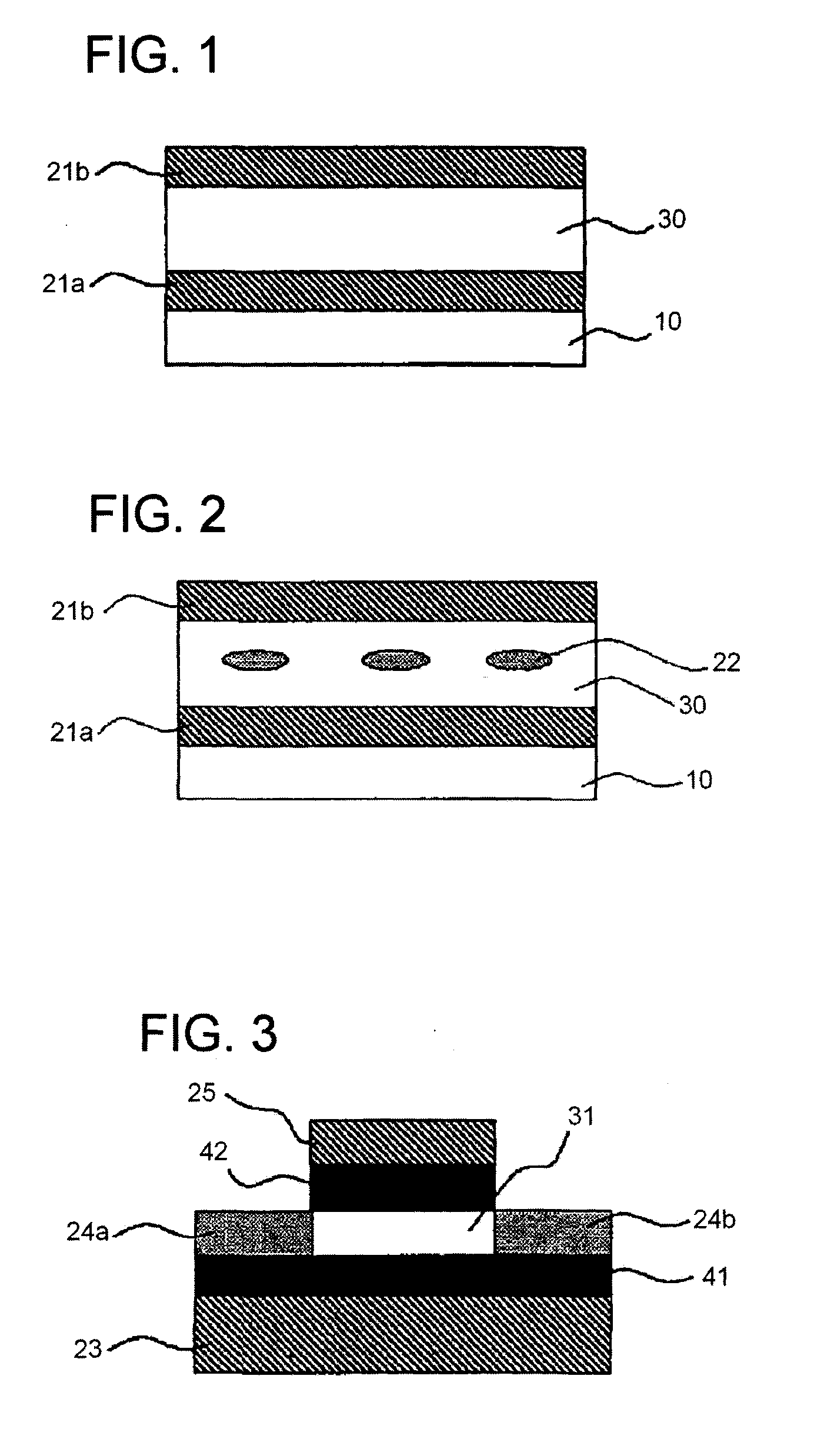
[0074] A switching device having a structure of FIG. 1 was produced in the following procedure. A glass substrate was used for substrate 10. Thin films of first electrode layer 21a, organic bistable material layer 30, and second electrode layer 21b having thicknesses of 100 nm, 80 nm, and 100 nm, respectively, were sequentially formed on the substrate by means of vacuum evaporation method, to form a switching device of Example 1.
[0075] Evaporation sources were aluminum for first electrode layer 21a and second electrode layer 21b, and a quinone compound represented by the structural formula (I-1) for organic bistable material layer 30. The evaporation apparatus was evacuated to 3×10⁻⁶ torr by a diffusion pump. The evaporation of aluminum was conducted by a resistance heating method with a deposition speed of 3 Å / sec; the evaporation of the quinone compound was conducted by a resistance heating method with a deposition speed of 2 Å / sec. The processes of evaporating the layers were co...
example 2
[0076] A switching device was produced in the same manner as in Example 1 except that the organic bistable material represented by the structural formula (I-1) used in Example 1 was replaced by the organic bistable material represented by the structural formula (I-2).
example 3
[0077] A switching device was produced in the same manner as in Example 1 except that the organic bistable material represented by the structural formula (I-1) used in Example 1 was replaced by the organic bistable material represented by the structural formula (II-1).
PUM
| Property | Measurement | Unit |
|---|---|---|
| thickness | aaaaa | aaaaa |
| temperature | aaaaa | aaaaa |
| temperature | aaaaa | aaaaa |
Abstract
Description
Claims
Application Information
 Login to View More