[0004] Starting from the problems and disadvantages of the prior art, it has been made the object of the invention to improve the productivity of coating systems, especially low pressure
plasma coating systems for coating gas
turbine blades, without having to accept losses in the quality of the coating.
[0006] A
temperature control of the treatment chamber, according to the invention, at a temperature of between 45° C. and 75° C., takes place preferably by means of heat exchangers on the walls of the chamber, which exchange the heat between the chamber walls and a
heat transfer fluid, for example water. In the previous prior art, a
temperature control of the chamber takes place at a temperature of about 20° C. The increase of the chamber temperature or the temperature of the chamber walls, as the case may be, to 45° C. to 75° C., preferably to 55° C. to 65° C., according to the invention, which produced the best results with regard to the
treatment duration and the coating quality, has the great
advantage that the desired vacuum can be achieved quicker, and, on account of the high quality of the vacuum, a reduction of the absorption of components of the air from the environment can be very much reduced within the scope of the coating process. Consequently, the quality of the coating is increased, with a simultaneous reduction of the
treatment time per workpiece. These positive effects are attributable to the higher temperature of the chamber or the chamber walls, as the case may be, very much reducing the condensation of components of the constantly moist air on the chamber walls or on the contaminants there, as the case may be. If the duration of the evacuation is maintained, a lower pressure can be achieved. On account of the lower volume of condensates in the region of the chamber walls, the negative pressure or the vacuum, as the case may be, is also sustainably stable, since the volume of subsequently evaporating condensates is much reduced on account of the increased temperature.
[0007] A further
advantage of the increased chamber temperature or chamber wall temperature, as the case may be, results from the workpiece being preheated for the most part to about 900° C. for the purpose of coating, and this temperature should be maintained even during the coating process in the interests of a high coating quality. The increased chamber wall temperature, compared to the prior art, is instrumental in even large workpieces as far as possible maintaining their increased temperature during the coating process. This effect is to be attributed basically to the altered
heat balance first of all as a result of heat
radiation into the evacuated chambers. As a result of the application of the method according to the invention or the implementation of a
coating system according to the invention, as the case may be, the productivity is increased by almost 10%.
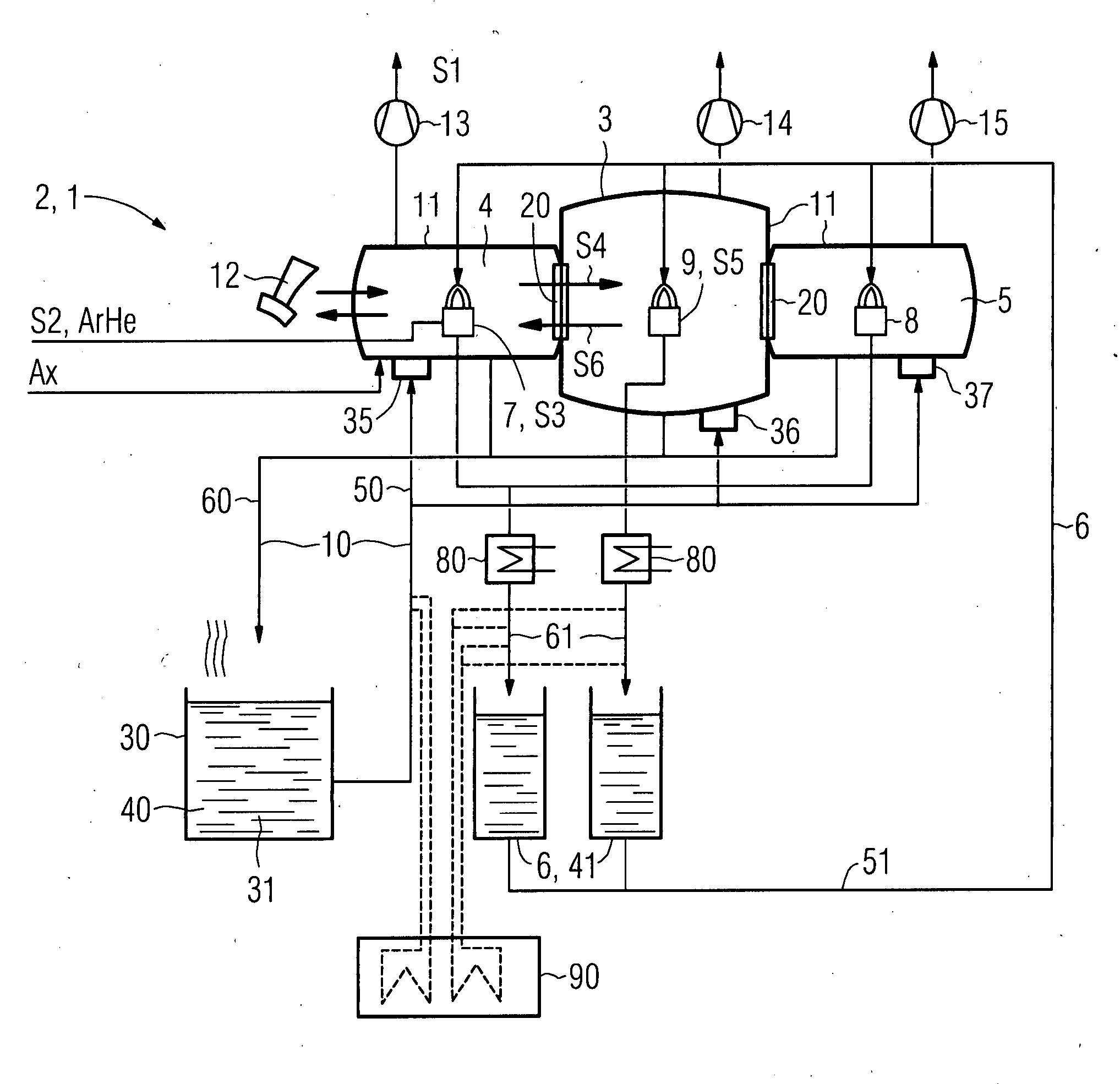
[0008] The coating system expediently has a second
heat exchanger in addition to a first
heat exchanger in the region of the chamber walls, which regulates the
inlet temperature for the first
heat exchanger at 55° C. to 65° C. In the interests of a high
throughput of workpieces which are to be coated, it is expedient if the coating system additionally has at least one, preferably two, antechambers in addition to the actual treatment chamber, in which antechambers the workpieces are heated to a temperature of preferably 900° C. which is expedient for the coating. In addition to a
temperature control of the
antechamber at a temperature of 45° C. to 75° C., it is sensible if the antechambers also experience such a temperature control. In order to carry out the actual coating in a space which is protected as far as possible, it is advantageous if the treatment chamber, in which the coating takes place, is separable from the antechambers in each case by means of a closable partition. Such a lock also enables the maintaining of a high vacuum quality, especially in the treatment chamber. Within the scope of the necessary opening of the partition during the transfer of a workpiece from an
antechamber into the treatment chamber, and during the pressure
equalization between the treatment chamber and the
antechamber which is associated with it, the antechamber can already be evacuated to the level of the treatment chamber so that the treatment chamber, basically without interruption, has the necessary negative pressure for the coating.



 Login to View More