
Floating gate memory device with interpoly charge trapping structure
a floating gate memory and charge trapping technology, applied in the field of nonvolatile memory devices, can solve the problems of performance degradation, performance degradation, and the technology of floating gate degrading, and achieve the effects of reducing interference between adjacent devices, constant threshold voltage, and improving data retention
- Summary
- Abstract
- Description
- Claims
- Application Information
AI Technical Summary
Benefits of technology
Problems solved by technology
Method used
Image

Examples
Embodiment Construction
[0060]A detailed description is provided with reference to FIGS. 1-28.
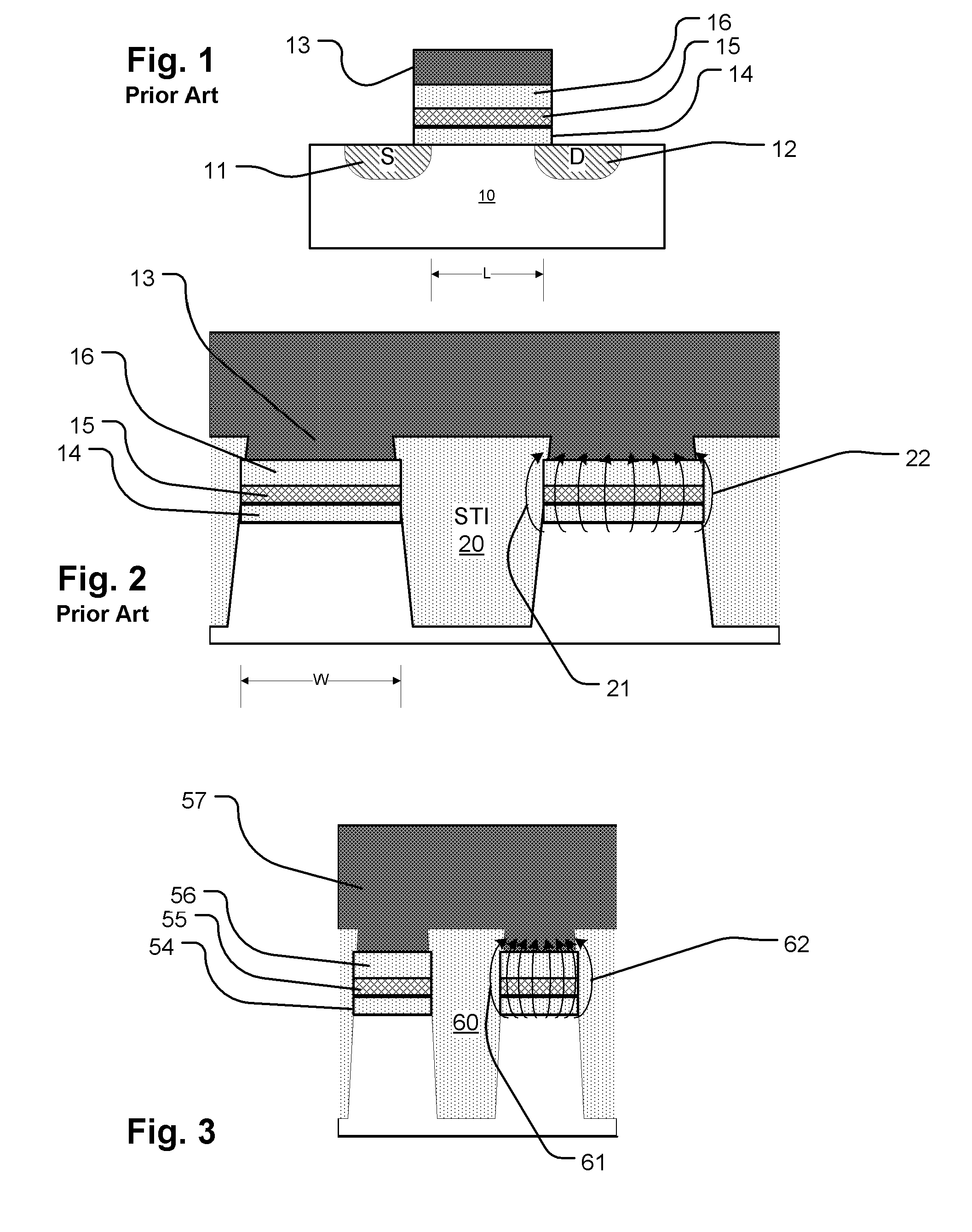
[0061]FIG. 1 illustrates the basic structure of a prior art SONOS-type memory cell. The cell is formed on a semiconductor substrate 10 in which a first doped region 11 acts as a source terminal and a second doped region 12 acts as a drain terminal. A control gate 13 is formed over a charge trapping structure which includes a bottom tunneling barrier structure 14, a dielectric charge trapping layer 15, and a top dielectric 16. The channel of the memory cell is the region of the substrate 10 between the first doped region 11 and the second doped region 12. The dimension L shown in FIG. 1 is typically referred to as the channel length L, because current flows between the source and drain along this dimension of the channel. The SONOS-type memory cell shown in FIG. 1 is often configured in a NAND array configuration, in which a column in the array includes sets of memory cells arranged in series between a ground conta...
PUM
 Login to View More
 Abstract
Description
Claims
Application Information
 Login to View More