
Highly conductive and stable transparent conducting polymer films
- Summary
- Abstract
- Description
- Claims
- Application Information
AI Technical Summary
Benefits of technology
Problems solved by technology
Method used
Image

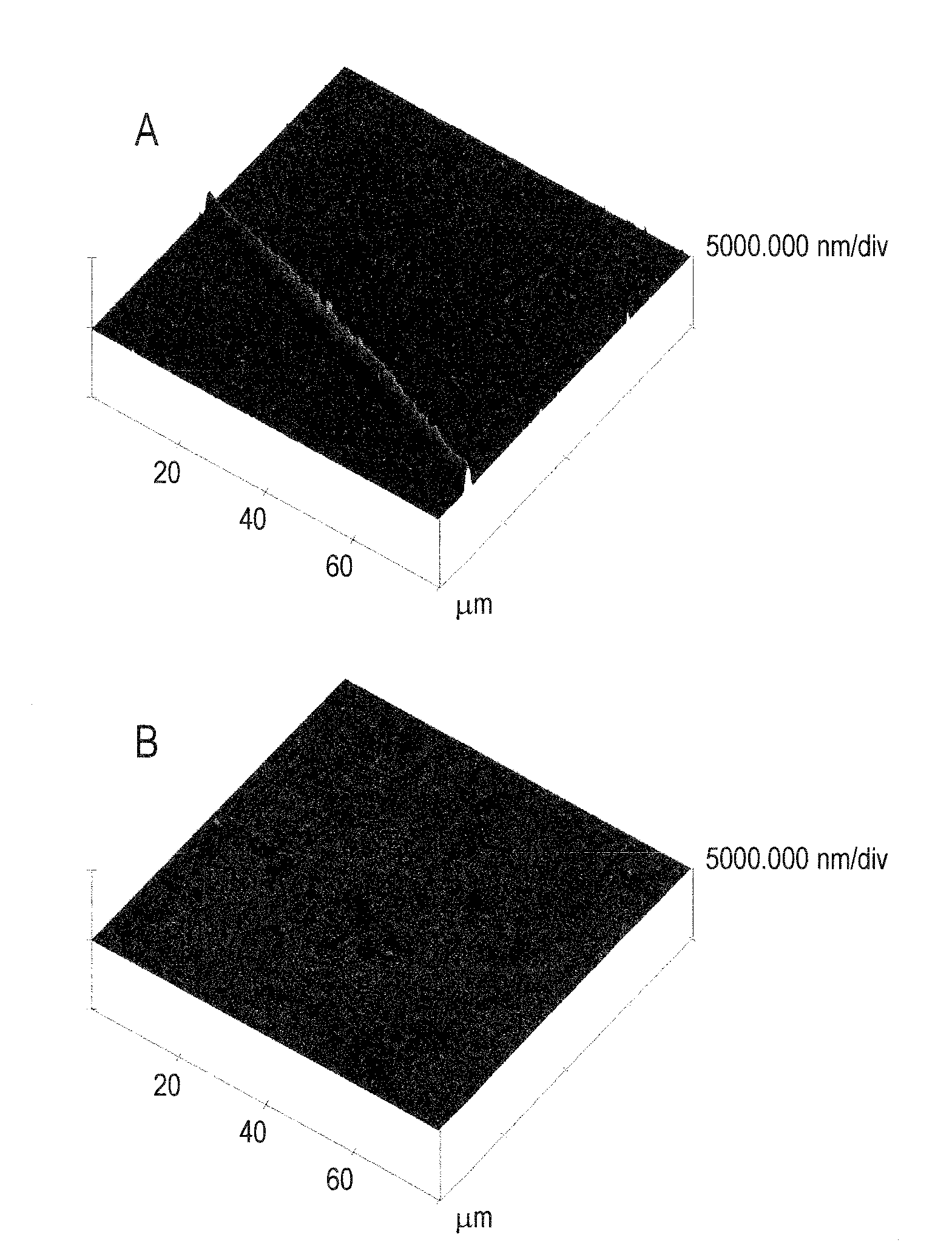
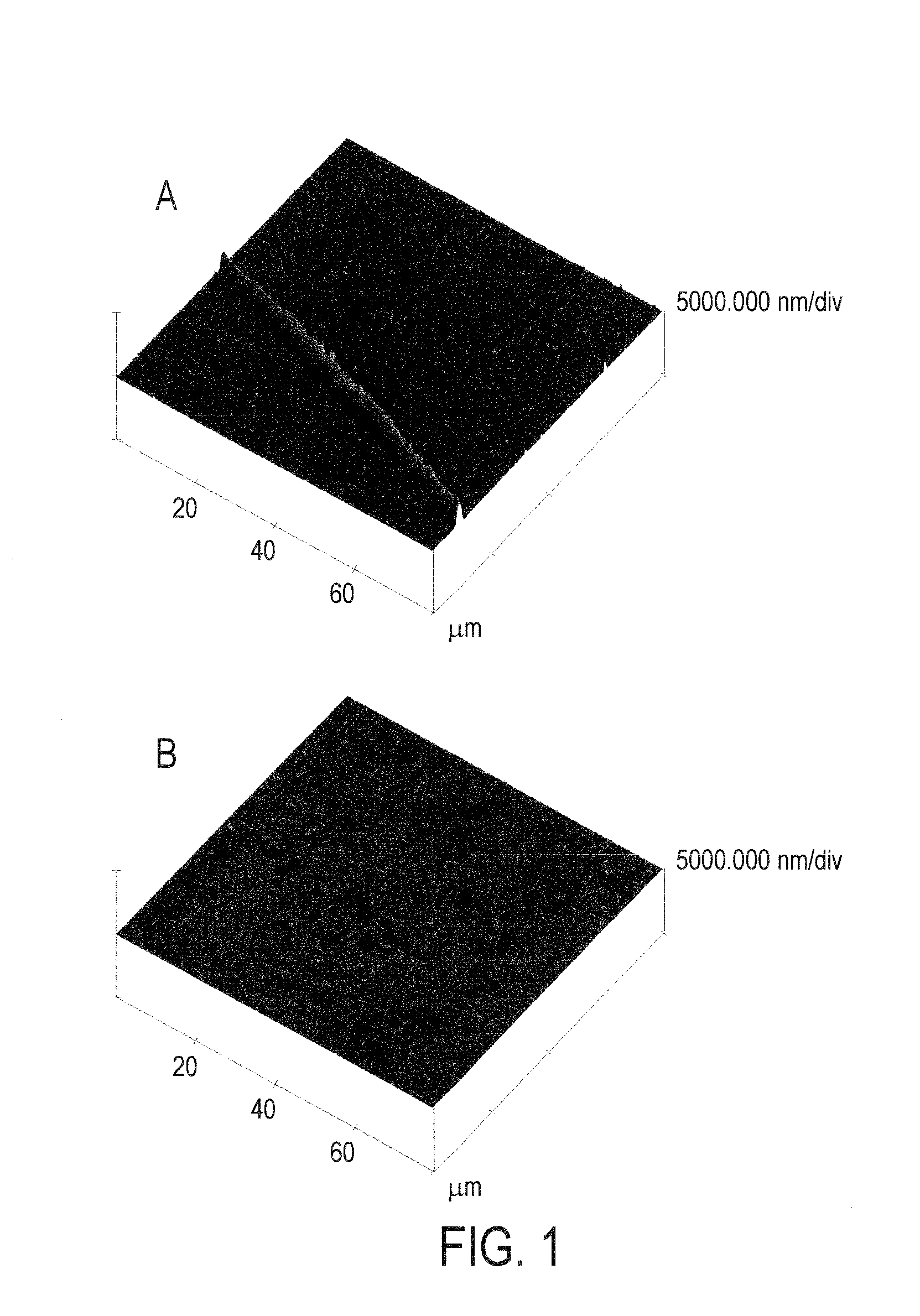
Examples
example 1
Comparison of VPP-PEDOT Produced with and without Polymer Additives
VPP_PEDOT Production a Method for Mass Production Using PVA / PEO Additives Solution Preparation
[0049]Aqueous solutions comprising an oxidant, a polymerization inhibitor and a polymeric additive were prepared by first preparing an oxidant solution and an additive solution and then combining these solutions. Oxidant solution (1), for use with PVA, was produced by dissolving 6 g Iron p-toluenesulfonate heptanedionate, 0.2 g pyridine, 0.8 g glycerol in 30 g iso-propanol. Oxidant solution (2), for use with PEO, was made by replacing the iso-propanol with DI water and keeping the other materials in the same amount as in solution (1). Glycerol is a viscous, water-miscible solvent which is included to tailor the viscosity of the oxidant solution. A PVA solution was made by dissolving 0.5 g PVA in 3 g DI water and a PEO solution by dissolving 0.6 g PEO in 3 g DI water. The solutions were stirred for several hours on a hot plat...
example 2
VPP-PEDOT Film with Pin Hole Free Substrate Coverage and High Conductivity
[0062]A series of VPP-PEDOT thin films was prepared using the known synthetic route described in example 1, depositing the oxidant layers from an oxidant solution containing 17% iron p-toluenesulfonate heptanedionate and 0.6% pyridine in a toluene and butanol (1:1) solution. There were no polymer additives in the solution. The temperatures for polymerization were varied from 3 to 40° C.
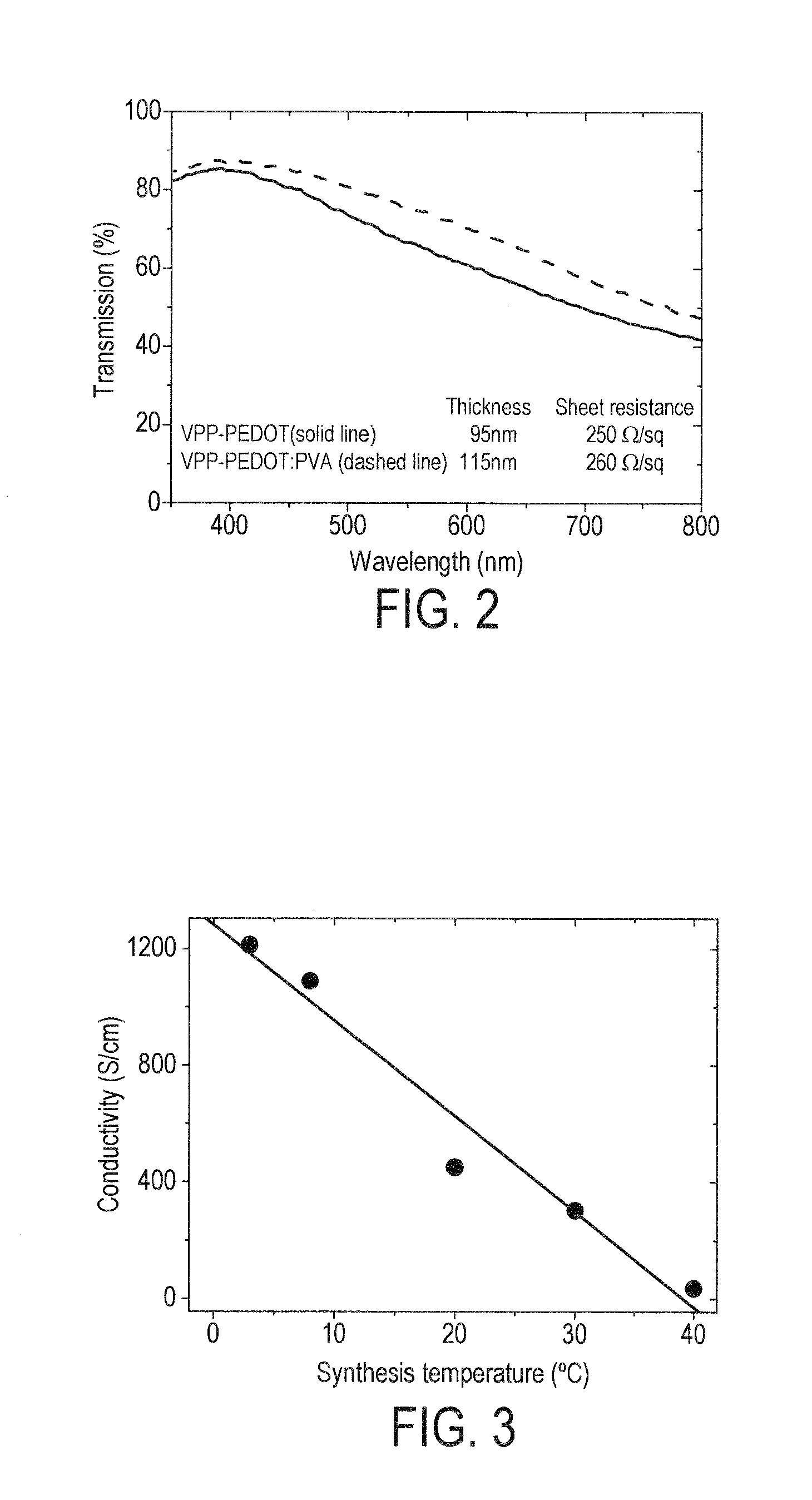
[0063]The conductivity of the VPP-PEDOT film is considerably increased by reducing the synthesis temperature. The conductivity of VPP-PEDOT film vs synthesis temperature is shown in FIG. 3. The highest conductivity, 1200 S / cm, was obtained at 3° C. It is considered that the high conductivity of VPP-PEDOT films synthesized at low temperature is predominantly due to the low growth rate, which is favorable for the formation of polymer chains with long conjugation lengths. A corresponding trend in increasing conductivity with reduct...
PUM
| Property | Measurement | Unit |
|---|---|---|
| Temperature | aaaaa | aaaaa |
| Temperature | aaaaa | aaaaa |
| Temperature | aaaaa | aaaaa |
Abstract
Description
Claims
Application Information
 Login to View More