Check patentability & draft patents in minutes with Patsnap Eureka AI!

Enzymes involved in triterpene synthesis

a triterpene and enzyme technology, applied in the field of enzymes involved in triterpene synthesis, can solve the problems that the gene machinery required for the elaboration of this important family of plant secondary metabolites is as yet largely uncharacterized

Inactive Publication Date: 2011-01-27
PLANT BIOSCI LTD
View PDF2 Cites 0 Cited by
  • Summary
  • Abstract
  • Description
  • Claims
  • Application Information

AI Technical Summary

Benefits of technology

Identification of the genes encoding enzymes responsible for triterpene synthesis in a variety of crops will allow their manipulation. Manipulation of triterpene synthesis will result in changes in the levels or structures of the triterpene saponins. An increase in saponin production will result in an enhancement of plant resistance to pests. Foods originating from plants having an increased level of triterpenes are thought to have a cholesterol lowering effect while decreased triterpenes are believed to result in better tasting foods having. Thus, transgenic plants having altered levels of triterpenes may be resistant to pests and foods prepared with seeds having altered levels or structures of saponins will have increased nutritional value or better flavor.

Problems solved by technology

The genetic machinery required for the elaboration of this important family of plant secondary metabolites is as yet largely uncharacterized, despite the considerable commercial interest in this important group of natural products.
This is likely to be due in part to the complexity of the molecules and the lack of pathway intermediates for biochemical studies.

Method used

the structure of the environmentally friendly knitted fabric provided by the present invention; figure 2 Flow chart of the yarn wrapping machine for environmentally friendly knitted fabrics and storage devices; image 3 Is the parameter map of the yarn covering machine
View more

Image

Smart Image Click on the blue labels to locate them in the text.
Viewing Examples
Smart Image
  • Enzymes involved in triterpene synthesis
  • Enzymes involved in triterpene synthesis
  • Enzymes involved in triterpene synthesis

Examples

Experimental program
Comparison scheme
Effect test

example 1

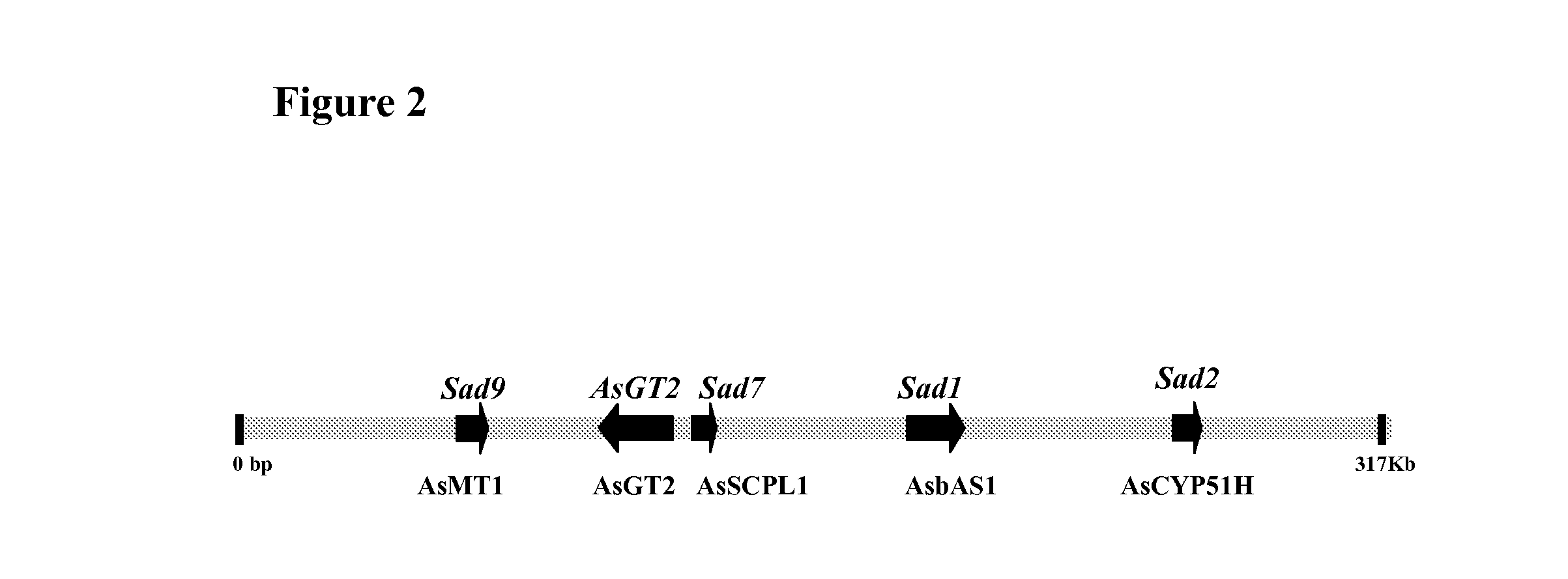
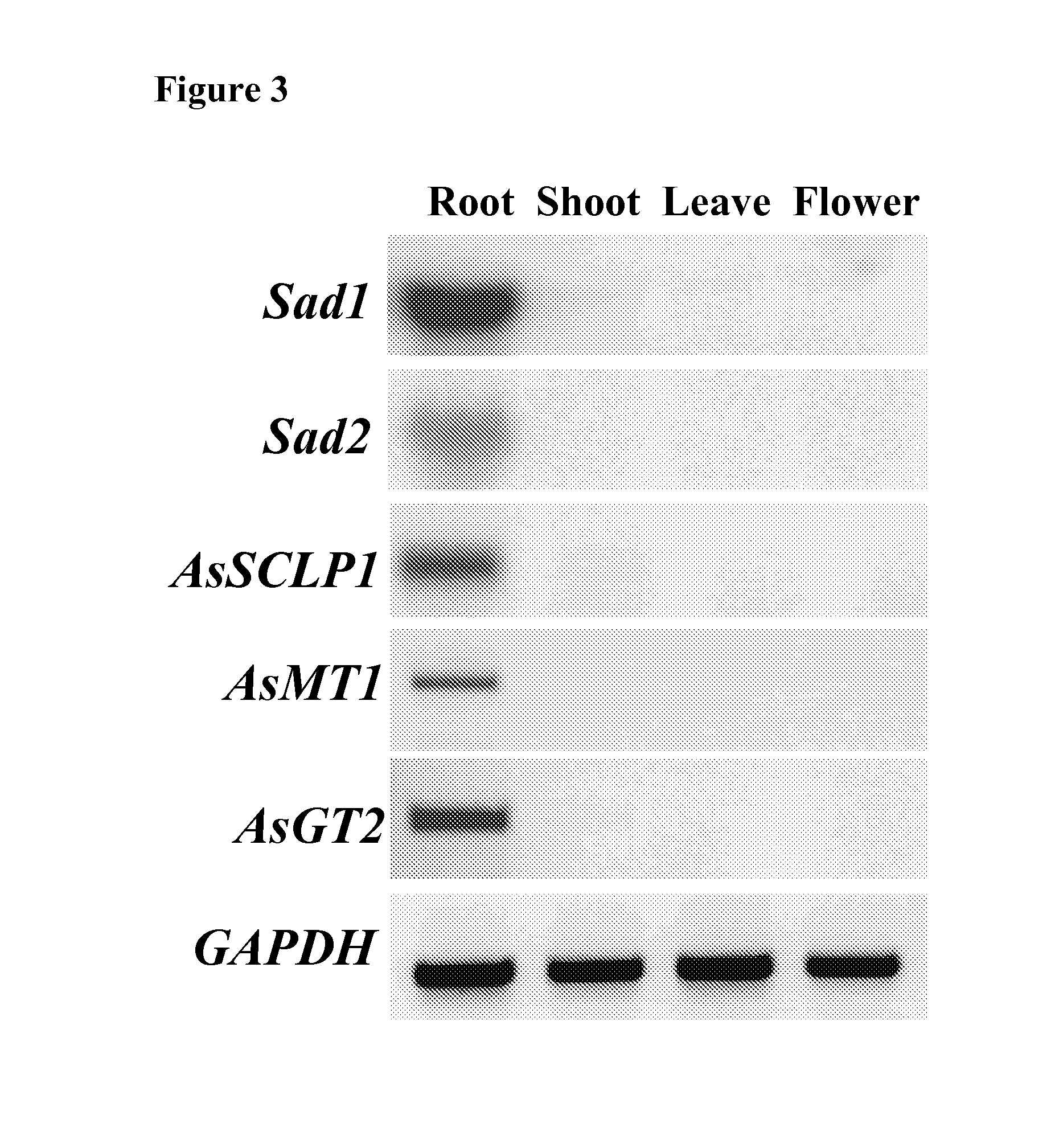
Isolation of Genomic and cDNA Fragments for the Serine Carboxypeptidase-Like Protein (AsSCPL1), the Methyltransferase (AsMT1) and the Glucosyltransferase (AsGT2)

The genomic polynucleotide fragment encoding the genes affected in the serine carboxypeptidase-like protein (AsSCPL1), the methyltransferase (AsMT1) and the glucosyltransferase (AsGT2) was isolated from a BAC library derived from Avena strigosa accession S75 genomic DNA and a cDNA library prepared from oat as follows.

A BAC library was constructed from A. strigosa accession S75 genomic DNA ((Qi X. et al., 2006, Proc. Natl. Acad. Sci. U.S.A. 103:18848-18853). DNA probes derived from Sad1 (Osbourn et al. Mar. 6, 2007, U.S. Pat. No. 7,186,884 B2) and Sad2 (Osbourn et al. US 2006-0112448 A1) were used to screen the entire BAC library. A BAC contig spanning a gene cluster for avenacin biosynthesis (Qi X. et al., 2004, Proc. Natl. Acad. Sci. U.S.A. 101:8233-8238) was built. BAC finger printing and BAC end sequence analysis allowed ...

example 2

Isolation and Characterization of Sad7 Oat Mutants

Seed of the diploid oat species Avena strigosa were mutagenized with sodium azide and M2 seed from individual M1 plants were germinated and assessed for root fluorescence as a preliminary screen to identify saponin-deficient, or Sad, oat mutants. Candidate avenacin-deficient mutants were identified on the basis of reduced root fluorescence and confirmed by TLC and HPLC analyses of methanolic root extracts from homozygous M3 seedlings.

Generation of Mutants

Seed of the diploid oat species Avena strigosa (accession S75 from the Institute of Grasslands and Environmental Research, Aberystwyth, Wales, UK) was mutagenized with sodium azide essentially as described (Rines, H. W., 1985, Env. Exp. Bot., 25:7-17). Briefly, mutagenesis was performed as follows. Seeds were presoaked in an Erlenmeyer flask sealed with a rubber stopper using 0.5 ml water per seed while shaking in an orbital platform shaker at 120 cycles per minute. After presoaking ...

example 3

Isolation and Characterization of Sad9 Oat Mutants

The original mutants #616, #825, #376 and #1243 (Papadopoulou et al. 1999. PNAS 96 12923-1928) do not contain any nucleotide changes in AsMT1 and AsGT2 genes. Sequence analysis was extended to the 82 new Sad mutants that were isolated as described in Example 2. Three mutant M3 lines (#195, #961 and #1310) were identified as having point mutations in the AsMT1 gene (Table 2). No mutations were identified in the AsGT2 gene for any of the mutants in the collection. DNA sequence analysis confirmed a single nucleotide change in the coding sequences in the three mutants, #195, #961 and #1310. Each of these nucleotide changes is predicted to cause an amino acid change (Table 2).

Roots of these three mutants lack the bright blue fluorescence associated with avenacin A-1 but fluoresce dull purple fluorescence under UV illumination. These mutants are referred to as “purple mutants”. One more purple mutant #841 was identified from the 82 new Sad...

the structure of the environmentally friendly knitted fabric provided by the present invention; figure 2 Flow chart of the yarn wrapping machine for environmentally friendly knitted fabrics and storage devices; image 3 Is the parameter map of the yarn covering machine
Login to View More

PUM

PropertyMeasurementUnit
Fractionaaaaaaaaaa
Fractionaaaaaaaaaa
Fractionaaaaaaaaaa
Login to View More

Abstract

This invention relates to isolated polynucleotides encoding enzymes consisting of a carboxypeptidase-like protein, a methyltransferase and a glucosyltransferase, involved in the biosynthesis of β-amyrin-derived triterpenes in plants and seeds. The invention also relates to the construction of recombinant DNA constructs comprising all or a portion of the isolated polynucleotides of the invention, in sense or antisense orientation, operably linked to at least one regulatory sequence.

Description

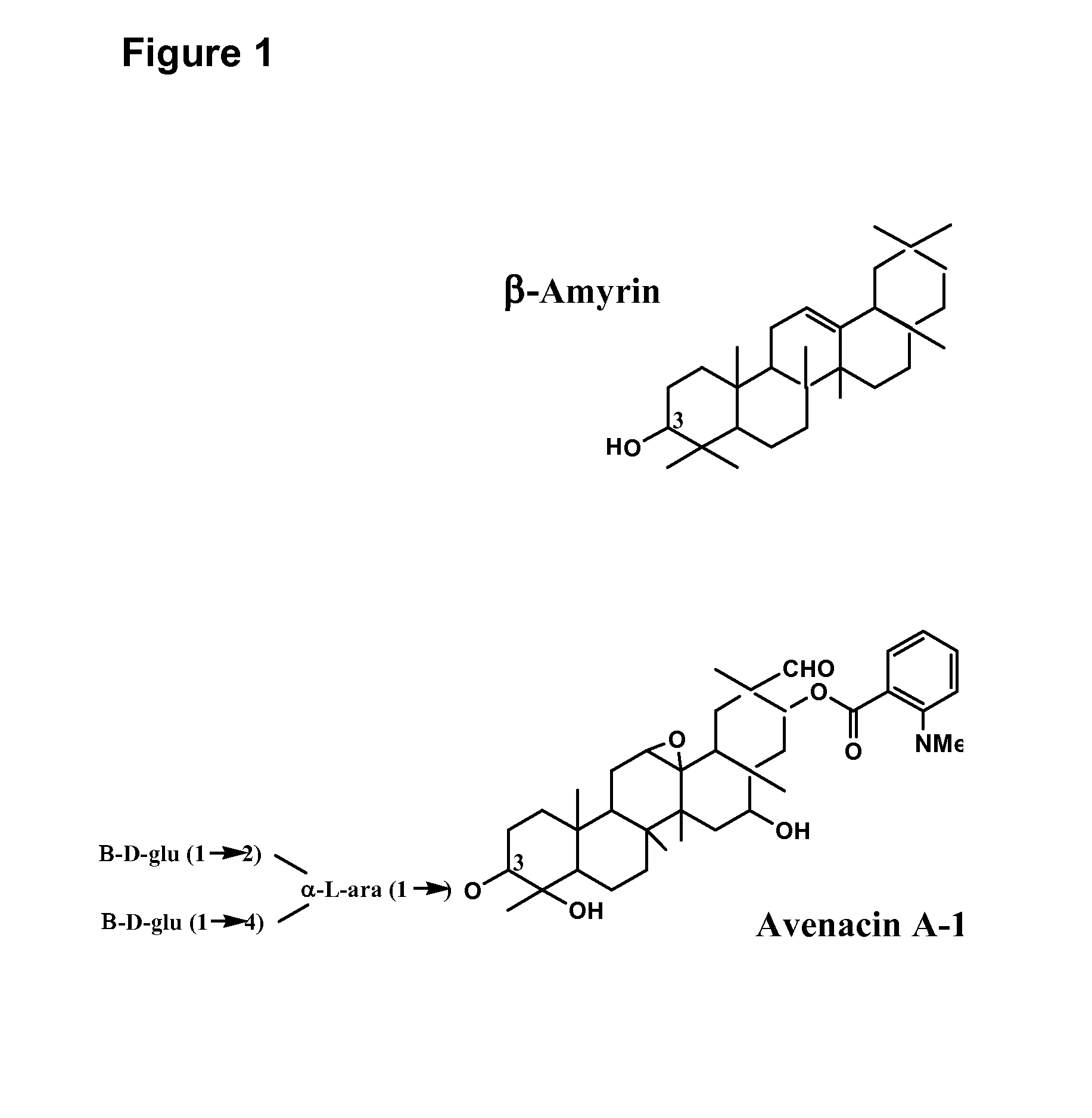
This invention is in the field of plant molecular biology. More specifically, this invention pertains to polynucleotides encoding enzymes involved in the biosynthesis of β-amyrin-derived triterpenes in plants and seeds. This invention also includes transgenic plants where the altered expression levels of the polynucleotides of the present invention results in altered levels or structures of β-amyrin-derived triterpenes, including saponins.BACKGROUND OF THE INVENTIONThe terpenoids, also called isoprenoids, constitute the largest family of natural products with over 22,000 individual compounds of this class having been described. The triterpenes or terpenoids (hemiterpenes, monoterpenes, sesquiterpenes, diterpenes, triterpenes, tetraterpenes, polyprenols, and the like) play diverse functional roles in plants as hormones, photosynthetic pigments, electron carriers, mediators of polysaccharide assembly, and structural components of membranes. The majority of plant terpenoids are found i...

Claims

the structure of the environmentally friendly knitted fabric provided by the present invention; figure 2 Flow chart of the yarn wrapping machine for environmentally friendly knitted fabrics and storage devices; image 3 Is the parameter map of the yarn covering machine
Login to View More

Application Information

Patent Timeline
no application Login to View More
IPC IPC(8): C12N15/82C07H21/04C12N15/63C12N5/10A01H5/00A01H5/10
CPCC12N9/1007C12N9/1029C12N15/8279C12N15/8243C12N9/1051
Inventor OSBOURN, ANNEQI, XIAOQUAN
Owner PLANT BIOSCI LTD
Features
  • R&D
  • Intellectual Property
  • Life Sciences
  • Materials
  • Tech Scout
Why Patsnap Eureka
  • Unparalleled Data Quality
  • Higher Quality Content
  • 60% Fewer Hallucinations
Social media
Patsnap Eureka Blog
Learn More