

Synthesis of High-Efficiency Thermoelectric Materials
- Summary
- Abstract
- Description
- Claims
- Application Information
AI Technical Summary
Benefits of technology
Problems solved by technology
Method used
Image

Examples
example 1
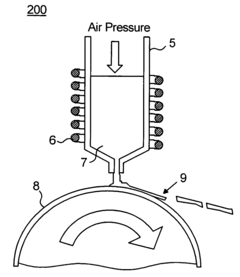
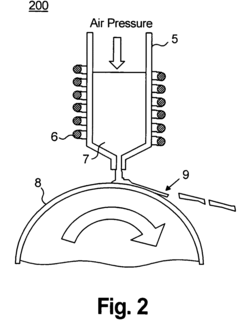
[0108]A predetermined quantity of Ce, Fe, and Sb is mixed together in the crucible of a melt-spinning apparatus. The ratio of Ce, Fe, and Sb present is nominally 1:4:12 such that it corresponds to the chemical formula for CeFe4Sb12. The mixture is heated to a temperature in excess of 1100° C. under an Ar gas ambient and held for a duration sufficient to completely melt all constituents and produce a uniformly mixed molten alloy. The Ar gas pressure is increased by ⅓ of the atmospheric pressure (atm), and a thin stream of molten alloy is ejected from the crucible through a 0.5 to 1.0-mm-diameter orifice, where it is directed onto a water-cooled wheel rotating at an angular velocity of 40 to 70 rpm (rotations per minute). The resulting melt-spun ribbons were analyzed using powder X-ray diffraction (XRD), as shown in FIG. 4A. Two additional melt-spun samples were fabricated under different melt-spinning conditions to serve as a basis for comparison and are also shown in FIG. 4A. From t...
example 2
[0115]A quantity of Ce, Fe, and Sb substantially identical to that used in Example 1 is mixed together in the crucible of a melt-spinning apparatus and heated above 1100° C. under an Ar gas ambient and held for a duration sufficient to completely melt all constituents and produce a uniformly mixed molten alloy. The Ar gas pressure is again increased by ⅓ atm and a thin stream of molten alloy is directed onto a water-cooled wheel rotating at 40 rpm. A quantity of the melt-spun particles was added to the SPS system and were again compacted under a force of FSPS=6.3 kN (kiloNewtons) on a circular cross section of diameter about 9 mm. However, in this case the particles were sintered at a temperature of TSPS=585° C. for 2 min. The resistivity ρ, thermal conductivity κ, figure of merit ZT, and Seebeck coefficient S for the TSPS=585° C. and 630° C. samples were measured and the results are plotted in FIGS. 6A, 6B, 6C, and 6D, respectively, as a function of temperature. T over the range T=...
example 3
[0117]Elemental Ce, Fe, and Sb are mixed together, melted, processed by melt spinning, and then sintered by SPS at TSPS=630° C. with FSPS=6.3 kN on a 9-mm diameter die in substantially the same manner as Example 1. However, for this sample the Sb content is increased slightly such that a sintered sample having atomic concentrations represented by the chemical formula CeFe4Sb12.04 is produced. Thus, the Sb ratio in Example 3 is increased from 11.85 to 12.04 and the thermoelectric properties of these materials are compared in FIGS. 7A-D. FIG. 7C shows that below approximately 100 K, the figure of merit ZT for CeFe4Sb11.85 is slightly higher than for CeFe4Sb12.04. As the temperature gradually increases, ZT for CeFe4Sb12.04 begins to increase with increasing temperature at a rate greater than that observed for CeFe4Sb11.85. However, the observed increase in ZT is not as significant as that obtained through a reduction in the sintering temperature TSPS in Example 2. The increase in ZT ob...
PUM
| Property | Measurement | Unit |
|---|---|---|
| Grain size | aaaaa | aaaaa |
| Grain size | aaaaa | aaaaa |
| Temperature | aaaaa | aaaaa |
Abstract
Description
Claims
Application Information
 Login to View More