Polypeptide Based Block Copolymer and the Process for the Preparation Thereof, and the Polymer Micelles Using the Same
- Summary
- Abstract
- Description
- Claims
- Application Information
AI Technical Summary
Benefits of technology
Problems solved by technology
Method used
Image

Examples
preparation example 1
Preparation of poly(ethylene glycol)-block-poly(benzyl-L-glutamic Acid) Copolymer
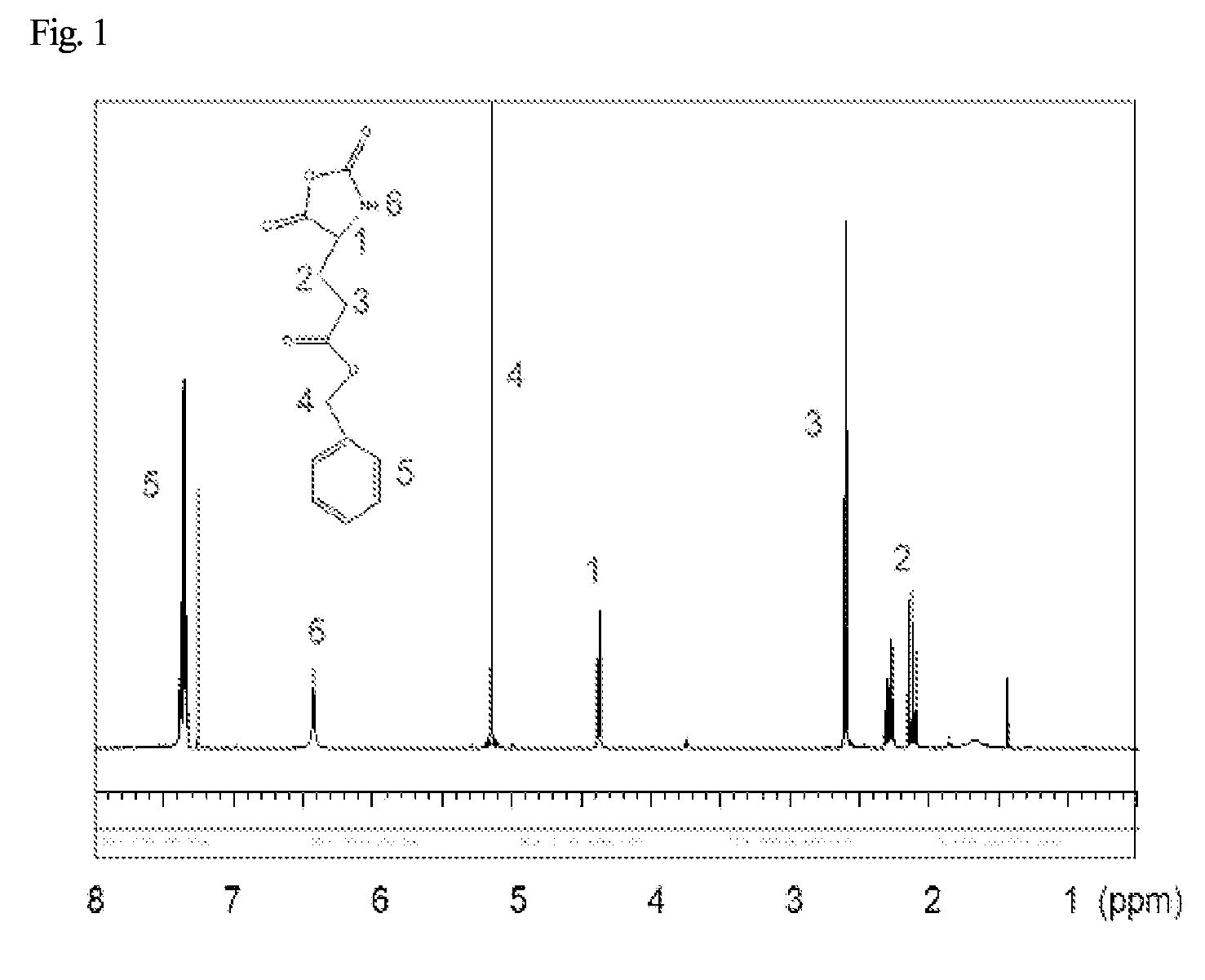
[0070]10 g of L-glutamic acid-benzyl ester and 6.255 g of triphosgene were mixed with 100 mL of anhydrous tetrahydrofuran. The reaction was carried out under nitrogen atmosphere at 50° C. After 2 hours and the reaction has completed, the above solution was introduced to hexane, and the mixture was recrystallized twice using 1:1 hexane / ethyl acetate as a recrystallization solvent, resulting in benzyl-L-glutamic acid-N-carboxy anhydride (BLG-NCA). The yield was 73%. The 1H NMR (500 MHz, CDCl3) measurement result of the BLG-NCA obtained above is shown in FIG. 1.
[0071]The benzyl-L-glutamic acid-N-carboxy anhydride (BLG-NCA) prepared above and polyethylene glycol of
were dissolved in anhydrous chloroform in a molar ratio of 20 to 1. The reaction was carried out under nitrogen atmosphere for 72 hours at room temperature. After the reaction has completed, poly(ethylene glycol)-block-poly(benzyl-L-glutamic acid...
preparation example 2
Preparation of poly(ethylene glycol)-block-poly(benzyl-L-glutamic Acid) Copolymer
[0072]The benzyl-L-glutamic acid-N-carboxy anhydride (BLG-NCA) prepared in the same manner as in Example 1 and polyethylene glycol of
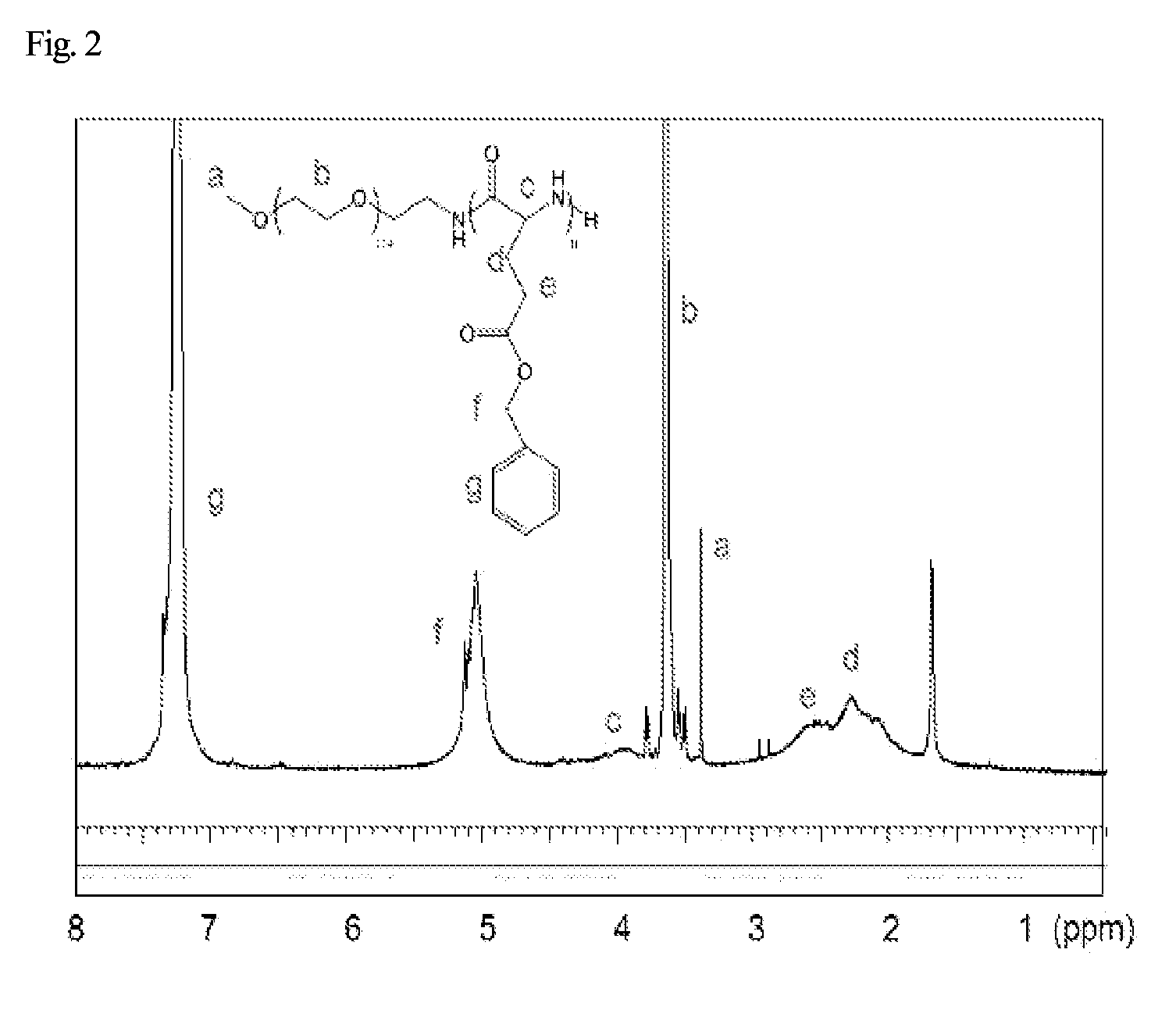
was dissolved in anhydrous chloroform in a molar ratio of 30 to 1. The reaction was carried out under nitrogen atmosphere for 72 hours at room temperature. After the reaction has completed, poly(ethylene glycol)-block-poly(benzyl-L-glutamic acid) (PEG-b-PBLG), a copolymer of a polyglutamic acid block and a polyethylene glycol block, which has a molecular weight of Mn=13,541, was formed. The reactant that has not been reacted was precipitated using a mixture of excess ethanol / ethyl ether, and then filtered. The 1H NMR (500 MHz, CDCl3) measurement result of the copolymer obtained above is shown in FIG. 2.
preparation example 3
Preparation of poly(ethylene glycol)-block-poly(benzyl-L-glutamic Acid) Copolymer
[0073]The benzyl-L-glutamic acid-N-carboxy anhydride (BLG-NCA) prepared in the same manner as in Example 1 and polyethylene glycol of
was dissolved in anhydrous chloroform in a molar ratio of 40 to 1. The reaction was carried out under nitrogen atmosphere for 72 hours at room temperature. After the reaction has completed, poly(ethylene glycol)-block-poly(benzyl-L-glutamic acid) (PEG-b-PBLG), a copolymer of a polyglutamic acid block and a polyethylene glycol block, which has a molecular weight of Mn=17,045, was formed. The reactant that has not been reacted was precipitated using a mixture of excess ethanol / ethyl ether, and then filtered.
PUM
| Property | Measurement | Unit |
|---|---|---|
| Fraction | aaaaa | aaaaa |
| Fraction | aaaaa | aaaaa |
| Fraction | aaaaa | aaaaa |
Abstract
Description
Claims
Application Information
 Login to View More
 - R&D
- Intellectual Property
- Life Sciences
- Materials
- Tech Scout
- Unparalleled Data Quality
- Higher Quality Content
- 60% Fewer Hallucinations
Browse by: Latest US Patents, China's latest patents, Technical Efficacy Thesaurus, Application Domain, Technology Topic, Popular Technical Reports.
© 2025 PatSnap. All rights reserved.Legal|Privacy policy|Modern Slavery Act Transparency Statement|Sitemap|About US| Contact US: help@patsnap.com