Check patentability & draft patents in minutes with Patsnap Eureka AI!

Method for processing organic phase substance by using halogen-containing checical or chemicals and/or mixture containing oxygen-containing oxidizer or oxidizers and organic carbonyl analogue or analogues, and/or method for extracting or depositing heavy element species and/or organic components of asphaltene and/or inorganic substance from the organic phase substance by using halogen-containing chemical or chemicals and/or mixture containing oxygen-containing oxidizer or oxidizers and organic carbonyl analogue or analogues, and plant using for the method, and organic phase substance

Inactive Publication Date: 2015-03-19
NAT INST OF ADVANCED IND SCI & TECH
View PDF1 Cites 0 Cited by
  • Summary
  • Abstract
  • Description
  • Claims
  • Application Information

AI Technical Summary

Benefits of technology

The present invention allows for processing organic phase substances at milder environmental conditions, while still extracting and depositing heavy element species, inorganic substances, and organic components from the organic phase substance into the water phase. This results in a cleaner, safer, and more efficient process. The recycling of chemicals and water also reduces environmental loads and provides a highly safe apparatus and plant.

Problems solved by technology

These literatures and related inventions are applicable to removing and collecting heavy element species from an organic phase substance, such as crude oil, bitumen, tar, or residual fuel oil; however all these techniques require complicated operation procedures and huge energy, more specifically, heat, high pressure and high electric field.
As a result, initial investments in plants and equipment and running cost have been increased.
These techniques are not free from these drawbacks.

Method used

the structure of the environmentally friendly knitted fabric provided by the present invention; figure 2 Flow chart of the yarn wrapping machine for environmentally friendly knitted fabrics and storage devices; image 3 Is the parameter map of the yarn covering machine
View more

Image

Smart Image Click on the blue labels to locate them in the text.
Viewing Examples
Smart Image
  • Method for processing organic phase substance by using
halogen-containing checical or chemicals and/or mixture
containing oxygen-containing oxidizer or oxidizers and
organic carbonyl analogue or analogues, and/or
method for extracting or depositing heavy element species
and/or organic components of asphaltene and/or inorganic
substance from the organic phase substance by using
halogen-containing chemical or chemicals and/or mixture
containing oxygen-containing oxidizer or oxidizers and
organic carbonyl analogue or analogues, and
plant using for the method, and organic phase substance
  • Method for processing organic phase substance by using
halogen-containing checical or chemicals and/or mixture
containing oxygen-containing oxidizer or oxidizers and
organic carbonyl analogue or analogues, and/or
method for extracting or depositing heavy element species
and/or organic components of asphaltene and/or inorganic
substance from the organic phase substance by using
halogen-containing chemical or chemicals and/or mixture
containing oxygen-containing oxidizer or oxidizers and
organic carbonyl analogue or analogues, and
plant using for the method, and organic phase substance
  • Method for processing organic phase substance by using
halogen-containing checical or chemicals and/or mixture
containing oxygen-containing oxidizer or oxidizers and
organic carbonyl analogue or analogues, and/or
method for extracting or depositing heavy element species
and/or organic components of asphaltene and/or inorganic
substance from the organic phase substance by using
halogen-containing chemical or chemicals and/or mixture
containing oxygen-containing oxidizer or oxidizers and
organic carbonyl analogue or analogues, and
plant using for the method, and organic phase substance

Examples

Experimental program
Comparison scheme
Effect test

embodiment 1

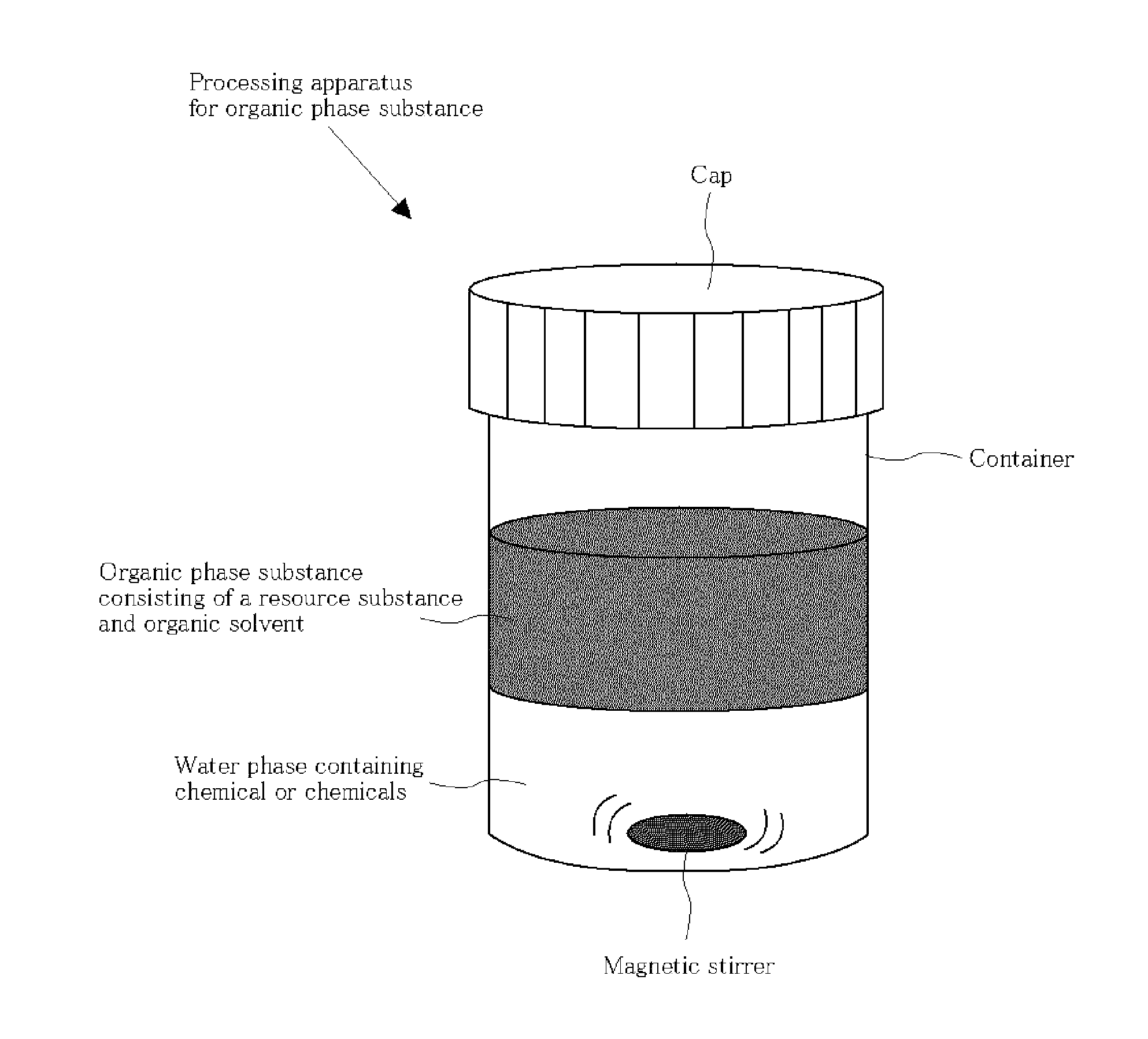
[0203]An experimental set-up is illustrated in FIG. 2. To a 6 mL organic phase substance of solution originating from bitumen produced in Alberta, Canada in toluene / petroleum ether (1 / 2) with a vanadium concentration of ca. 2 ppm, which is filtered by cellulose (advantec No. 5B), is mixed ca. 10 mL of chlorine gas in air by syringe bubbling three times and stirred about 20 min. The small amount of precipitate is collected by alumina filtering, however, no significant signals of vanadium are observed by UV-Vis, XPS, and SIMS in the precipitation, and heavy element species including vanadium remained in organic phase substance.

[0204]On the other hand, to an organic phase substance solution (6 mL), which is originating from bitumen produced in Alberta, Canada dissolved in toluene / petroleum (1 / 2) having a vanadium concentration of about 2 ppm and filtered by cellulose (advantec No. 5B), accompanying water (milliQ water 5.9 mL having 0.1 mL of dimethylformamide (DMF) added thereto), more...

embodiment 2

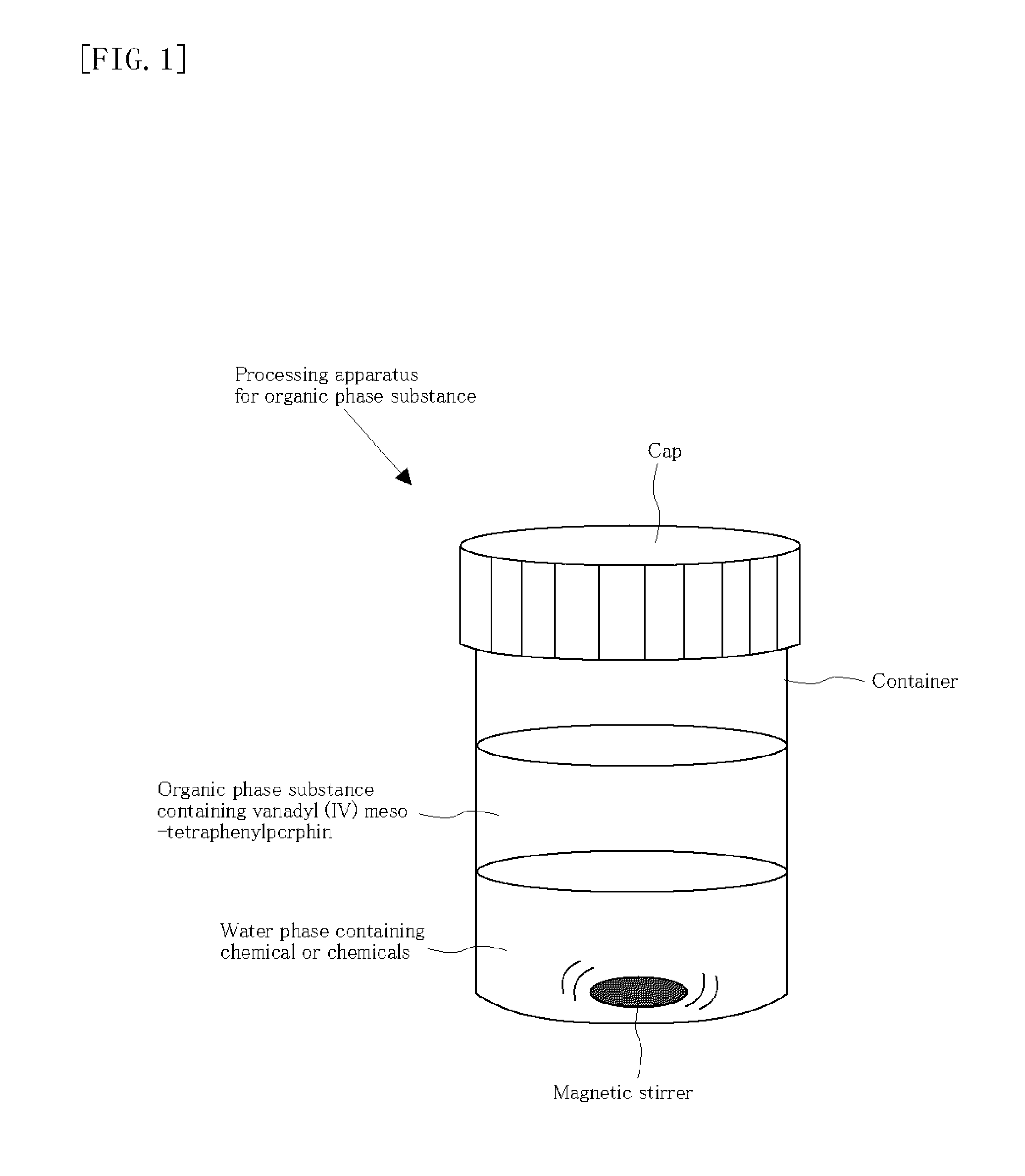
[0207]A facile experimental set-up is illustrated in FIG. 1 as following below when used porphine compounds. A 2 mL of a solution of an organic phase substance originating from vanadyl (IV) meso-tetraphenylporphin, which is used as a simple model of organic components of porphyrin in toluene having a concentration of about 107 ppm, is subjected accompanying with pure water (milliQ) of 1.5 mL including 5.25% sodium hypochlorite as one of oxidized chlorine species, and dimethylformamide (DMF) (0.1 mL) as one of nitrogen-organic compounds.

[0208]To the obtained two-phase solution, if 0.3 mL of concentrated hydrochloric acid (30%) is added while stirring by a magnetic stirrer, chlorine gas is generated on site. The color of vanadyl (IV) meso-tetraphenylporphin disappeared within 4 minutes. The obtained organic phase substance and water phase were separated by an extraction funnel and analyzed by UV-Vis, XPS and SIMS. As a result, it was found that vanadium was significantly removed from ...

embodiment 3

[0211]A 3 mL organic phase substance of solution originating from vanadyl (IV) meso-tetraphenyl porphine as a simple model organic components (non patent literatures 1 and 2) about 120 ppm is subjected accompanying with pure water (milliQ) of 2 mL including 5.25% sodium hypochlorite as one of oxidized chlorine species.

[0212]Acetic acid of 0.2 mL is added to the obtained two phase solution stirring with magnetic stirrer, which leads to partially production of chlorine gas and / or the other reactive oxidized chlorine species such as hydrogen hypochlorite in situ. The color of vanadyl (IV) meso-tetraphenyl porphine disappeared within 10 min. The obtained organic phase substance and water phase are separated by extraction funnel and analyzed by UV-Vis, XPS, and SIMS to find significant removal of vanadium from material to water phase.

[0213]More specifically, it was found that a reduction of vanadium concentration in the organic phase substance is over −68%. An appropriate amount of vanad...

the structure of the environmentally friendly knitted fabric provided by the present invention; figure 2 Flow chart of the yarn wrapping machine for environmentally friendly knitted fabrics and storage devices; image 3 Is the parameter map of the yarn covering machine
Login to View More

PUM

PropertyMeasurementUnit
Fractionaaaaaaaaaa
Concentrationaaaaaaaaaa
Login to View More

Abstract

The invention provides a processing method for upgrading an organic phase substance by removing heavy element species from the organic phase substance originating from a resource substance in mild environmental conditions, and further provides a method for collecting removed heavy element species and a method for collecting other substances.The invention is constituted of a method for processing an organic phase substance, including: allowing an organic phase substance to coexist with a water phase, wherein the organic phase substance contains at least organic components originating from one or more selected from crude oil, bitumen, tar, residual fuel oil, petroleum residue, oil sands, tar-sand, asphaltene, fossil strata, cokes, oil-shale and coal, and contacting resultant of the above coexistence with halogen-containing chemical or chemicals, thereby extracting or depositing the heavy element species from the organic phase substance into the water phase; a plant for the method; and substances collected by the method.

Description

TECHNICAL FIELD[0001]The present invention relates to an effective processing method for separating and removing heavy element species such as vanadium (e.g., vanadium oxide, such as V2O5 and VO2 and other oxide complexes), nickel, and other transition metal ions, from organic phase substances originating from e.g., crude oil, bitumen, tar, asphaltene, oil sands, tar-sand, residual fuel oil, petroleum residue, fossil strata, cokes, oil-shale or coal so as to improve the quality of the organic phase substance used as a resource, and / or for collecting and concentrating constitutive heavy element species including oxidized heavy metals, ions, elemental metals, alloys or mixtures of these. These collected heavy element species are also utilized as resources.[0002]Furthermore the present invention is also associated with effective process methods in order to separate and remove organic components of asphaltene included in crude oil, bitumen, tar, oil sands, tar-sand, residual fuel oil, p...

Claims

the structure of the environmentally friendly knitted fabric provided by the present invention; figure 2 Flow chart of the yarn wrapping machine for environmentally friendly knitted fabrics and storage devices; image 3 Is the parameter map of the yarn covering machine
Login to View More

Application Information

Patent Timeline
no application Login to View More
IPC IPC(8): C10G21/08C10G21/20C10C1/18C10C1/20C10C3/04C10C3/08C10L9/00C10L9/06C08L95/00C01G31/02C01G53/04C22B34/22C22B23/00C22B34/32C22B34/12C22B30/04C22B3/00C10G53/14
CPCC10G21/08C10L2290/544C10G21/20C10C1/18C10C1/20C10C3/04C10C3/08C10L9/00C10L9/06C08L95/00C01G31/02C01G53/04C22B34/22C22B23/00C22B34/32C22B34/12C22B30/04C22B3/00C10G53/14B01D11/04C10G21/18C10G27/12C10G27/14C10G45/04C10C3/026C01G53/00C22B7/006C10L2290/28Y02P10/20
Inventor NAKAMURA, TOORUHAYASHI, YUTAKASUZUKI, AKIRABROMMELAND, RICHARDMYLES, ANDREW
Owner NAT INST OF ADVANCED IND SCI & TECH
Features
  • R&D
  • Intellectual Property
  • Life Sciences
  • Materials
  • Tech Scout
Why Patsnap Eureka
  • Unparalleled Data Quality
  • Higher Quality Content
  • 60% Fewer Hallucinations
Social media
Patsnap Eureka Blog
Learn More