HIV type 1 group o reverse transcriptases that are active at high temperatures

a reverse transcriptase, high temperature technology, applied in the direction of enzyme stabilisation, enzymology, transferases, etc., can solve the problem of reducing the effectiveness of these techniques

US20160090580A1Active Publication Date: 2016-03-31CONSEJO SUPERIOR DE INVESTIGACIONES CIENTIFICAS (CSIC)
0 Cites 1 Cited by

Patent Information

Authority / Receiving Office
US · United States
Current Assignee / Owner
Publication Date
2016-03-31

Smart Images

  • Figure 1
    Figure 1
  • Figure 2
    Figure 2
  • Figure 3
    Figure 3
Patent Text Reader

Abstract

The present invention falls within the field of biotechnology. More specifically, the invention relates to reverse transcriptases expressed and purified in bacteria and having the amino acid sequence of the reverse transcriptase of a human immunodeficiency virus type 1 (HIV-1) group O, modified at positions 358, 359 and 360; and variants of this enzyme that contain additional changes at positions 355 and 357 or at 478 or position 69 (in this case accompanied by an insertion of two amino acids). These polymerases have greater activity than the non-mutated enzyme at high temperatures (above 60° C.). In addition, they retain the capacity for DNA synthesis at temperatures greater than 70° C. Moreover, the copying fidelity of these enzymes is not significantly different from that of the non-mutated reverse transcriptase.
Need to check novelty before this filing date? Find Prior Art

Description

[0001] This invention is in the field of biotechnology. More specifically it refers to reverse transcriptases expressed and purified in bacteria and that have the amino acid sequence of the reverse transcriptase of human immunodeficiency virus type 1 group O (HIV-1) modified in various positions. These polymerases have higher activity than the non-mutated enzyme at elevated temperatures (above 60° C.). They also retain DNA synthesis ability at temperatures of over 70° C. The copying fidelity of these enzymes does not significantly differ from that of the non-mutated reverse transcriptase.STATE OF THE ART

[0002] In retroviruses, reverse transcriptase (RT) is the enzyme responsible for replicating the viral genome. RT converts the single-stranded RNA genome into double-stranded DNA capable of integration into the genome of the host cell [reviewed by Le Grice. J Biol Chem, 2012; 287: 40850-40857]. This is a polymerase that can synthesise DNA using either RNA or DNA as the template. RT als...

Examples

examples

Effect of Reverse Transcription Reaction Temperature on the Effectiveness of the RT-PCR Reaction Using Different Mutants of RT of HIV-1 Group O

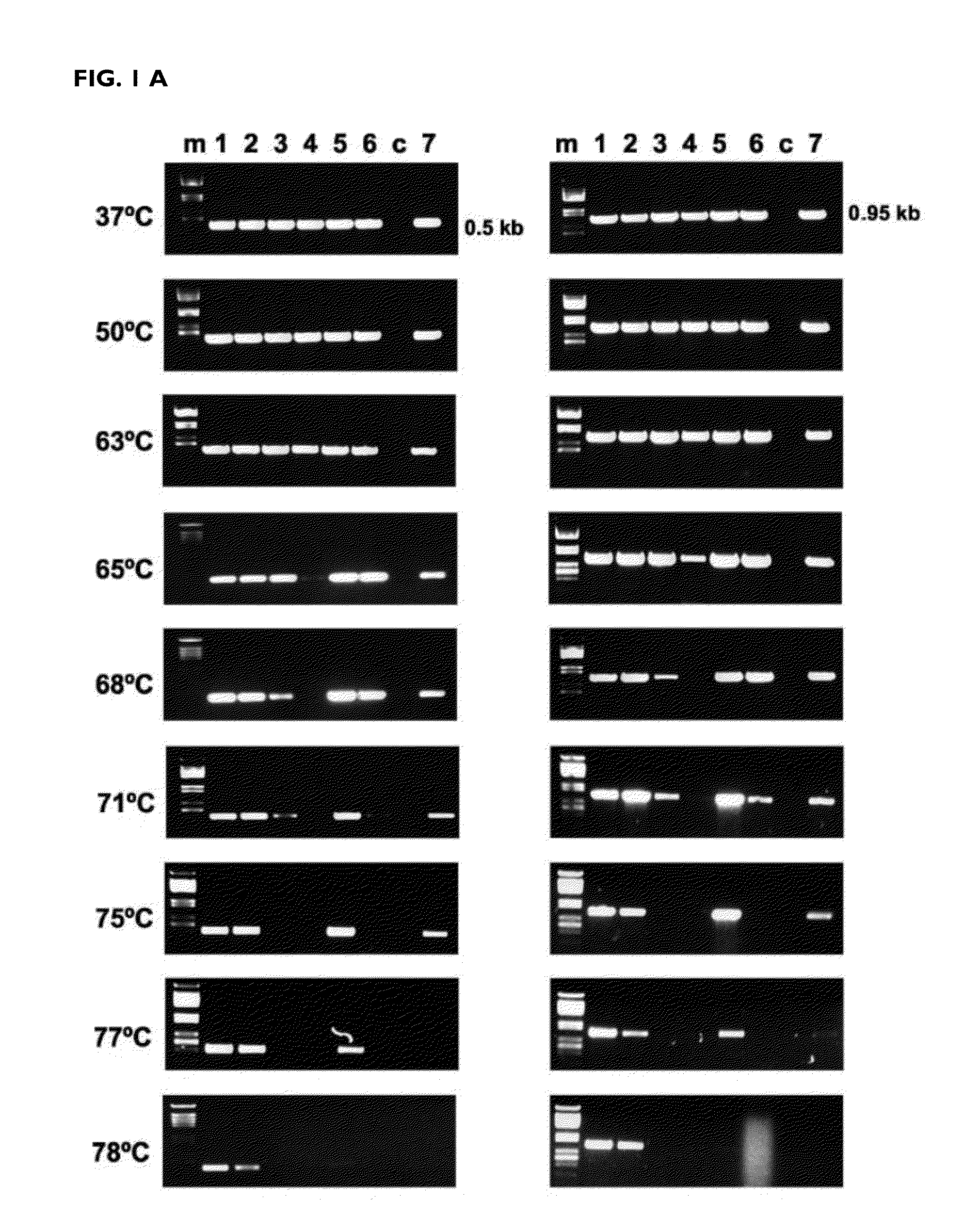
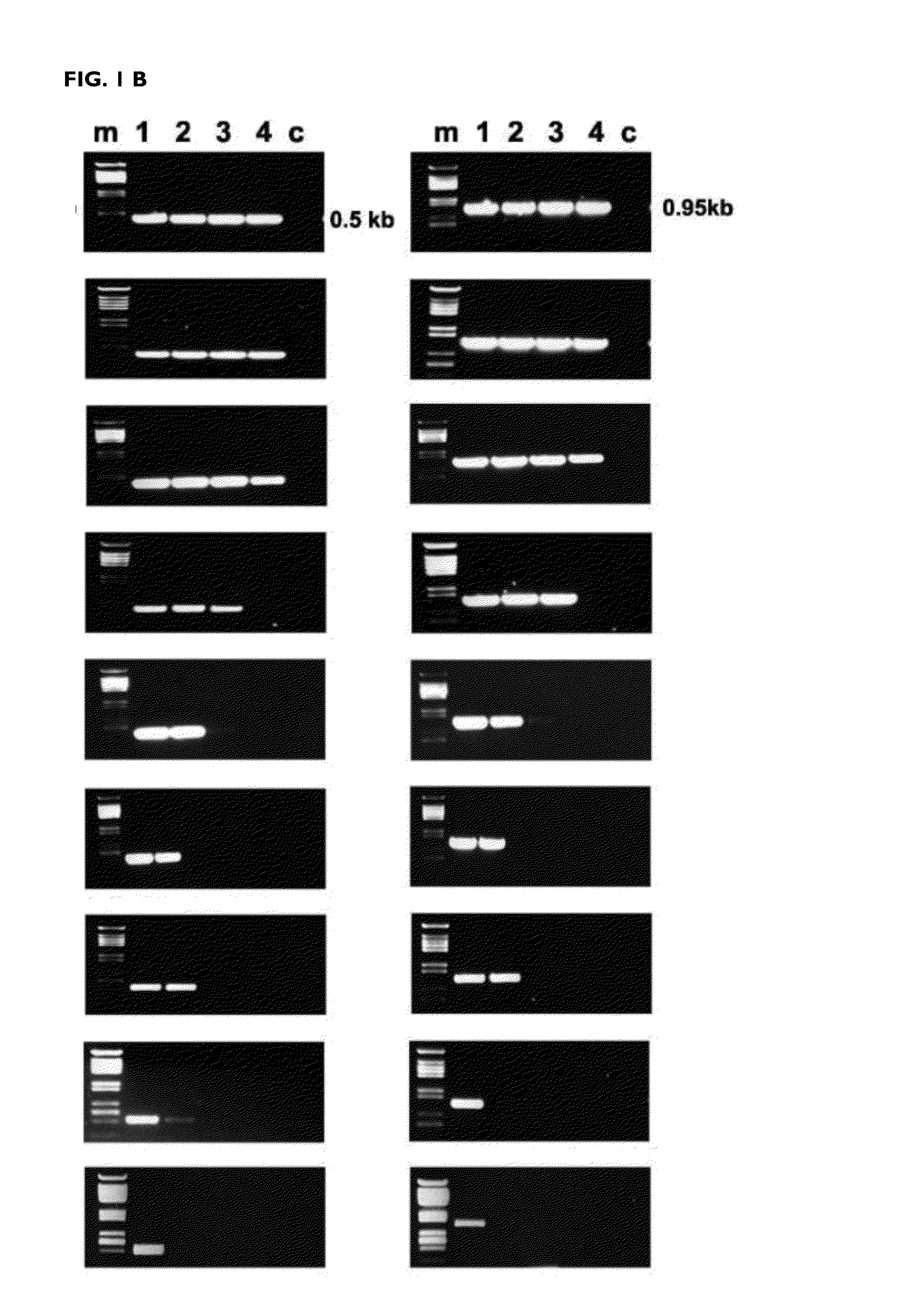
[0147]The efficiency of the reverse transcription reaction at different temperatures was determined after amplification by PCR of the DNA copy obtained. The mutants K358R / A359G / S360A (RTO_3M*), K358R / A359G / S360A / E478Q (RTO_E478Q_3M*), T355A / Q357M / K358R / A359G / S360A (RTO_5M*) and T69SSG / K358R / A359G / S360A (RTO_T69SSG_3M*) were more effective than “wild-type RT of HIV-1 group O (RTO_WT*) and other mutant RTs in the amplification of RNA fragments of approximately 500 and 950 base pairs derived from the actin gene, in reverse transcription reactions carried out at different temperatures in the range of 37 to 78° C. (FIG. 1).

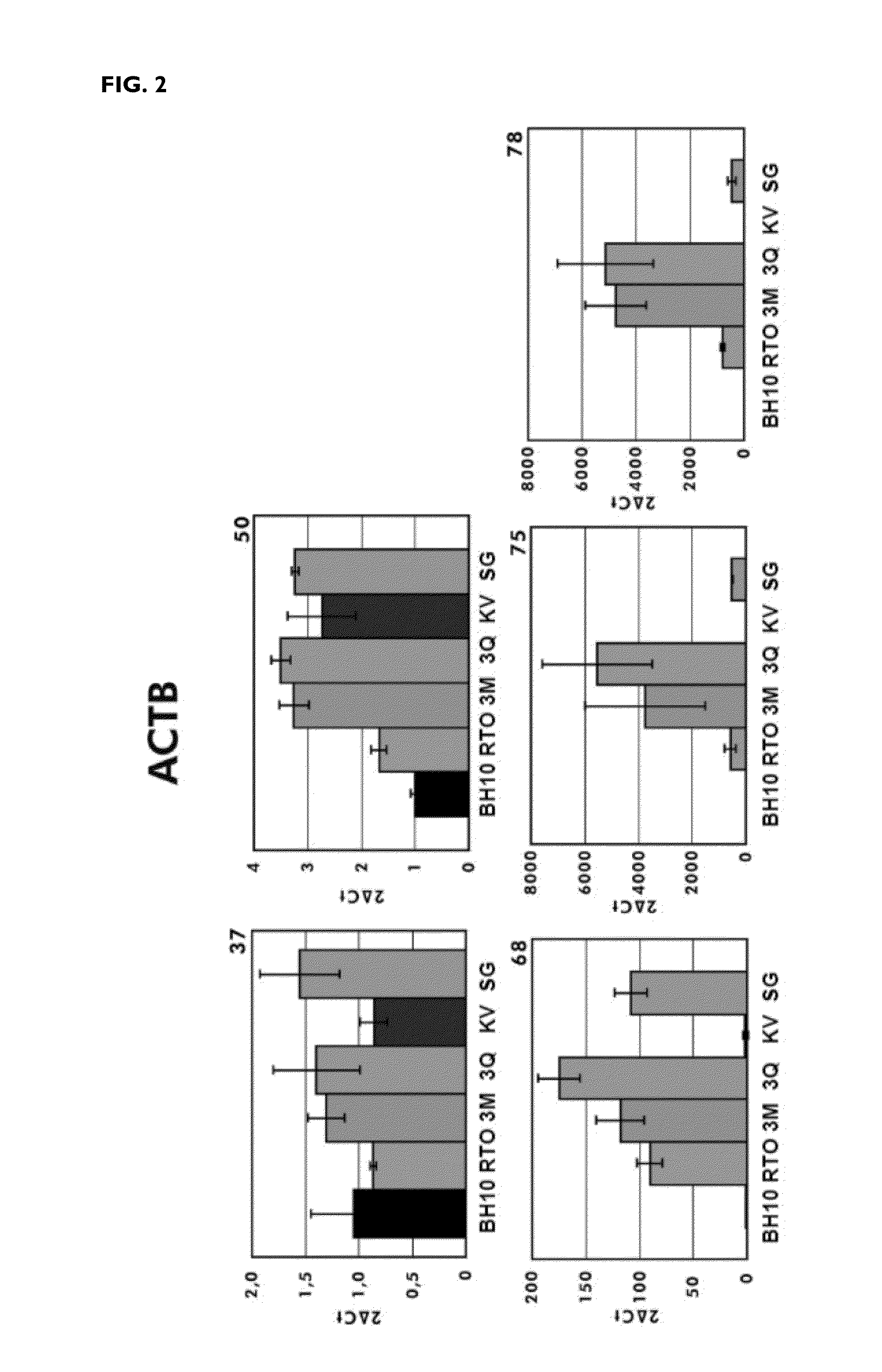
[0148]These results were consistent with those obtained in the amplification of sequences derived from messenger RNAs of actin or of glyceraldehyde-3-phosphate dehydrogenase (GAPDH) in real time PCR reactions. In both cases, the...