Electrical storage system comprising a sheet-type discrete element, discrete sheet-type element, method for the production thereof, and use thereof

a technology of electric storage system and discrete element, which is applied in the manufacture of secondary cells, final product manufacturing, climate sustainability, etc., can solve the problems of undesirable side reactions of mobile lithium ions with the substrate, safety concerns, and particular difficulties

Active Publication Date: 2017-09-14
SCHOTT AG
View PDF4 Cites 2 Cited by
  • Summary
  • Abstract
  • Description
  • Claims
  • Application Information

AI Technical Summary

Benefits of technology

The patent text is discussing the use of high-energy optical energy sources, such as excimer lasers, to make thin film electrical storage elements. However, it is important to have the ability to control the amount of UV light that is transmitted through the substrate material during processing. This allows for all the necessary steps to be performed, such as cutting wafers or curing adhesive materials. The technical effect of this invention is to improve the efficiency and precision of the fabrication process for thin film electrical storage elements.

Problems solved by technology

As the latter are inflammable, they lead to safety concerns regarding the unrestricted use thereof.
In case of lithium-based thin film storage elements, particular difficulties are moreover encountered due to the use of metallic lithium as an anode material because of the high reactivity thereof.
In addition, as described in document US 2010 / 0104942 A1 by way of example, under the manufacturing conditions of a lithium-based thin film storage element, in particular during so-called annealing or heat treatment steps which are necessary for the formation of crystal structures suitable for lithium intercalation, undesirable side reactions of the mobile lithium ions with the substrate may occur, since lithium exhibits high mobility and can easily diffuse into common substrate materials.
A further issue with thin film storage elements relates to the substrate materials employed.
This is due to the fact that for producing a cathode from the usually employed lithium cobalt oxide (LCO), a temperature treatment at temperatures of more than 400° C., even more than 500° C. and above is necessary in order to obtain a crystal structure that is particularly favorable for storing Li+ ions in this material, so that materials such as polymers or inorganic materials with low softening points cannot be used.
For example, dielectric materials are usually brittle and cannot be used in cost-efficient roll-to-roll processes, while metals or metal alloys, on the other hand, tend to oxidize during a high-temperature treatment of the cathode material.
In general, however, such process engineering adaptations are expensive and, depending on the processing, are hardly implementable in a cost-effective manner, especially if in-line coating of wafers is envisaged.
Even small unevenness of the surface may have a critical adverse effect on the functional layers of the thin film storage element and may thus result in failure of the battery as a whole.
Therefore, problems of conventional thin film storage elements are related to the corrosion susceptibility of the employed materials, in particular if metallic lithium is used, which implies complex layer structures and hence usually causes high costs, and are also related to the type of the substrate which should in particular be non-conductive but flexible, should exhibit high temperature resistance and should preferably be inert to the functional layers of the storage element used, and moreover should allow for deposition of layers preferably free of defects and with good layer adhesion on the substrate.
However, it has been found that even with substrates having a particularly low surface roughness such as the glass film proposed in US 2012 / 0040211 A1, for example, failure of layers may occur as a result of cracks and / or detachment of the layers, as described in US 2014 / 0030449 A1, for example.
The method for avoiding high annealing temperatures proposed therein, namely by applying a bias voltage when creating the lithium cobalt oxide layer, however, is difficult to implement in the common in-line processes for producing thin film storage elements, as already described above, so that from a process engineering point of view it is more favorable to use a substrate having a correspondingly high temperature resistance.
Another problem that is inherent to all substrate materials regardless of their exact composition relates to one of the possible handling procedures for ultra-thin glass.
The debonding often provokes the occurrence of torsional stresses in the substrate, which stresses may furthermore be transferred to the layers deposited on the substrate, which also leads to cracks and detachment of the layers, so that as a result the layer defects caused by thickness variations of the substrate may further aggravate.
This is disadvantageous in particular when the application requires an extremely homogeneous consistency of the product specifications of the electrical storage element.
Furthermore, lithium ions from the electrolyte of the battery system, for example LiPON, may penetrate into and damage the sheet-type discrete element upon contact therewith.
Based on the examinations it was found that a content of titanium oxide as an example for a content of a polyvalent element in the composition of the sheet-type discrete element is unfavorable with respect to the contact to Li metal.

Method used

the structure of the environmentally friendly knitted fabric provided by the present invention; figure 2 Flow chart of the yarn wrapping machine for environmentally friendly knitted fabrics and storage devices; image 3 Is the parameter map of the yarn covering machine
View more

Image

Smart Image Click on the blue labels to locate them in the text.
Viewing Examples
Smart Image
  • Electrical storage system comprising a sheet-type discrete element, discrete sheet-type element, method for the production thereof, and use thereof
  • Electrical storage system comprising a sheet-type discrete element, discrete sheet-type element, method for the production thereof, and use thereof
  • Electrical storage system comprising a sheet-type discrete element, discrete sheet-type element, method for the production thereof, and use thereof

Examples

Experimental program
Comparison scheme
Effect test

Embodiment Construction

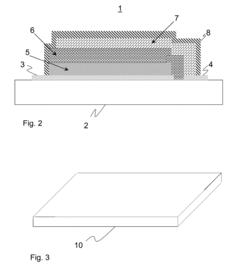
[0150]FIG. 2 schematically shows an electrical storage system 1 according to the present invention. It comprises a sheet-type discrete element 2 which is used as a substrate. A sequence of different layers is applied on the substrate. By way of example and without being limited to the present example, first the two collector layers are applied on the sheet-type discrete element 2, cathode collector layer 3, and anode collector layer 4. Such collector layers usually have a thickness of a few micrometers and are made of a metal, for example of copper, aluminum, or titanium. Superimposed on collector layer 3 is cathode layer 5. If the electrical storage system 1 is a lithium-based thin film battery, the cathode is made of a lithium-transition metal compound, preferably an oxide, for example of LiCoO2, of LiMnO2, or else of LiFePO4. Furthermore, the electrolyte 6 is applied on the substrate and is at least partially overlapping cathode layer 5, and in the case of a lithium-based thin fi...

the structure of the environmentally friendly knitted fabric provided by the present invention; figure 2 Flow chart of the yarn wrapping machine for environmentally friendly knitted fabrics and storage devices; image 3 Is the parameter map of the yarn covering machine
Login to View More

PUM

PropertyMeasurementUnit
Temperatureaaaaaaaaaa
Fractionaaaaaaaaaa
Login to View More

Abstract

An electrical storage system is provided that has a thickness of less than 2 mm, where the system includes at least one sheet-type discrete element, the sheet-type discrete element exhibiting high resistance to an attack of alkali metals or alkali metal ions, in particular lithium, wherein the sheet-type discrete element has a low content of TiO2, the TiO2 content preferably being less than 2 wt %, preferably less than 0.5 wt %, and preferably free of TiO2.

Description

CROSS REFERENCE TO RELATED APPLICATIONS[0001]This application is a continuation of International Application No. PCT / EP2015 / 077794 filed on Nov. 26, 2015, which claims the benefit under 35 U.S.C. 119 of German Application No. 102014117633.2 filed on Dec. 1, 2014, German Application No. 102015103857.9 filed on Mar. 16, 2015, German Application No. 102015103863.3 filed on Mar. 16, 2015, and Taiwanese Application No. 104120251 filed on Jun. 23, 2015, the entire contents of all of which are incorporated by reference herein.BACKGROUND[0002]1. Field of the Invention[0003]The invention relates to an electrical storage systems comprising a sheet-type discrete element, to a discrete sheet-type element, a method for the production thereof, and its use.[0004]2. Description of Related Art[0005]Electrical storage systems have long been state of the art and include in particular batteries, but also high energy density capacitors, known as supercaps. Since high energy densities can also be realize...

Claims

the structure of the environmentally friendly knitted fabric provided by the present invention; figure 2 Flow chart of the yarn wrapping machine for environmentally friendly knitted fabrics and storage devices; image 3 Is the parameter map of the yarn covering machine
Login to View More

Application Information

Patent Timeline
no application Login to View More
IPC IPC(8): H01M2/02H01M10/0525H01M10/0585C03C3/091C03C3/097C03C3/078C03C3/087C03C3/083C03C3/085C03C3/095H01M2/08C03C3/093H01M50/11H01M50/117H01M50/183
CPCH01M2/0207H01M2002/0297H01M2/028H01M2/0292H01M2/08H01M10/0525H01M10/0585C03C3/091C03C3/093C03C3/078C03C3/087C03C3/083C03C3/085C03C3/095C03C3/097H01M2/0267H01M10/0436H01M6/40C23C14/0676C23C14/3414Y02E60/10H01M50/131H01M50/124H01M50/1245H01M50/183Y02P70/50H01M50/11H01M50/117
InventorKUNZE, MIRIAMPEUCHERT, ULRICHSCHULTZ, NIKOLAUSDAMM, THORSTENOTTERMANN, CLEMENS
OwnerSCHOTT AG