
Coated tool of cemented carbide
a cemented carbide and tool technology, applied in the direction of instruments, superimposed coating process, other chemical processes, etc., can solve the problems of reducing the breakage resistance of the tool, reducing the breakage resistance, so as to improve the breakage resistance and wear resistance, and prolong the tool life.
- Summary
- Abstract
- Description
- Claims
- Application Information
AI Technical Summary
Benefits of technology
Problems solved by technology
Method used
Image

Examples
example 2
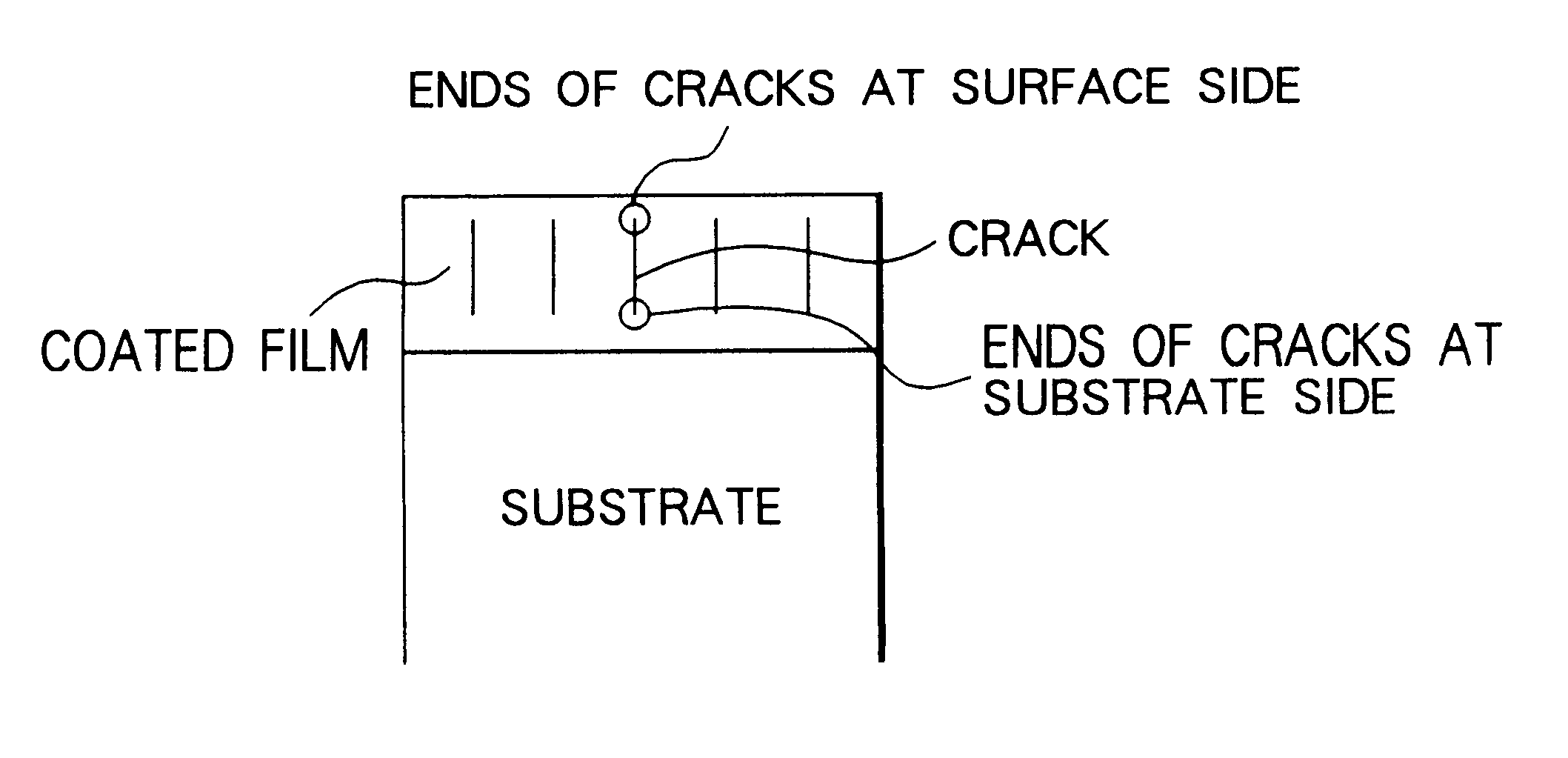
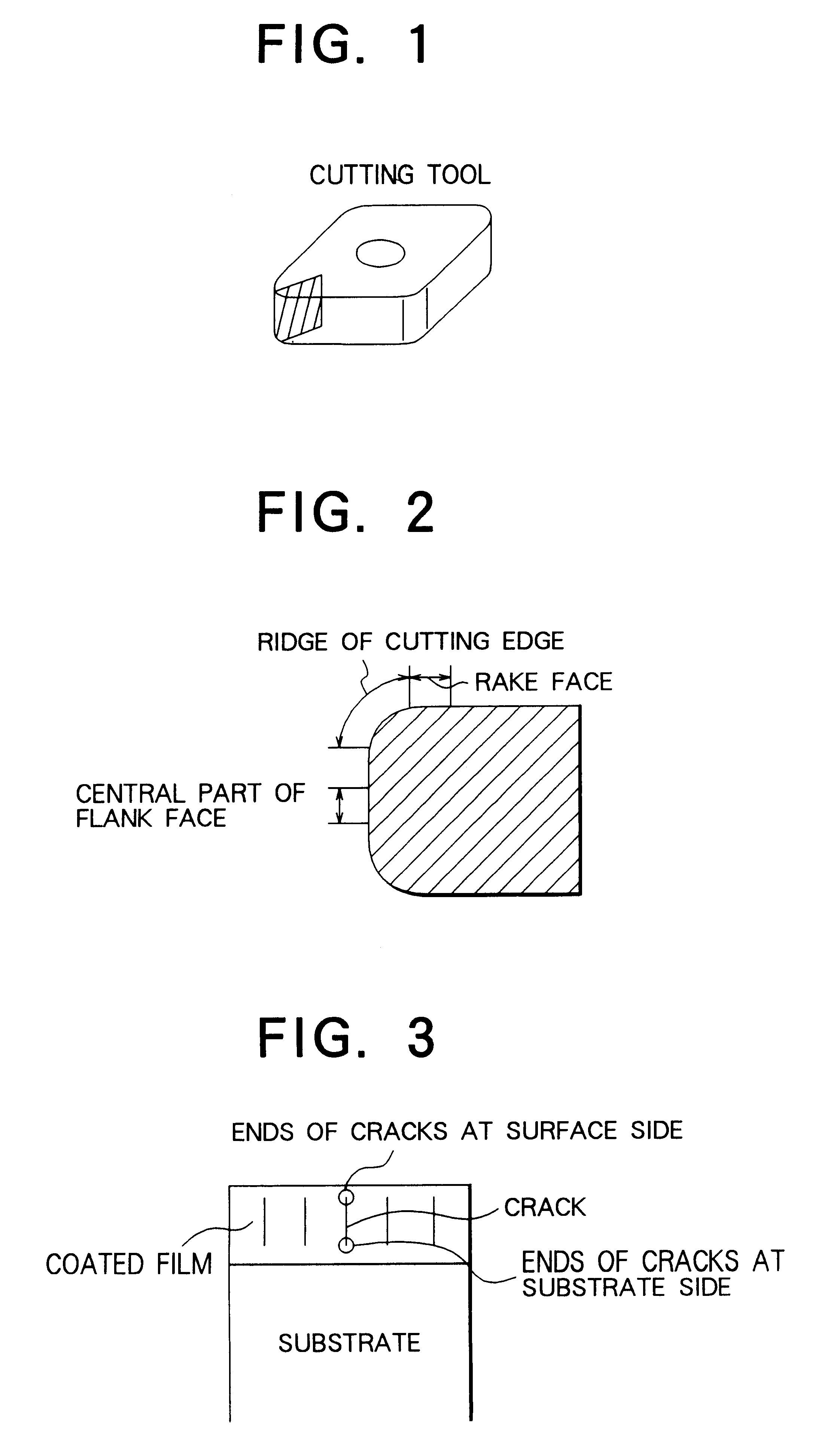
An insert of the same cemented carbide having a Form No. ISO and a shape of CNMG 120408 as that of Example 1 was prepared. This insert was coated with Coated Film Quality 3 described in Example 1 and subjected to a blasting treatment of the surface of the coated cemented carbide using iron powder of about 100 .mu.m in grain size from the rake face side while changing a projection speed of the iron powder to prepare various inserts differing in cracked state in the coated film, as shown in Table 3. Using these inserts, the same cutting test as that of Example 1 was carreid out.
The results are shown in Table 4. The inserts of Sample Nos. 2-3 to 2-7 within the scope of the present invention all exhibit excellent breakage resistance and wear resistance and above all, Sample Nos. 2-5, 2-6 and 2-7, in which such a proportion that the ends of cracks, at the substrate side, in the coated film on the ridge of the cutting edge are terminated in the innermost titanium nitride layer and titaniu...
example 3
An insert of the same cemented carbide having a Form No. of ISO and a shape of CNMG 120408 as that of Example 1 was prepared. This insert was then coated with the following Coated Film Quality 4 in order from the lower layer:
Film Quality 4: 1 .mu.m TiN-7 .mu.m TiCN (aspect ratio 5.about.20)-2 .mu.m TiC-5 .mu.m .kappa.-alumina (total film thickness 15 .mu.m)
The TiCN film was prepared by effecting the coating using acetonitrile, nitrogen gas, TiCl.sub.4 and hydrogen gas as a starting gas or carrier gas, while varying the coating temperature within a range of 800 to 1000.degree. C. during the coating and further varying the pressure in a furnace and gas composition to obtain an aspect ratio 5.about.20. In addition, the flank face of each sample of the resulting tools was masked and then was subjected to a blasting treatment with an iron powder from the rake face side while changing a projection speed of the iron powder to prepare various inserts differing in cracked state in the coated...
example 4
A cemented carbide powder with a composition comprising, by weight, 86% WC-1% TaC-1% NbC-3% TiC-2% ZrCN-7% Co was pressed, sintered in vacuum at 1400.degree. C. for 1 hour and subjected to a surface grinding treatment and cutting edge treatment to prepare a cemented carbide insert with a Form No. ISO and a shape of CNMG 120408. When a cross section of this cemented carbide was mirror-polished and its microstructure was observed by an optical miscroscope, it was confirmed that there could be formed a .beta.-free layer of about 25 .mu.m in thickness on the alloy surface and an area with a higher hardness an inside the alloy directly below the .beta.-free layer. This insert and the insert having no .beta.-free layer on the alloy surface, prepared in Example 1, were coated with Film Quality 3 coated in Example 1.
Furthermore, the surface of this coated cemented carbide was subjected to a blasting treatment using an iron ball in an analogous manner to Example 1, while changing the size, p...
PUM
| Property | Measurement | Unit |
|---|---|---|
| thickness | aaaaa | aaaaa |
| thickness | aaaaa | aaaaa |
| thickness | aaaaa | aaaaa |
Abstract
Description
Claims
Application Information
 Login to View More