The use of
titanium dioxide nano-coatings is, however, currently still restricted by the fact no economic process is known which is capable of producing nano-coatings comprised of the stated particle size on an
industrial scale.
Moreover, the products have an undesirably elevated carbon content.
However, due to the high price of these alkoxides and particular handling requirements (protective gas, strict exclusion of
moisture in order to prevent premature
hydrolysis), the stated reactions have not been considered for a large scale industrial process.
Still furthermore, working in microemulsions has the
disadvantage that, due to the frequently low concentration of the reactants, (i) the space / time yield is low and (ii) large quantities of water /
solvent / surfactant mixtures are produced which must be disposed of.
While small quantities of powders produced using such processes are presently (circa 2000) commercially available, they are extremely expensive.
Of the hitherto known processes performed on a large
industrial scale for the production of finely divided (sub-pigmentary)
titanium dioxide, none yields a product comparable in terms of
fineness and transparency with
sol / gel materials.
This process is inefficient because a significant portion, approximately 50%, of the titanyl
sulfate does not react acidically with the stoichiometrically deficient alkaline liquid so that a significant portion, approximately 50%, of the potential TiO.sub.2 product is left in solution in the form of titanyl
sulfate.
However, due to the complicated
processing requirements, it is doubtful that a commercially viable product may be obtained using this method.
Wide-spread commercial use has been limited largely due to the relatively high cost and poor dispersion characteristics of commercially available photocatalytic
titanium oxide powders.
While prior art techniques attempt to minimize cost barriers, they are deficient in one or more areas.
For example, extenders have been added to paint formulations to space photocatalyst particles to preserve photocatalytic efficiency, however, these extenders are difficult to distribute within the paint matrix to maximize photocatalytic efficiency.
Extenders are typically larger particles and / or in the form of aggregates and thus tend to increase the effective photocatalyst
volume concentration and decrease photoactive efficiency as they are added to replace paint resin content, a phenomena analogous to decreasing scattering efficiency as described in F. Stieg, "The Effect of Extenders on the Hiding Power of
Titanium Pigments", Official Digest, 1959, pp.
Titanium oxide particles, especially
anatase titanium dioxide, are difficult to distribute evenly in coating formulations.
Anatase titanium dioxide preferentially agglomerates due to a relatively large Hamaker constant (6.times.10.sup.-20 J) that causes individual photocatalyzing particles to clump and effectively shade each other, reducing photocatalytic efficiency.
However, the composite pigments described do not attempt to maximize photocatalytic activity and indeed often subdue
photocatalysis as a way to protect paint resin from
photodegradation.
Although not at all necessary for their photocatalytic action, and not absolutely necessary for the formation of a sol and the use of same as a coating, it becomes increasingly harder to get
uniform quality results with wide variations in the TiO.sub.2 starting material, and to that extent some homogeneity is preferred.
They may become "hot spots" of "stinging" death to those microorganisms with which they come into contact.
Aqueous solutions of
ammonium hydroxide,
sodium hydroxide, or
potassium hydroxide are preferably used as the alkaline-reacting liquid; it is, in principle, also possible to use carbonates of sodium, potassium and ammonium, but these are less suitable due to vigorous evolution of CO.sub.2.
Inorganic post-treatment is not necessary, and generally undesirable, if the product is used as a catalyst for the
photochemical degradation of organic compounds (polymers, pollutants) or as a support for dye solar cells.
However, surprisingly it has been found that a coating of
silicate precipitated onto the nano-coating from a solution of
sodium silicate has a limited
impact on photocatalytic activity when the amount of
silicate precipitated is approximately less than 5 times the amount of TiO.sub.2 in the nano-coating.
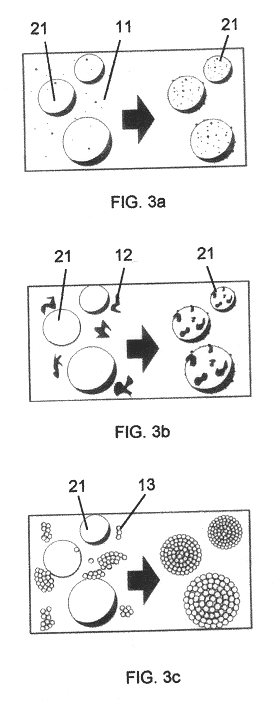
Particularly obvious in FIGS. 3a and 3c--but, technically, also in FIG. 3c--the coating is not even, and is not uniform.


 Login to View More