Ideally, a small and efficient antenna should be designed for most
wireless devices, however, a well known rule of
thumb trades off between these two parameters, limiting the
miniaturization of the electrical size of an antenna, for a given efficiency.
Clearly, smaller than λ / 4 antennas can be tuned for a specific frequency, yet this usually degrades the
antenna efficiency.
Practically, in mobile or portable communication devices, this limitation is particularly relevant to UHF, VHF and lower frequency bands.
The size issue becomes much more challenging when two or more antennas are required to be placed in the same
communication device.
Then, each of the antennas has its
size reduction limitations, as discussed above, but also, the
electromagnetic coupling between the antennas is important, as one antenna might load and reduce the performance of another, if collocated too close.
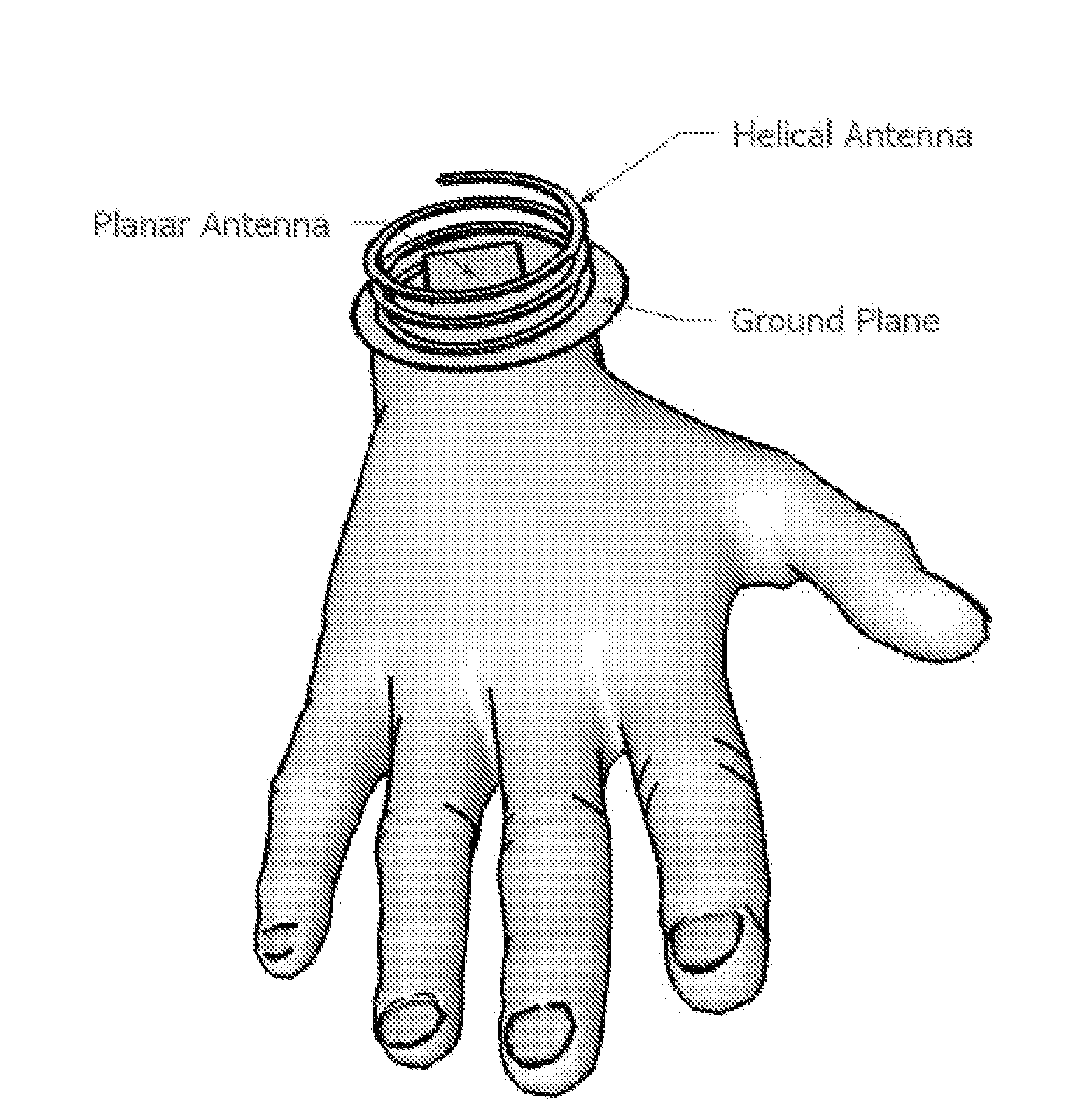
Clearly, holding an operating PLB, with its antenna extended and kept substantially vertically to enable good transmission conditions, might well disturb a person in distress.
Yet, fitting a proper antenna to a
wrist-worn PLB is not easy, due to the electrical size of a 406 MHz antenna and considering the interfering of the
human body to
RF radiation.
Fast detection and location of such accidents is crucial, since survival time in water is limited, typically less than 2 days at ˜20° C. and less than 6 hours at ˜10° C.
Present devices usually operate on unlicensed bands, thus restricted to a
low transmission power (typically less than 100 mw), so consequently obtain a poor transmission range.
Furthermore, Boyle refers only to a single antenna for a body-worn device, however when an additional antenna is required, such as for GPS, volume and area limitations become stricter.
However placing two helical antennas in a small
communication device, particularly dealing with lower than
GSM frequencies, would hardly enable a compact design and electromagnetic decoupling between the antennas.
Kita fails to teach how such a helical
whip antenna is installed in the watch, or extend from the watch.
Furthermore, Kita fails to teach if this
whip antenna is a
dipole or monopole, and also fails to teach a proper ground plane, in case of a monopole.
This method might be problematic since such a whip
dipole antenna is quite long for VHF / UHF bands.
This device also requires a quite inconvenient manipulation of the antenna to be placed in a proper transmission position, and as the antenna is extended, it would probably disturb the operator from freely move his hands.
The present art methods described above have not yet provided a satisfactory solution to the problem of a portable communication device, operating on a relatively
low frequency, obtaining a compact size yet efficient antenna.
Furthermore, the present art methods described above have not yet provided satisfactory solutions to the problem of a small communication device with two efficient antennas, still compact enough to be carried routinely by a person.


 Login to View More
  Login to View More